
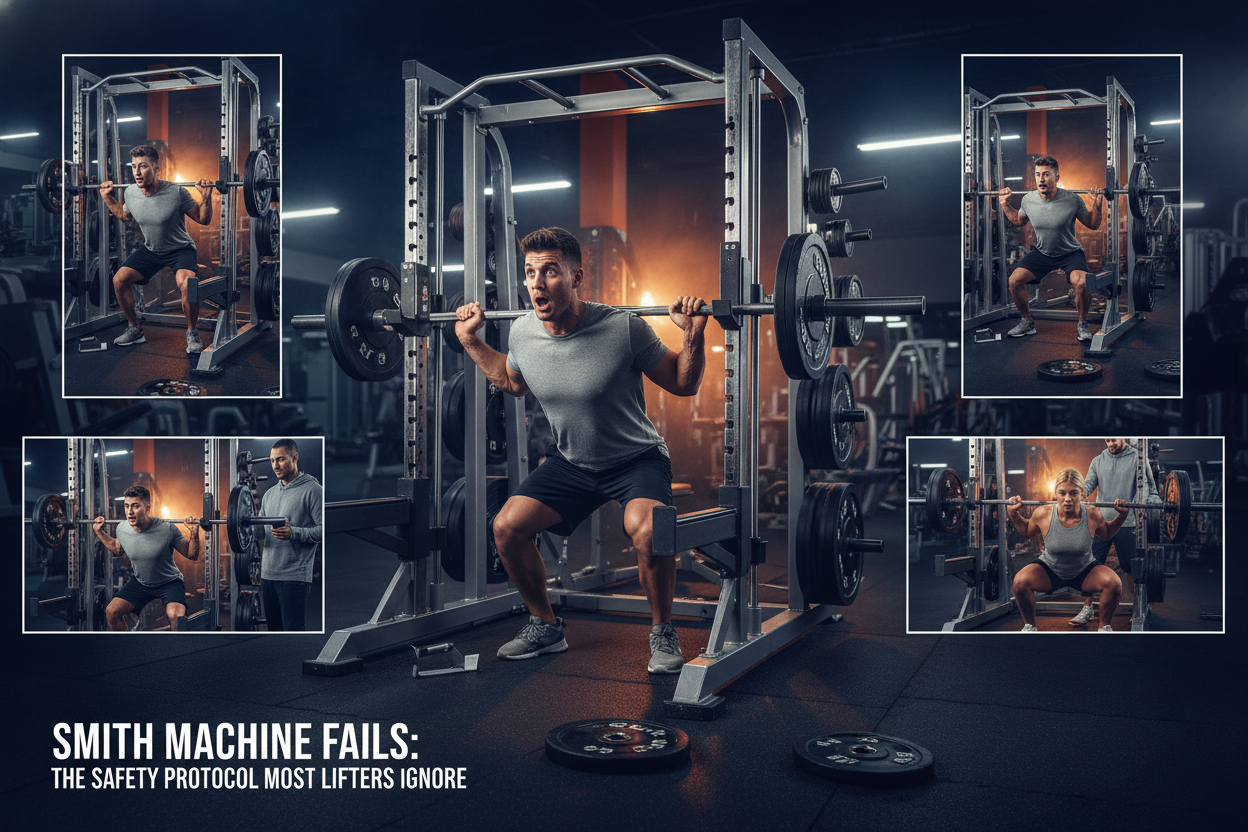
Smith Machine Fails: The Safety Protocol Most Lifters Ignore
You walk into the gym, bypass the power rack, and head straight for the guided rails. You assume it is safer. You assume you don't need a spotter. This false sense of security is exactly why smith machine fails can be more dangerous than free weight accidents.
When a barbell falls during a free-weight squat, you can dump it behind you. On a Smith machine, the bar is locked in a vertical plane. If you crumble, the bar follows you down, potentially folding you in half. Understanding the mechanics of these machines isn't just about gains; it is about survival.
Key Takeaways: Preventing a Smith Machine Fail
- Engage the Safety Stops: Never lift without adjusting the bottom stoppers to a height just below your lowest range of motion.
- Master the Wrist Roll: Practice the forward-and-back wrist rotation required to re-rack the weight before loading heavy plates.
- Check Foot Placement: Placing feet too far forward creates a shearing force that makes standing up from a failed rep nearly impossible.
- Don't Ego Lift: The fixed path isolates muscles more than free weights; do not assume your 1RM is the same.
The Mechanics of Getting Stuck
The primary reason lifters get into trouble is the fixed path. The machine forces you into a rigid movement pattern. If your body fatigues and you deviate from that line—even slightly—the friction increases, and the biomechanics shift against you.
Unlike a standard barbell, you cannot adjust your center of gravity mid-lift. Once the bar stalls, you have two options: muscle it up or rack it immediately. If you wait too long, your wrists may not have the strength to rotate the hooks back onto the pegs.
The Danger of the Smith Machine Squat Fail
The most notorious accident is the smith machine squat fail. This usually happens due to poor foot positioning. Many lifters place their feet far out in front, mimicking a wall sit. While this targets the quads, it puts the hips in a compromised position at the bottom of the squat.
If you fail here, you cannot fall backward. The bar drives your shoulders down while your feet remain planted forward. This compresses the spine and hips into an accordion shape. To avoid this, keep your feet closer to the body, similar to a traditional high-bar squat stance, so your skeletal structure can support the load if your muscles give out.
How to Bail Properly
Bailing on a Smith machine is technically impossible in the traditional sense. You cannot drop the weight. Your "bail" strategy is purely mechanical:
1. The Safety Stop Method: If you set the stops correctly, you simply lower your body until the bar rests on the springs or rubber stoppers. You then crawl out from underneath.
2. The Re-Rack Panic: If you didn't set stops (a huge mistake), you must aggressively roll your wrists back to catch the nearest hook. This requires grip strength that is often depleted by the time you reach failure.
Common Mistakes That Lead to Injury
Beyond foot placement, the smith machine fail often occurs because of guide rod friction. If the machine hasn't been oiled, the bar can "stutter" on the way up. This stutter disrupts your force production.
Another error is using the machine for movements it isn't designed for, like heavy bench pressing without a spotter. If the bar lands on your neck, the hooks won't save you unless you can rotate them, which is nearly impossible when you are choking.
My Training Log: Real Talk
I learned this lesson the hard way back in 2016. I was trying to hit a PR on incline bench using an older, counter-balanced Smith machine. I didn't bother setting the safety catches because I thought, "I can just hook it if I get stuck."
On the final rep, my triceps quit. The bar stalled three inches off my chest. I tried to rotate my wrists back to engage the hooks, but the knurling was worn down and slippery from sweat. My grip slipped, and the hooks just clicked uselessly against the vertical posts as the weight came down. It didn't slam—it just slowly, relentlessly crushed my sternum. The worst part wasn't the weight; it was the panic of being pinned by a machine that wouldn't budge sideways. I had to awkwardly roll the bar down my stomach to my hips to sit up. Since that day, I never touch the bar until I've physically tested the safety stops first.
Conclusion
The Smith machine is a tool, not a crutch. It offers stability, but it demands respect. The fixed rail system removes the need for stabilization muscles, but it adds the risk of being pinned in a fixed position. Set your safeties, check your foot placement, and never assume the machine will save you. You have to save yourself.
Frequently Asked Questions
Can you fail safely on a Smith machine?
Yes, but only if you have pre-set the adjustable safety stops. These are the spring-loaded or rubber stoppers at the bottom of the guide rods. Without them, there is no safe way to fail a rep if you cannot re-rack the hooks.
Why are Smith machine squats harder to bail from?
You cannot dump the weight behind you like a free-weight squat. The bar is locked on a vertical track, meaning if you collapse, you are forced straight down under the load. This makes the smith machine squat fail particularly dangerous for the lower back.
Is the Smith machine safer than free weights?
Not necessarily. It is safer in terms of balance, but potentially more dangerous regarding entrapment. A spotter or safety bars are required for both to be truly safe during heavy lifting.

