Skip the Gym: The Ultimate Guide to Building Strong Legs in Your Living Room
You do not need a squat rack, a leg press machine, or hundreds of pounds of iron to build impressive lower body strength. Many people fall into the trap of thinking that effective leg training requires a gym membership, but your body weight and gravity are formidable opponents if you know how to manipulate them. The best workout for legs at home focuses on leverage, tempo, and unilateral movement rather than just piling on weight. By shifting the focus to single-leg exercises, you double the intensity on the working muscle while simultaneously challenging your balance and core stability.
I learned this lesson the hard way a few years ago. I was stuck in a small apartment with zero equipment for three months, convinced my legs would shrink to nothing. I decided to try a routine consisting entirely of single-leg variations and high-volume calisthenics. The result? My legs didn't just maintain size; my stabilizers got stronger, my knee pain vanished, and I developed a level of muscle control I never achieved with a barbell. That experience shifted my entire philosophy on training. You can generate immense mechanical tension right on your living room floor if you stop counting reps and start focusing on the quality of the contraction.
The Mechanics of Home Leg Growth
Before jumping into the movements, you need to understand how to trigger growth without heavy plates. In a gym, we use progressive overload by adding weight. When you are looking for the best at home leg workouts, you have to overload differently. You can do this by increasing the range of motion, slowing down the tempo (time under tension), or decreasing rest times to increase metabolic stress.
The most effective tool in your arsenal is unilateral training. A standard air squat might feel easy after 20 reps. However, a pistol squat or a Bulgarian split squat places the entire load of your body on one limb. This immediately increases the relative load, making bodyweight training effective for hypertrophy (muscle growth) and strength.
The Essential Movements
To construct the best home leg exercises routine, you need to hit the major movement patterns: the squat, the hinge, and the lunge. Neglecting any of these will lead to imbalances.
1. The King of Home Legs: Bulgarian Split Squats
If you only do one movement, make it this one. This is arguably the best leg exercise at home because it targets the quads, glutes, and adductors while stretching the hip flexors of the trailing leg. It is humbling and effective.
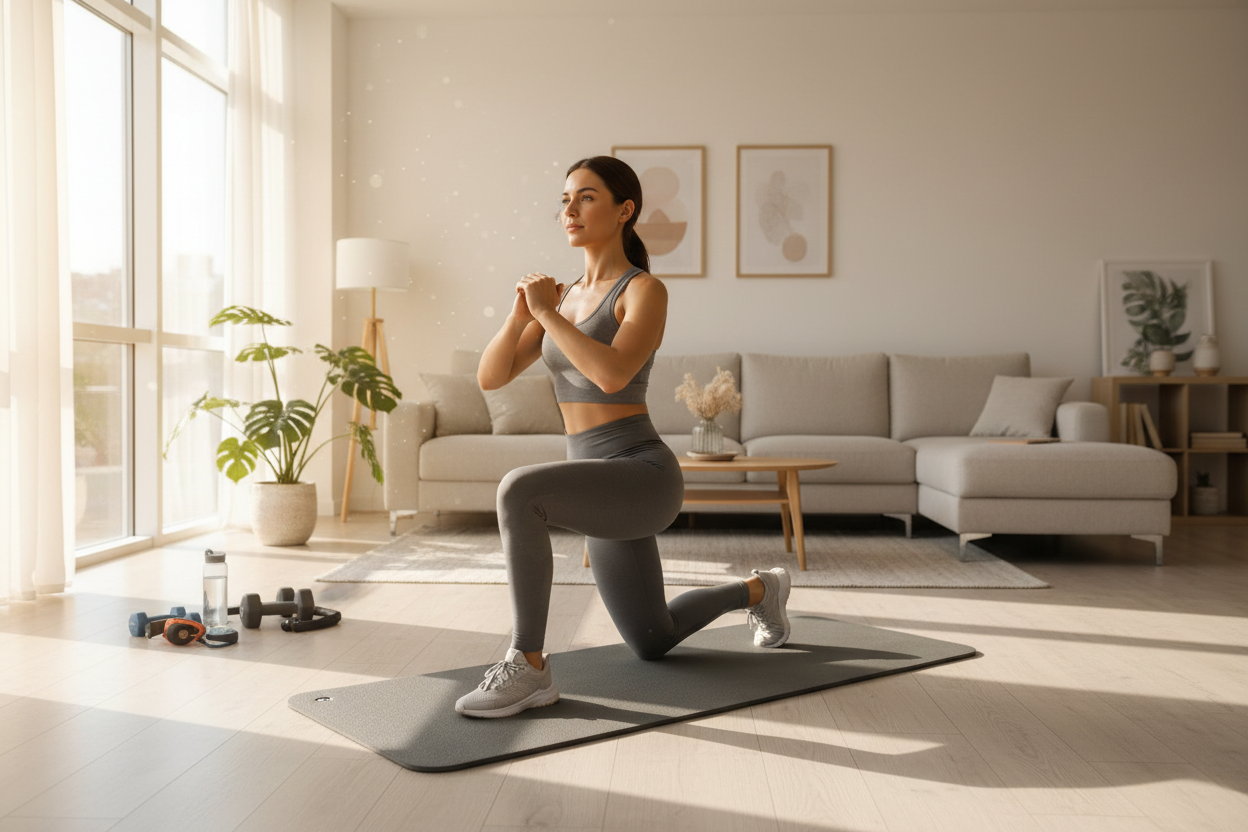
Place your rear foot on a couch, chair, or coffee table. Step the other foot out far enough so that when you lower your hips, your front thigh becomes parallel to the floor. Keep your torso upright to hit the quads or lean forward slightly to engage the glutes. The beauty of this movement is that you don't need external weight to feel it. If you do have a backpack full of books or a pair of dumbbells, holding them makes this exercise rival any heavy gym machine.
2. The Hinge: Single-Leg Romanian Deadlift (RDL)
Most home routines neglect the hamstrings, leading to knee issues and poor posture. The Single-Leg RDL creates the best leg workouts home routines have to offer by isolating the posterior chain. Stand on one leg with a slight bend in the knee. Hinge at the hips, sending your back leg straight behind you like a seesaw. Keep your back flat. You should feel a deep stretch in the hamstring of the standing leg. Return to the start by driving your hips forward. This teaches balance and strengthens the glute-ham tie-in.
3. The Squat Pattern: 1.5 Rep Air Squats
Standard squats can become boring and too easy. To make them part of the best at home legs workout, we add a "half rep" to increase time under tension. Squat all the way down, come up halfway, go back down to the bottom, and then stand up fully. That counts as one rep. This technique keeps the muscles under constant tension and removes the momentum often used to cheat through regular squats. It burns, but it works.
4. The Glute Finisher: Single-Leg Hip Thrusts
Lie with your upper back against the edge of your couch. Plant one foot on the ground and extend the other leg straight out. Drive through the heel of the planted foot to lift your hips until your body forms a straight line from shoulder to knee. Squeeze the glute hard at the top. This provides direct glute isolation that squats alone cannot provide.
Structuring Your Routine
Random exercise selection won't get you results. You need a structured approach. Here is a sample routine designed to maximize fatigue and muscle stimulation.
- Warm-up: 3 minutes of bodyweight lunges and leg swings.
- Bulgarian Split Squats: 3 sets of 8-12 reps per leg. (Rest 60 seconds).
- Single-Leg RDLs: 3 sets of 10-15 reps per leg. Focus on the stretch.
- 1.5 Rep Air Squats: 3 sets of 15-20 reps. Do not lock out your knees at the top; keep tension.
- Single-Leg Hip Thrusts: 3 sets of 15 reps per leg.
- Nordic Hamstring Curl Negatives (Advanced): 2 sets of 5 reps. Anchor your feet under a couch and slowly lower your torso to the ground using only your hamstrings.
Perform this routine two to three times a week. As you get stronger, reduce the rest time between sets or add a pause at the bottom of every rep.
Making It Harder Without Weights
Eventually, you might adapt to the routine above. When that happens, you don't necessarily need to buy weights. You can utilize "plyometrics" (jump training) to recruit fast-twitch muscle fibers. Jump squats and alternating jump lunges are explosive movements that require immense power.
Another method is varying your foot placement. A narrow stance squat targets the outer quad, while a wide "sumo" stance targets the inner thigh and glutes. By constantly varying the stimulus, you ensure that you are always performing the best workout for legs at home based on your current adaptation level.
Consistency Over Equipment
The biggest hurdle to training at home isn't the lack of equipment; it's the abundance of distractions. Your couch, TV, and refrigerator are right there. Treat your living room workout with the same respect you would give a gym session. Put on your workout clothes, play your music, and focus.
Building legs at home is entirely possible. It requires a shift in mindset from "lifting heavy" to "moving well." Embrace the burn of high reps and the stability challenge of single-leg work. Your joints will thank you, and you will build a functional, athletic lower body that looks as strong as it performs.
Frequently Asked Questions
Can I really build muscle mass with just bodyweight leg exercises?
Yes, you can build significant muscle mass using bodyweight exercises if you train close to failure. By using unilateral exercises like split squats, you apply enough resistance to the muscle to trigger hypertrophy, similar to how lifting weights works, provided the intensity is high enough.
How often should I do this leg workout?
For most people, training legs 2 to 3 times per week is ideal. This frequency allows for sufficient recovery while providing enough stimulation for growth. Ensure you have at least one rest day between sessions to let the muscles repair.
What should I do if I have bad knees?
If you suffer from knee pain, focus on posterior chain exercises like glute bridges and RDLs which place less stress on the knee joint. For squatting movements, limit the depth to a pain-free range of motion and focus on slow, controlled tempos rather than explosive movements.