Sculpt Stronger Legs Without Weights: The Ultimate Floor Routine Guide
You do not need a squat rack, heavy dumbbells, or a gym membership to build powerful, defined legs. In fact, relying solely on heavy weights can sometimes mask imbalances that smaller, targeted movements reveal immediately. A dedicated leg exercise on mat routines can generate surprising levels of muscle activation, stability, and endurance. By using gravity and high-repetition ranges, you force the muscles to work through a full range of motion without the joint compression associated with heavy lifting.
Many people underestimate the intensity of floor work until they are halfway through a set of single-leg bridges and their hamstrings are screaming. The secret lies in time under tension and eliminating momentum. When you are on the floor, you cannot cheat the movement by swinging your body. This isolation is what makes mat leg exercises so effective for toning and functional strength.
Why Floor Work Changes Your Physique
I learned the value of floor-based training the hard way. A few years ago, a minor lower back injury sidelined me from heavy squats and deadlifts for months. I was terrified of losing all the muscle I had built. My physical therapist introduced me to a regimen of floor mat leg exercises that looked deceptively simple. I remember thinking, "How is lying down going to keep my legs strong?"
The first session humbled me. Without the ability to compensate with my lower back, my glutes and quads had to do 100% of the work. Within six weeks, not only did I not lose size, but I actually developed better muscle separation in my quads and outer hips than I ever had with barbells. That experience shifted my entire philosophy on training. Now, even when I lift heavy, I incorporate a leg workout on mat at least once a week to maintain hip health and muscle firing patterns.
The Foundations of a Mat Workout for Legs
To get the most out of these movements, you need to focus on the mind-muscle connection. Since you aren't fighting a 200-pound bar, you must mentally squeeze the target muscle at the peak of every contraction. A comprehensive mat workout for legs should hit the quads, hamstrings, inner thighs, and the outer hip complex.
Side-Lying Leg Lifts
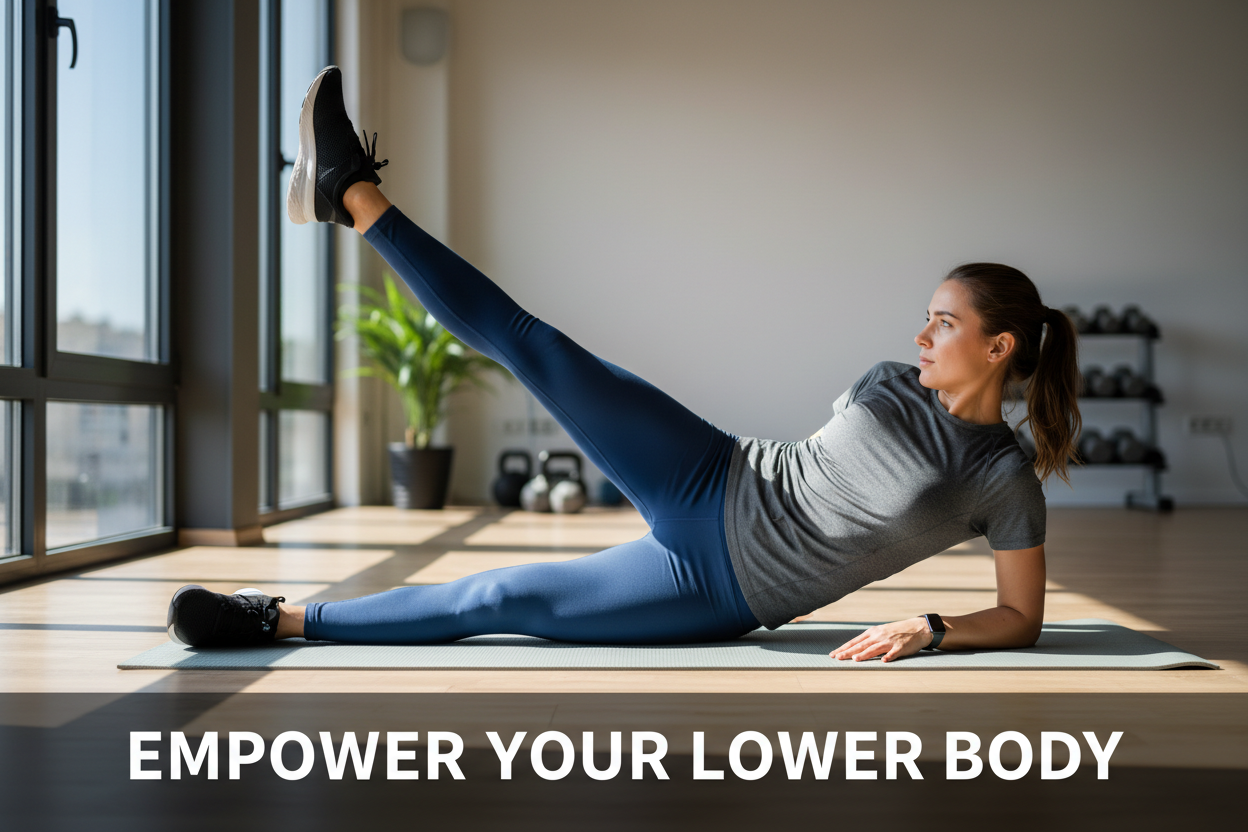
This is the bread and butter of Pilates and rehabilitation alike. Lying on your side creates a direct line of gravity against the abductors. Keep your bottom leg bent for stability and extend the top leg straight out. The key here is to turn your toe slightly downward toward the floor. This internal rotation targets the gluteus medius, a muscle often neglected in standing exercises.
Perform these slowly. If you rush, you are likely using momentum rather than muscle strength. Incorporating these specific mat leg workouts into your routine improves knee stability by strengthening the hips that control femoral alignment.
Inner Thigh Lifts
While still on your side, cross your top leg over the bottom one, planting the foot on the floor. Extend the bottom leg long and lift it toward the ceiling. This targets the adductors. Many athletes have weak inner thighs, which can lead to knee pain. Adding this simple leg exercise on mat ensures you are building balanced legs, not just bulky quads.
Targeting the Posterior Chain
The backside of the legs—the glutes and hamstrings—respond incredibly well to high-volume floor work. Glute mat exercises are particularly good at fixing "glute amnesia," a condition where the glute muscles forget how to fire due to excessive sitting.
The Single-Leg Glute Bridge
Standard bridges are great, but lifting one leg off the ground changes the game. It forces your core to resist rotation and places the entire load on a single hamstring and glute. This is one of the most efficient mat exercises for glutes available. Drive through your heel, lift your hips until your body forms a straight line from shoulder to knee, and pause. That pause is crucial. If you just bounce up and down, you miss the benefit.
Quadruped Hip Extensions (Donkey Kicks)
Get on your hands and knees. Keep your knee bent at 90 degrees and press your foot toward the ceiling. This glute workout on mat isolates the gluteus maximus without involving the hamstrings as much as the bridge does. Ensure your lower back remains flat; if your back arches, you are using your spine, not your hip. Visualizing pushing the ceiling away with your footprint helps maintain proper form.
Structuring Your Routine
You don't need to overcomplicate things. A solid legs workout on mat can be done in circuit fashion. Perform each exercise for 45 to 60 seconds, or aim for high rep ranges like 20 to 30 reps per side. Move from one exercise to the next with minimal rest.
Start with the side-lying series to pre-fatigue the hips. Move into your glute bridges to wake up the posterior chain, and finish with quadruped movements like fire hydrants or donkey kicks. This flow ensures that by the time you finish, every muscle fiber in your lower body has been exhausted.
Advanced Variations for Progression
Once the standard movements feel easy, you need to increase the intensity to continue seeing results. You don't necessarily need weights for this. For your mat glute exercises, try adding a pulse at the top of the movement. For example, during a bridge, hold the top position and pulse your hips up an inch and down an inch for 10 reps before lowering. This keeps the muscle under constant tension and increases metabolic stress.
Another method is slowing down the eccentric phase (the lowering part). Take three full seconds to lower your leg during side lifts. This fights gravity and causes more micro-tears in the muscle fiber, which leads to stronger, more toned muscles during recovery. These adjustments turn a beginner routine into an advanced glute workout on mat that challenges even seasoned athletes.
Consistency remains the most critical factor. Because these exercises are low impact, you can perform them more frequently than heavy lifting sessions. Doing a quick 20-minute session of mat leg exercises three to four times a week can dramatically improve muscle tone and hip health without wear and tear on your joints.
FAQ
Can I really build muscle with just mat exercises?
Yes, you can build lean muscle and significant definition. While you might not achieve the massive bulk associated with heavy barbell squatting, mat exercises increase muscle endurance and tone by maximizing time under tension and targeting stabilizer muscles that heavy lifts often miss.
How often should I do a mat leg workout?
Since bodyweight floor exercises place less stress on the central nervous system and joints compared to heavy lifting, you can perform them 3 to 4 times per week. Allow at least one rest day between sessions if you are working to total failure to let the muscles recover and repair.
Do I need ankle weights for these workouts?
Beginners do not need ankle weights, as the weight of the leg and gravity provide sufficient resistance. However, as you get stronger, adding 2-5 lb ankle weights can be an excellent way to apply progressive overload and continue seeing results from your routine.