Sculpt Long, Lean Legs: The Ultimate Barre Lower Body Guide
You might have seen the trembling legs of students leaving a studio and wondered what exactly goes on behind those glass doors. Barre is deceptive. It looks graceful and gentle, but the burn it creates is unlike anything else in the fitness world. If you want to build endurance and definition without heavy lifting, a focused barre legs workout is one of the most efficient methods available. By combining elements of ballet, Pilates, and functional strength training, this discipline targets the muscles from every angle, often isolating specific areas until they reach total fatigue.
Many people assume you need a background in dance to succeed here, but that is a misconception. A ballet barre leg workout focuses on biomechanics rather than choreography. You aren't training for a recital; you are training for functional strength and aesthetic sculpting. The movements are small, controlled, and precise, designed to tap into slow-twitch muscle fibers. This results in the long, lean look often associated with dancers, achieved through high repetitions and low-impact movements.
The Reality of the "Barre Shake"
I still remember my very first experience at the barre. I walked in confident, thinking my background in running and standard gym squats would carry me through. I was wrong. About ten minutes into the lower body barre workout, my legs began to vibrate uncontrollably. It wasn't just a little twitch; it was the famous "barre shake." This happens when the muscles are under constant tension without the release phase found in dynamic exercises like jumping or running. That shaking sensation is actually the goal. It signifies that you have exhausted the muscle fibers to the point where they have to change and grow stronger to adapt. Embracing that shake is the hardest mental hurdle, but it is exactly where the physical change happens.
Why Micro-Movements Deliver Major Results
Standard strength training often relies on full ranges of motion. While valuable, that approach sometimes allows momentum to take over, giving the muscles a momentary break at the top or bottom of a rep. Barre leg exercises operate differently. We utilize isometric holds and tiny pulses—movements often no larger than an inch. This keeps the muscle under tension for the entire duration of the set.
When you perform these small barre moves for legs, you minimize the risk of injury because there is no jarring impact on the joints. You can safely fatigue the quadriceps and hamstrings without putting undue stress on your knees or lower back, provided your form is correct. This accessibility makes barre legs attainable for almost everyone, from fitness novices to those recovering from certain injuries.
Essential Barre Thigh Workout
The thigh series is usually the most challenging part of class. To replicate an effective barre thigh workout at home, you don't need a professional studio setup. A sturdy chair back, a kitchen countertop, or even a wall works perfectly for balance.
Parallel Heel Lifts
Stand facing your support with feet hip-width apart and parallel. Lightly rest your hands on the support. Lift your heels high off the floor, balancing on the balls of your feet. Bend your knees, sinking your hips down toward heel level, keeping your spine perfectly straight—imagine sliding your back down a wall. This is your starting point.
Lower your hips an inch, then lift them an inch. Repeat this pulsing motion for 30 seconds. The key here is to never straighten the legs fully; keep the tension in the quads. These barre thigh exercises target the front of the leg specifically. If you feel pressure in your knees, don't sink as low, but keep the heels high.
The Wide Second Position
This move transitions into an inner thigh barre workout. Step your feet wider than your hips and turn your toes out to a 10 or 2 o'clock position. Lower your hips until your thighs are roughly parallel to the floor, ensuring your knees track directly over your toes. If your knees roll inward, narrow your stance slightly.
Hold this deep plié. Lift your right heel, then lower it. Lift your left heel, then lower it. Alternate for one minute. The instability of lifting the heels forces the inner thighs to engage deeply to stabilize the pelvis. This is one of the most effective barre exercises for inner thighs because it combines a static hold with dynamic movement.
Sculpting the Glutes and Hamstrings
A complete barre leg workout isn't finished until you address the back of the legs. While the quads often take the brunt of the work in daily life, the posterior chain is vital for posture and pelvic alignment.
Standing Seat Fold-Over
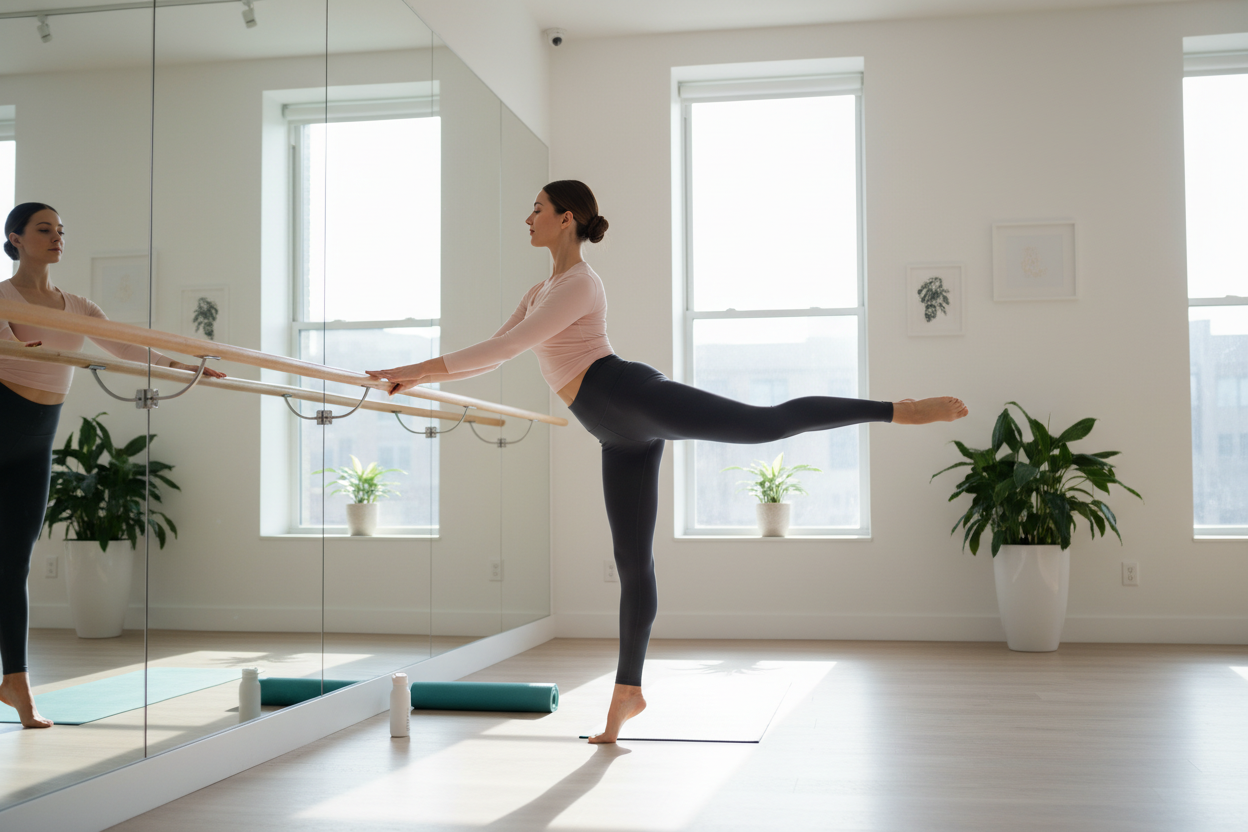
Face your support and fold forward at the hips, resting your forearms on the surface. Your back should be flat like a table. Extend one leg straight back behind you, pointing the toe. Keep your supporting leg slightly bent to protect the joint.
Lift the extended leg until you feel the glute engage, then lower it just a few inches. Avoid arching your lower back; the movement should come strictly from the hip. Perform 20 lifts, then hold the leg at the top and pulse for 20 counts. This targets the "glute-ham tie-in," the area where the butt meets the leg. It creates a lifted appearance and is a staple in any comprehensive lower body barre workout.
Refining the Inner Leg Line
The inner thighs are notoriously difficult to target with conventional gym equipment. Barre exercises for inner thighs shine here because they emphasize adduction—bringing the legs toward the centerline of the body.
The Diamond Plié
Stand with your heels together and toes apart (first position). Rise onto the balls of your feet and glue your heels together. Bend your knees to form a diamond shape with your legs. From this position, squeeze your heels together as hard as you can. You should feel an immediate activation running up the inside of the legs.
Pulse your hips down and up within a small two-inch range. The focus must remain on the heel squeeze; if you lose that connection, the work shifts back to the quads. This subtle shift is what defines a true inner thigh barre workout. It teaches the body to recruit the adductors for stability.
Consistency and Frequency
Seeing changes from a barre leg workout requires consistency. Because the resistance is relatively low (body weight), you can perform these routines more frequently than heavy weightlifting sessions. Aiming for three to four sessions a week allows for adequate recovery while maintaining the muscle memory required for proper form.
Listen to your body. If your muscles are extremely sore, focus on stretching or active recovery. Over time, the shaking will start later in the set, indicating that your endurance is improving. That is when you sink an inch lower or hold the position a few seconds longer to chase that challenge again.
Common Mistakes to Avoid
Even seasoned practitioners can fall into bad habits. The most common error during barre moves for legs is tucking the pelvis too aggressively. While we want a neutral spine, forcefully tucking the tailbone under can strain the lower back and hip flexors. Aim for a heavy tailbone that points straight down, rather than curling under.
Another pitfall is gripping the support bar too tightly. Your hands are there for balance, not to bear your weight. If your knuckles are white, you are cheating your core and legs out of the work. Lighten your grip or try hovering your hands above the support to ensure your lower body is doing the heavy lifting.
Barre legs are built on precision. It is better to perform ten reps with perfect alignment than fifty reps with poor form. Focus on the mind-muscle connection, breathe through the burn, and trust the process. The results are not just aesthetic; you will walk taller, move with more agility, and feel a grounded strength in everything you do.
Frequently Asked Questions
Do I need ballet shoes to do a barre workout at home?
No, you do not need ballet shoes. Most people practice in grippy socks to prevent slipping, or even barefoot. Regular socks can be dangerous on smooth floors, and running shoes are generally too bulky and prevent proper foot articulation.
How long does it take to see results from barre leg exercises?
With consistent practice of 3-4 times a week, most people begin to feel stronger and see improved posture within a few weeks. Visible muscle definition, such as leaner thighs or more lifted glutes, typically becomes noticeable after 8 to 12 weeks of dedicated training.
Can barre bulk up my legs?
It is highly unlikely. Barre focuses on high repetitions with low resistance, which builds muscular endurance (Type I muscle fibers) rather than the hypertrophy (bulk) associated with heavy weightlifting. The result is typically a compact, sculpted muscle rather than increased mass.