Rotator Cuff Repair Exercises: The Safe Path to Full Mobility
Waking up in a sling is a humbling experience. The surgery fixed the structural damage, but the real work—the restoration of function—is entirely up to how you handle the next few months. It is a delicate balance between protecting the surgical site and preventing your shoulder from freezing up completely. The goal of exercises for rotator cuff repair is not to build muscle immediately, but to coax the joint back into movement without disrupting the healing tendon.
Many patients rush this process, assuming that "no pain, no gain" applies here. It does not. In the early stages of recovery, pushing through pain can undo the surgeon's work. This guide breaks down the progression from passive movement to active strengthening, helping you navigate the recovery timeline with confidence.
Key Takeaways: The Recovery Roadmap
- Respect the Biology: Tendon-to-bone healing takes at least 12 weeks; early exercises must be passive to protect the stitches.
- Passive Range of Motion (PROM): The first phase relies on gravity or the other arm to move the shoulder, keeping the repaired muscles completely relaxed.
- Active Assist (AAROM): Phase two introduces movement where the arm helps slightly, often using a cane or pulley system.
- Scapular Stability: Strengthening the shoulder blade muscles is critical before targeting the rotator cuff itself.
- Listen to the "Bad" Pain: Sharp, stabbing pain usually means you are stressing the repair; dull aches are generally part of the rehab process.
The Science of Tendon Healing
Before grabbing a resistance band, you need to understand what is happening inside your shoulder. When a surgeon reattaches the tendon to the bone, the connection is initially held only by sutures or anchors. The biological fusion—where the body creates new collagen fibers to bridge the gap—takes time.
If you engage the rotator cuff muscles too early, the tension can pull the tendon away from the bone. This is why rotator cuff repair physical therapy exercises are strictly phased. We aren't trying to get strong in the first six weeks; we are trying to maintain mobility while the biological glue sets.
Phase 1: Passive Motion (Weeks 0-6)
In this phase, your operated shoulder is a passenger. It should not do any of the driving. The focus is strictly on Passive Range of Motion (PROM).
The Pendulum (The Right Way)
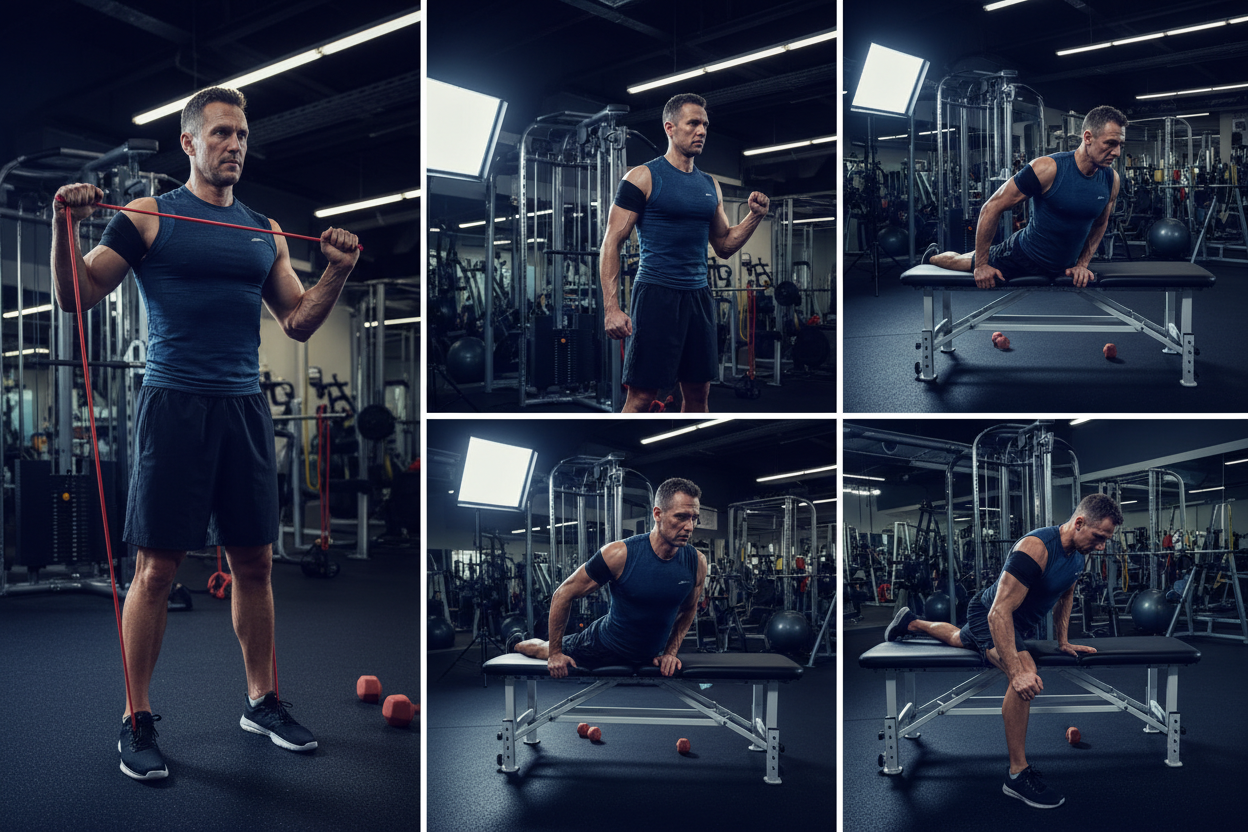
Most people do this wrong. They use their shoulder muscles to make small circles. Instead, you must lean forward, supporting your weight with your good arm on a table. Let the surgical arm hang like dead weight. Use your hips and torso to sway, creating momentum that moves the arm. If you feel the muscle in your shoulder firing, you need to stop and relax.
Passive Supine Forward Flexion
Lie on your back. Clasp your hands together, with the non-surgical hand doing all the lifting. Slowly raise your arms overhead. The operated arm goes along for the ride but contributes zero force. This keeps the joint capsule from shrinking without stressing the repair.
Phase 2: Active-Assisted Motion (Weeks 6-12)
Once your surgeon clears you (usually around the 6-week mark), you can begin Active-Assisted Range of Motion (AAROM). The tendon is stronger, but not ready for full loads.
The Cane/Wand Exercise
Using a broomstick or a cane, use your good arm to push the operated arm outward or upward. You are beginning to guide the movement, but the heavy lifting is still done by the healthy side or the object. This restores external rotation, which is often the hardest range to regain.
Phase 3: Initial Strengthening (Weeks 12+)
This is where the actual "building" begins. However, we start with the foundation: the scapula (shoulder blade).
Scapular Retractions
Your rotator cuff needs a stable platform. Stand tall and squeeze your shoulder blades together as if trying to hold a pencil between them. Hold for 5 seconds, then release. This doesn't stress the cuff but builds the necessary back strength to support the shoulder.
Isometric Holds
Before moving the arm against resistance, we train the muscle to hold tension without movement. Press your forearm into a wall (gently) and hold. This wakes up the neuromuscular connection without the shearing force of movement.
My Personal Experience with exercises for rotator cuff repair
I want to share something that doesn't usually make it into the medical brochures. When I was rehabbing a shoulder injury, the hardest part wasn't the pain—it was the mental trust issues I developed with my own arm.
I remember doing the "Pendulum" exercise about three weeks post-injury. I was leaning over my kitchen table, and I realized that even though I told myself to relax, my shoulder was hiking up toward my ear. I was subconsciously guarding the injury. I had to physically take a deep breath and visualize the tension draining out of my neck before the arm actually dropped into a true dead hang. That sensation of "letting go" felt terrifying, like the joint was going to slide out of the socket. But that specific moment of trusting the passive hang was the turning point. If you don't conquer that subconscious guarding, you'll never get the full range of motion back, no matter how many reps you do.
Conclusion
Recovering from shoulder surgery is a marathon, not a sprint. The timeline feels slow, but biology cannot be rushed. By adhering to a strict progression of exercises for rotator cuff repair, you ensure that when you finally do return to sport or lifting, the repair is solid enough to handle the load. Trust the protocol, listen to your physical therapist, and don't test your limits until the time is right.
Frequently Asked Questions
How do I know if I tore my rotator cuff again during exercises?
A re-tear is often accompanied by a sharp, popping sensation followed by immediate weakness or the inability to lift the arm. However, general soreness and stiffness are normal. If you have sharp pain that persists for hours after exercise, consult your surgeon.
When can I start lifting weights after rotator cuff repair?
Generally, light resistance training doesn't begin until week 12 at the earliest. Full return to heavy lifting or overhead sports often takes 4 to 6 months. This timeline varies based on the size of the tear and the quality of the tissue.
Why does my shoulder hurt more at night after therapy?
Inflammation tends to pool in the shoulder joint when you lie flat, and cortisol levels (natural anti-inflammatories) drop at night. This is a common complaint. Propping yourself up with pillows or sleeping in a recliner for the first few weeks can significantly reduce this nocturnal throbbing.