The Multifunctional Smith Machine: Your All-in-One Home Gym Solution
Building a home gym often feels like a game of Tetris. You want a power rack, a cable crossover, a lat pulldown, and a leg press, but you only have a two-car garage—and you still want to park your car in it. This is where the multifunctional smith machine enters the conversation.
It’s no longer just that rigid, fixed-path squat rack people used to mock. Modern iterations have evolved into comprehensive strength training centers that rival commercial setups. If you are looking to maximize floor space without sacrificing exercise variety, understanding the mechanics of these units is critical.
Key Takeaways
- Hybrid Design: Combines a traditional Smith machine with a power rack and dual adjustable pulley system (functional trainer).
- Safety First: The guided bar allows for safe solo training to failure without a spotter.
- Space Efficiency: Consolidates 4-5 large machines into a single footprint, ideal for home gyms.
- Mechanical Action: High-quality units use linear bearings for smooth vertical travel, whereas cheaper models use bushings.
- Versatility: The addition of cable systems allows for isolation movements (flyes, curls) alongside compound lifts.
The Evolution: More Than Just a Guide Rod
Years ago, a Smith machine was a one-trick pony. You used it for squats or bench presses on a fixed vertical plane. Today, the "multifunctional" label changes everything. These units are essentially a hybrid of three distinct gym staples: a Smith machine, a half-rack for free weights, and a functional trainer.
By integrating a dual pulley system, manufacturers have solved the biggest drawback of the traditional Smith machine: the lack of lateral movement. You can now perform cable crossovers, face pulls, and tricep pushdowns on the same unit you use for heavy pressing.
Linear Bearings vs. Nylon Bushings
When shopping for these machines, the "feel" of the bar is the most important factor. This comes down to the engineering inside the sliding mechanism.
You want a machine that utilizes linear bearings. These are ball bearings that glide along the steel guide rods. They provide a smooth, frictionless experience even under heavy loads. Cheaper models often use nylon bushings, which create drag and friction, making the weight feel heavier on the descent and "sticky" on the ascent. If the specs don't mention linear bearings, walk away.
Safety Mechanisms for Solo Training
The primary reason lifters gravitate toward this equipment is safety. When you train alone at home, getting stuck under a heavy bench press is a genuine risk.
A multifunctional Smith machine utilizes a hook-and-catch system. A simple rotation of the wrist locks the bar instantly at any point during the lift. Furthermore, most modern units come with adjustable safety stops. These are physical barriers you set at the bottom of your range of motion. If your muscles give out, the stops catch the bar before it crushes you. This allows you to safely test your 1-rep max without a spotter hovering over you.
The Cable System Advantage
The real magic lies in the pulley ratio. Most multifunctional units use a 2:1 pulley ratio. This means lifting 100 lbs feels like 50 lbs.
Why is this good? It allows for longer cable travel and smoother acceleration, which is essential for explosive movements and functional training. It turns a static heavy-lifting station into a dynamic athletic training tool. You aren't just building muscle; you are training movement patterns.
My Personal Experience with Multifunctional Smith Machines
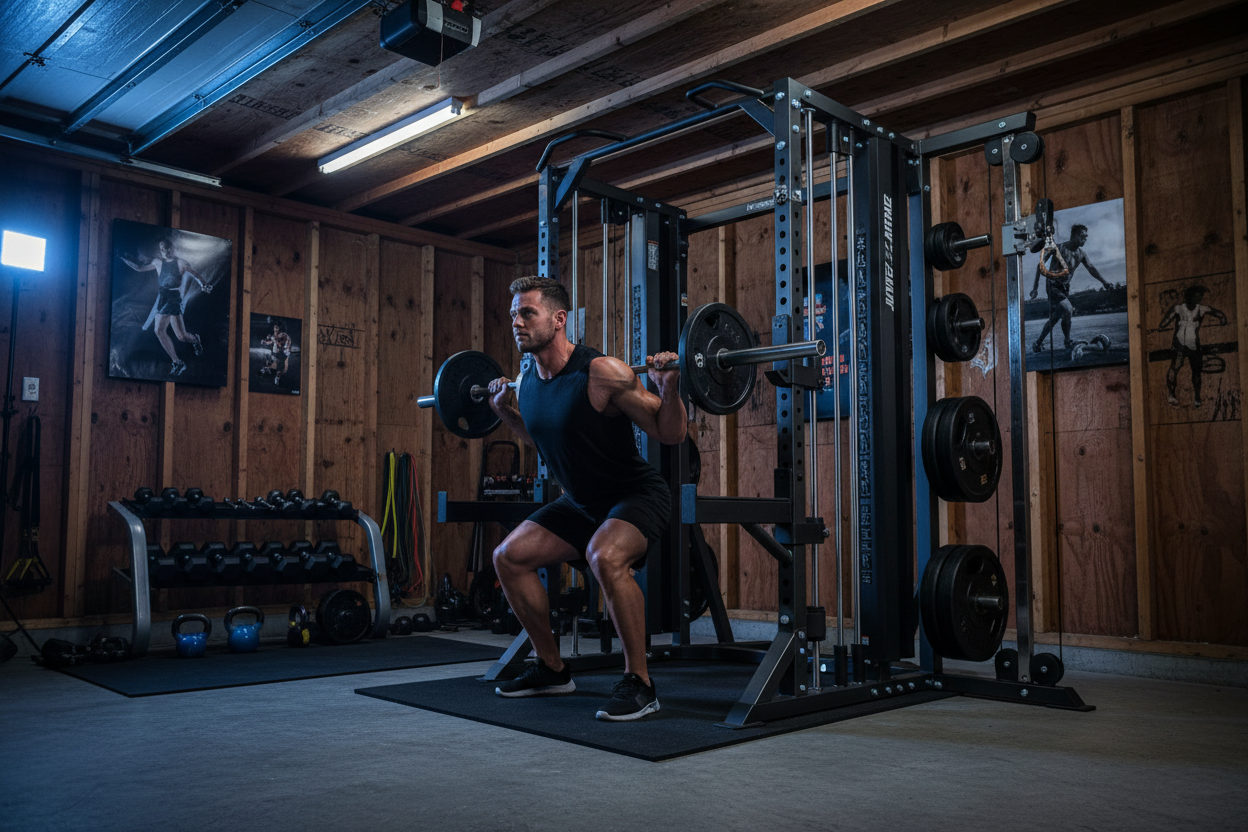
I’ve spent the last three years training almost exclusively on a high-end multifunctional Smith unit in my garage, and I need to be honest about the quirks that product descriptions won't tell you.
The first thing you realize is the maintenance. About six months in, the guide rods will start to get gritty. It’s not a defect; it’s dust mixing with the factory oil. If you don't wipe them down and re-apply silicone spray (never WD-40) every few weeks, the bar starts to "stutter" on the way down. It’s incredibly distracting during a heavy squat.
Another reality check is the width. I have a standard 7-foot Olympic bar for the free-weight rack portion. On my specific machine, the uprights are wide. When I re-rack a sloppy squat, I have to be precise. If I’m off by two inches to the left, the collar hits the upright before the bar rests on the J-hook. It’s a small annoyance, but it forces you to be disciplined with your racking.
However, the ability to superset a heavy Smith bench press immediately into a cable fly without moving my feet? That is an efficiency level you just can't get in a commercial gym.
Conclusion
A multifunctional Smith machine is a significant investment, both financially and spatially. But for the serious home gym owner, it is the most efficient way to replicate a commercial gym experience. By combining safety, heavy loading potential, and functional cable work, it eliminates the need for multiple bulky machines. Just ensure you prioritize linear bearings and robust safety stops.
Frequently Asked Questions
Can I use a multifunctional Smith machine for free weight exercises?
Yes. Most multifunctional units include J-hooks and spotter arms attached to the front of the frame. This allows you to place a standard Olympic barbell on the rack and perform free-weight squats, bench presses, and overhead presses, using the machine essentially as a power rack.
Is the fixed path of a Smith machine bad for my joints?
Not necessarily, but it requires adjustment. Because the bar moves in a fixed line, your body must adjust to the bar, rather than the bar adjusting to your body. To prevent joint stress, ensure your foot placement allows for natural biomechanics. For example, you may need to place your feet further forward during squats compared to a free-weight squat.
How much ceiling height do I need?
Most multifunctional Smith machines are between 83 and 90 inches tall. You need to account for the height of the machine plus clearance for pull-ups if the unit has a pull-up bar. A standard 8-foot ceiling (96 inches) is usually sufficient, but always measure the highest point of the machine's assembly before purchasing.