Resistance Exercise Training: Full-Body Movement Blueprints, Loading Frameworks, and Home Floor Staging
Executing a deliberate physical conditioning program requires an understanding of how external tension interacts with human movement. Incorporating structured resistance exercise training into a home fitness plan enables individuals to build balanced movement competency, improve physical coordination, and target major muscle groups across consistent training cycles.
Foundations of Resistance Exercise Training
At its fundamental level, resistance training involves moving the body against opposing forces to stimulate muscular engagement. Applying resistance in training can take many forms, including manipulating bodyweight against gravity, displacing iron implements, or elongating elastic bands. The underlying goal remains consistent: systematically challenging movement patterns across controlled ranges of motion.
Unlike passive activities, a well-planned resistance training exercise routine emphasizes controlled tempo, joint alignment, and consistent tension throughout both concentric and eccentric phases. When individuals understand how leverage, angles, and mechanical resistance affect work output, they can refine their sessions for progressive development without relying on excessively complex equipment setups.
Core Movement Patterns in Resistance Training Exercise
Effective movement blueprints avoid isolating individual muscles in favor of multi-joint movement archetypes that reflect natural physical function. Organizing routines around five central movement patterns ensures balanced development:
- Squat Pattern: Knee-dominant knee flexion and hip extension, such as goblet squats and split squats, that engage the quadriceps, glutes, and core musculature. Reviewing an extensive resistance training guide can help refine lower-body mechanical cues and stance variations.
- Hinge Pattern: Hip-dominant flexion and extension, such as Romanian deadlifts and kettlebell swings, targeting the posterior chain including the hamstrings, glutes, and spinal extensors.
- Push Pattern: Horizontal and vertical pushing movements, such as floor presses and overhead dumbbell presses, recruiting the pectorals, anterior deltoids, and triceps.
- Pull Pattern: Horizontal and vertical pulling movements, including bent-over rows and pull-ups, developing the latissimus dorsi, rhomboids, rear deltoids, and biceps.
- Core and Rotational Stability: Anti-extension, anti-rotation, and loaded carries that reinforce trunk rigidity and efficient force transfer between the upper and lower body.
Full-Body Training Frameworks vs. Split Routines
When organizing weekly schedules, trainees frequently choose between full-body sessions and body-part split routines. A comprehensive resistance training guide often outlines how full-body programming allows each primary pattern to be trained multiple times throughout the week with balanced distribution.
For home training environments where time and equipment availability can be limiting factors, full-body sessions offer practical advantages. Combining a lower-body push with an upper-body pull, followed by a lower-body hinge and an upper-body push, maximizes session density while allowing opposing muscle groups to rest between paired sets.
Modality Selection: Resistance Weight Training and Variable Resistance
Selecting appropriate equipment depends on movement goals, storage capabilities, and training preferences. A well-rounded setup can incorporate several complementary modalities:
- Free Weights: Dumbbells and kettlebells provide constant gravitational load, demanding active stabilization through three-dimensional space during resistance weight training.
- Elastic Bands: Banded setups offer variable resistance that increases toward the end range of motion, making them ideal for dynamic warm-ups, movement grooving, and accommodating resistance.
- Bodyweight and Levers: Calisthenic movements utilize body angles and mechanical disadvantage to alter loading parameters without external hardware.
- Sport-Specific Implements: Medicine balls and suspension trainers support multi-planar stability suitable for broad resistance sport conditioning.
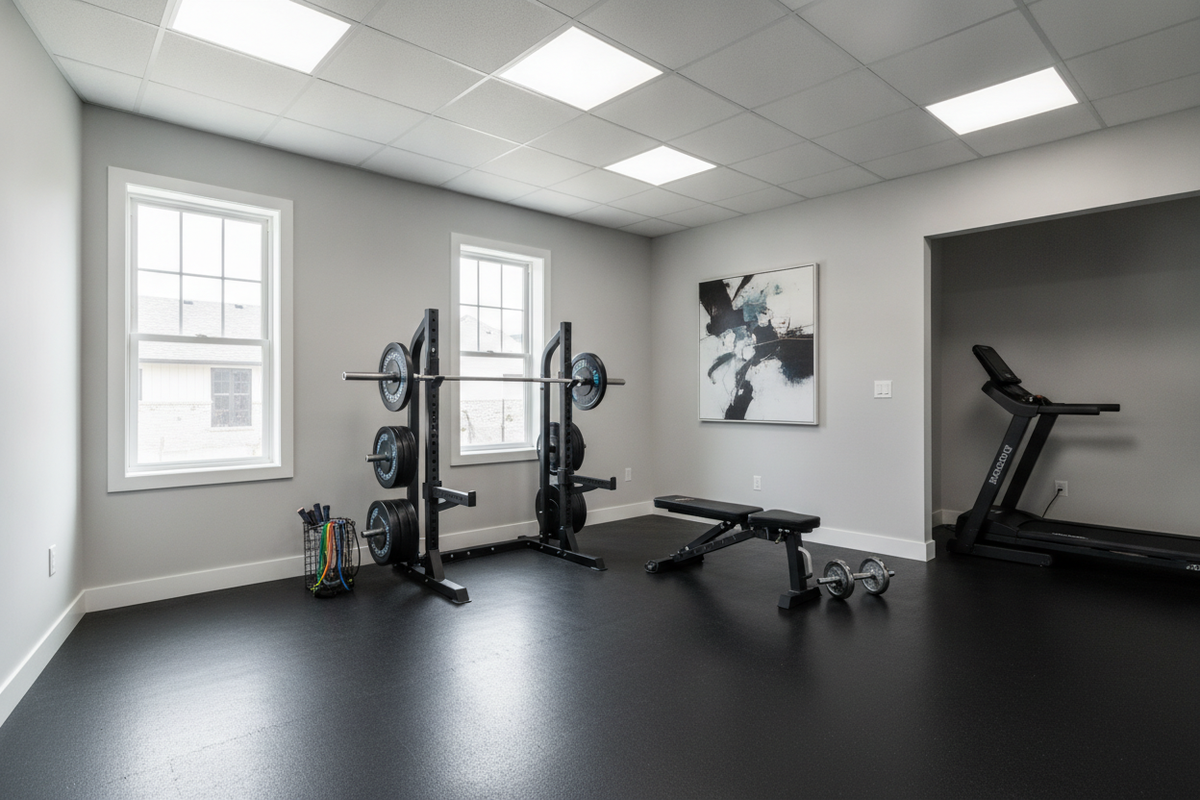
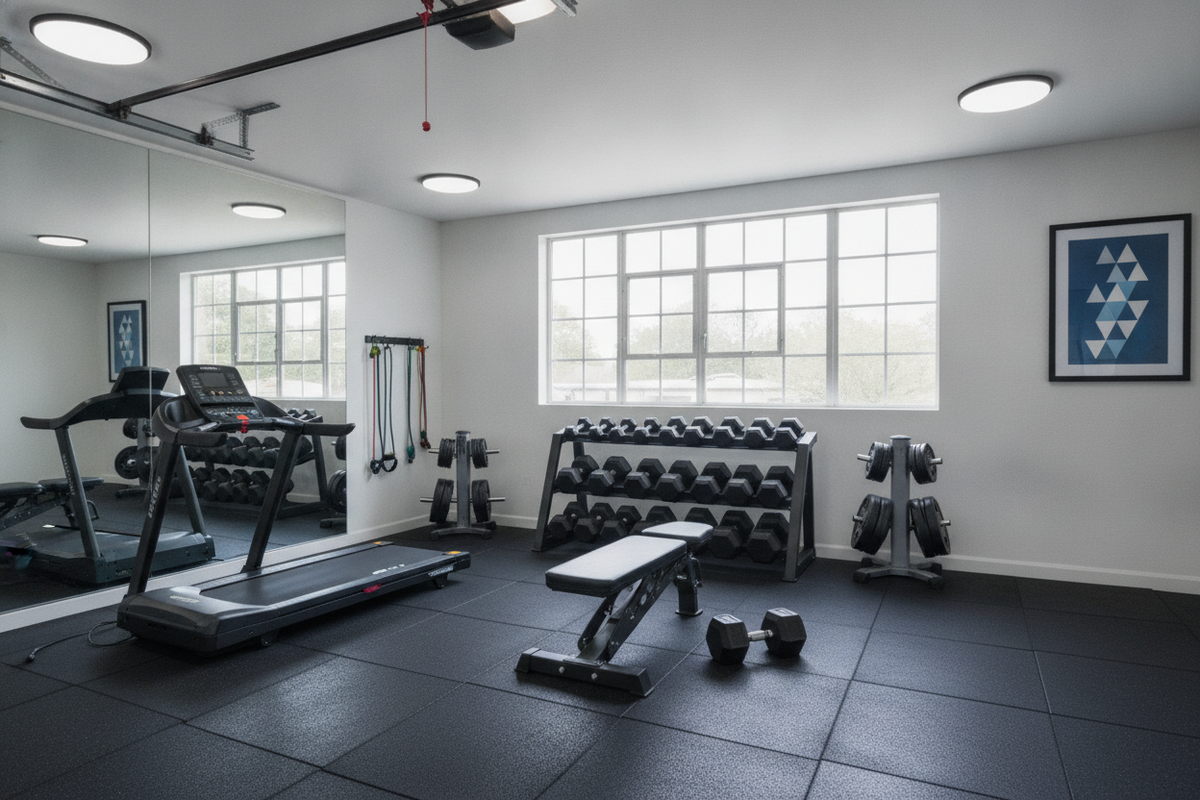
Home Gym Staging, Equipment Placement, and Subfloor Protection
Executing explosive or heavy movements in a residential setting introduces unique physical demands on living spaces. Hardwood, laminate, tile, and concrete subfloors require protective surfacing to dampen vibrational transfer and guard against surface abrasion during dumbbell or kettlebell drills.
Establishing a designated training zone with high-density matting from an exercise collection provides a dedicated non-slip foundation. Proper surface texture enhances foot traction during split squats, lunges, and overhead presses, preventing lateral foot slide under load. For expansive multi-directional training, outfitting the space with a seamless mat from an exercise collection ensures sufficient room for dynamic transitions, loaded carries, and floor-based core work.
When laying out a home workout perimeter, maintain clear clearances around weight racks and active workout stations. Keep walking pathways free from loose plates or bands, and position heavier implements near stable structural boundaries to streamline equipment transitions during interval or circuit sessions.
Structuring an Efficient 20-Minute Full-Body Routine
For trainees working with tight schedules, an efficient full-body routine can be structured using non-competing exercise pairings. Below is an adaptable framework designed for home practice:
- Block A (8 Minutes): Alternate between a goblet squat (8 to 10 repetitions) and a dumbbell row (8 to 10 repetitions per arm). Rest briefly between movements and complete 3 total rounds.
- Block B (8 Minutes): Alternate between a Romanian deadlift (10 repetitions) and an incline push-up or floor dumbbell press (8 to 12 repetitions). Complete 3 total rounds.
- Block C (4 Minutes): Conclude with a trunk stability pairing, such as alternating front planks and bird-dogs, focusing on controlled breathing and posture.
Flooring Maintenance and Workout Area Care
Maintaining a clean, functional training space prolongs the lifespan of both protective mats and conditioning hardware. Routine surface care prevents dust accumulation, sweat residue, and debris from reducing surface grip.
Wipe down heavy-duty mats, such as a specialized exercise product, using a mild cleaning solution and a microfiber cloth after intensive sessions. Allow the surface to dry completely before rolling or storing accessories on top. Regularly inspect free weights, band attachments, and floor seams to ensure the workout area remains clean, organized, and ready for progressive training.