Reclaiming Your Floor Space: How to Organize a Growing Kettlebell Collection Without Losing Your Mind
If you have ever stubbed your toe on a 24kg cast iron doorstop in the middle of the night, you know exactly why equipment organization isn't just about aesthetics—it is about survival. As home gyms evolve from a yoga mat in the living room to fully-equipped garage setups, the accumulation of gear happens faster than most of us anticipate. One day you buy a single kettlebell for swings, and six months later, you are navigating a minefield of iron just to reach your bench.
The solution to this creeping chaos is simple, though often overlooked until the clutter becomes unbearable: you have to stop storing things horizontally and start storing them vertically. Getting your weights off the floor protects your flooring, saves your lower back during setup, and drastically increases the usable footprint of your workout area. For those dealing with limited square footage, implementing proper vertical kettlebell storage is the single most effective change you can make to improve your training workflow.
The Reality of the Home Gym "Creep"
I learned the hard way that kettlebells are like rabbits; they seem to multiply when you aren't looking. My journey started with a modest pair of 16kgs. They sat harmlessly in the corner. Then came the 24kg for heavy swings, followed by a lighter pair for my partner, and eventually a heavy 32kg for carries. Before I knew it, a significant portion of my garage floor was dedicated to a sprawling graveyard of iron. Not only was I losing workout space, but the constant clanking of bells against each other was chipping the powder coat I had paid good money for.
The turning point came when I tried to set up for a circuit workout. I needed clear floor space for Turkish get-ups, but I spent five minutes shuffling weights around just to carve out a 6x6 area. That was the moment I realized that floor storage was a dead end. If you want to train seriously, your environment needs to facilitate movement, not hinder it. Moving to a racked solution wasn't just an organizational choice; it was a commitment to taking my training space seriously.
Going Up: The Logic of Vertical Storage
Most residential rooms aren't blessed with endless square footage, but they almost always have vertical height available. A standard kettlebell has a footprint of roughly 8 to 10 inches. If you own ten of them, you are losing nearly seven linear feet of floor space if you line them up against a wall. That is space that could be used for a rower, a bench, or simply room to breathe.
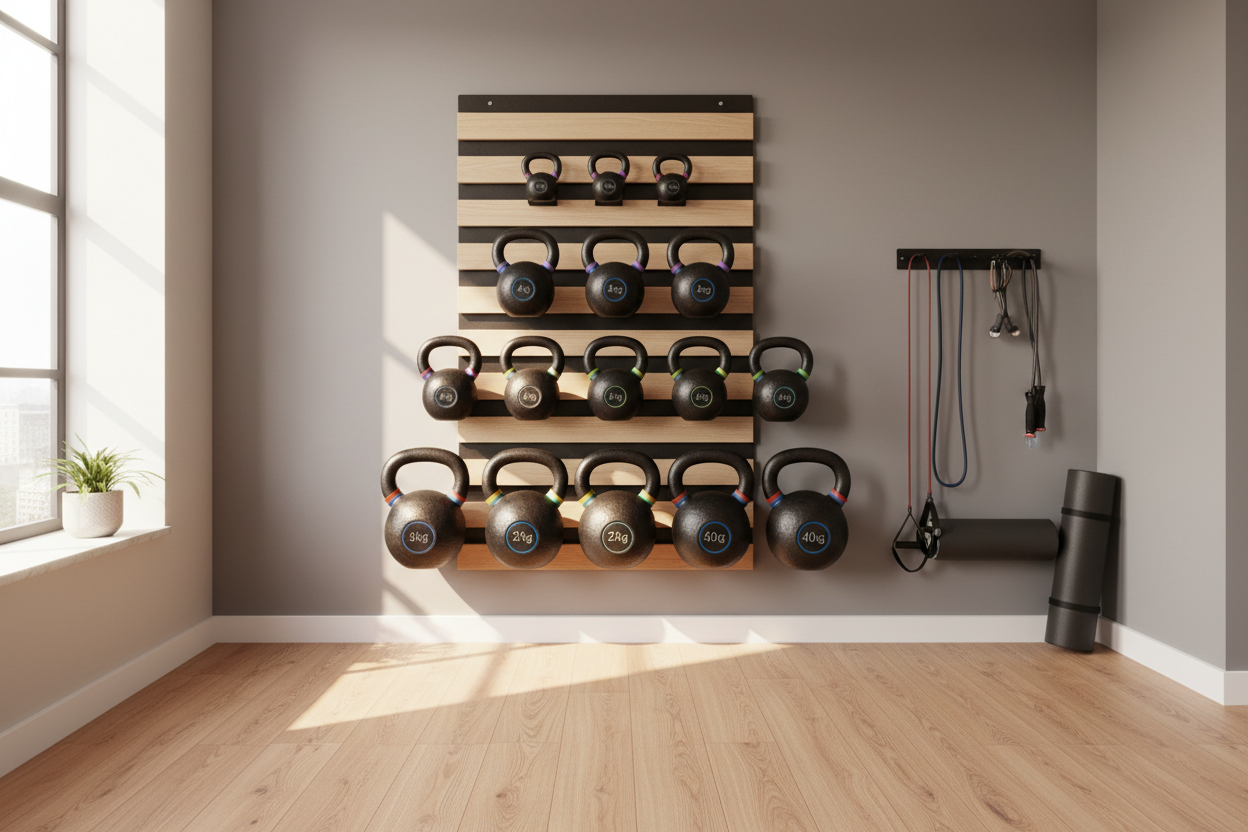
A dedicated vertical kettlebell rack solves this geometry problem instantly. By stacking the weights on tiers, you condense that seven-foot line into a compact footprint, often less than two feet wide. This type of racking system usually features two or three tiers with open shelving or specific holding rings. Unlike dumbbell racks, which are often angled specifically for hex weights, kettlebell shelves are generally flat and reinforced to handle the concentrated center of gravity that bells possess.
When choosing a vertical setup, stability is the primary metric. Kettlebells are dense. A compact rack holding six bells might be supporting 300 to 400 pounds. You need a unit with a wide enough base to prevent tipping, especially if you grab a heavy bell from the top shelf. Look for racks constructed with heavy-gauge steel and rubber-lined trays. The liner is essential—it prevents the metal-on-metal grinding that strips the finish off your bells and keeps them from sliding if the rack gets bumped.
Utilizing the Dead Zones
Every room has dead zones—those awkward spaces where two walls meet that rarely serve a purpose. In a gym setting, corners are often wasted because barbells and benches don't fit there. This is where a corner kettlebell rack becomes a strategic asset. These units are triangular or wedge-shaped, designed to slide deep into the corner and turn wasted space into a high-density storage area.
The geometry of a corner rack is particularly clever for kettlebells. Because the shelves fan out, they naturally accommodate the round shape of the bells. You can often fit three or four bells on the bottom shelf, tapering up to smaller ones on top. This setup keeps the heaviest weights at the bottom, which lowers the center of gravity and maximizes stability.
Beyond the physics, the corner setup creates a psychological shift in the room. It visually anchors the space. Instead of weights scattered like toys, they are displayed like an arsenal. There is a tangible satisfaction in finishing a set of heavy squats and racking the weight into a designated spot rather than dropping it on the floor. It creates a ritual of cleanliness that tends to bleed over into the rest of your training.
Key Features That Matter
Not all storage solutions are created equal. If you are in the market for a rack, ignore the flashy branding and look at the welds and the weight capacity. A generic shelving unit from a hardware store is not a substitute for proper vertical kettlebell storage. Industrial shelving is designed for distributed loads (like boxes of paper), not the point-load stress of a 32kg ball of iron sitting on a 6-inch spot. Using improper shelving is a recipe for a collapse that could injure you or damage your floor.
Lip Height and Shelf Depth
Pay close attention to the lip on the edge of the shelves. You want a lip that is high enough to prevent a bell from rolling off if bumped, but low enough that it doesn't catch your wrist or the bell's handle when you are lifting it off. The shelf depth also matters. If the shelf is too shallow, larger competition bells might hang off the edge, creating a hazard. If it is too deep, you might struggle to reach the handle comfortably without compromising your lifting posture.
Material Finish
Sweat and humidity are constants in a gym environment. If your rack is going into a garage or basement, look for a powder-coated finish rather than cheap paint. Powder coating is resistant to chipping and rust. Since kettlebells are constantly being dragged across the surface, a poor finish will degrade within months, leading to rust spots that can transfer onto your equipment.
The Safety Factor
We often think of safety in terms of spotting a bench press, but gym organization is a safety protocol in itself. Tripping hazards are the most common cause of minor injuries in home gyms. When you are fatigued at the end of a metabolic conditioning session, your proprioception (body awareness) drops. Stepping backward off a mat and rolling your ankle on a stray 12kg bell is a fast way to sideline yourself for weeks.
By designating a specific home for every piece of equipment—whether it is a vertical kettlebell rack for your main set or a corner unit for the overflow—you enforce a "clean as you go" mentality. It streamlines your workout. You spend less time hunting for the matching weight and more time lifting. Ultimately, investing in storage isn't about buying furniture; it is about buying back your focus.
Frequently Asked Questions
Can I store dumbbells on a kettlebell rack?
Generally, yes, provided the shelf is flat. However, because dumbbells are longer, they take up more horizontal space, which might reduce the total capacity of the rack. Some racks offer reversible shelves that can be angled for dumbbells or laid flat for kettlebells.
How much weight can a standard vertical rack hold?
Most quality home gym racks are rated for between 500 and 1,000 pounds. Always check the manufacturer's specifications, and remember that this rating assumes the weight is evenly distributed across the tiers, not piled onto a single shelf.
Do I need to bolt the rack to the floor?
For most residential vertical racks, bolting is not required if the weight is loaded properly (heaviest items on the bottom). However, if you have small children who might climb on the shelves, or if the rack is particularly tall and narrow, anchoring it to the wall or floor is a wise safety precaution.