Quit the Gym: The Ultimate Guide to Massive Legs With Zero Equipment
You do not need a squat rack, a leg press machine, or heavy dumbbells to develop powerful, muscular legs. The common misconception in the fitness industry is that hypertrophy—muscle growth—stops the moment you step away from iron. That is simply untrue. You can absolutely build leg muscles without weights, provided you understand the physics of body leverage and the physiology of muscle tension.
The secret isn't doing endless repetitions of air squats until you get bored. To stimulate growth, you must force your muscles to adapt to high levels of stress. When you take away external load, you have to replace it with mechanical disadvantage, unilateral (single-leg) training, and explosive movement. If you are wondering how to get strong legs without weights, the answer lies in manipulating intensity rather than just counting reps.
The Reality of Bodyweight Leg Training
A few years ago, I found myself without gym access for three months due to a relocation. I was terrified I would lose the quad sweep and hamstring thickness I had spent years building under a barbell. I decided to commit fully to a calisthenics leg program. I didn't just maintain my size; I actually improved my muscle separation and balance. The soreness I experienced from high-volume Bulgarian split squats rivaled any heavy leg day I had ever endured.
Your muscles do not have eyes. They cannot see that you are holding a dumbbell. They only detect tension. If you can generate enough tension using your own body weight, your legs will grow. The key is progressive overload. In a gym, you add weight to the bar. At home, you add range of motion, decrease leverage, or increase time under tension.
The Holy Trinity of Bodyweight Leg Growth
To build legs without weights effectively, you need to categorize your training into three distinct buckets. Relying on just one will leave gaps in your development.
1. Unilateral Movements
This is the bread and butter of equipment-free training. Your legs are incredibly strong. Two legs working together can move hundreds of pounds, which means your body weight alone distributed across both legs is often too easy to stimulate growth. By shifting all your weight onto one leg, you instantly double the intensity. This also fixes muscular imbalances that barbells often hide.
2. Plyometrics
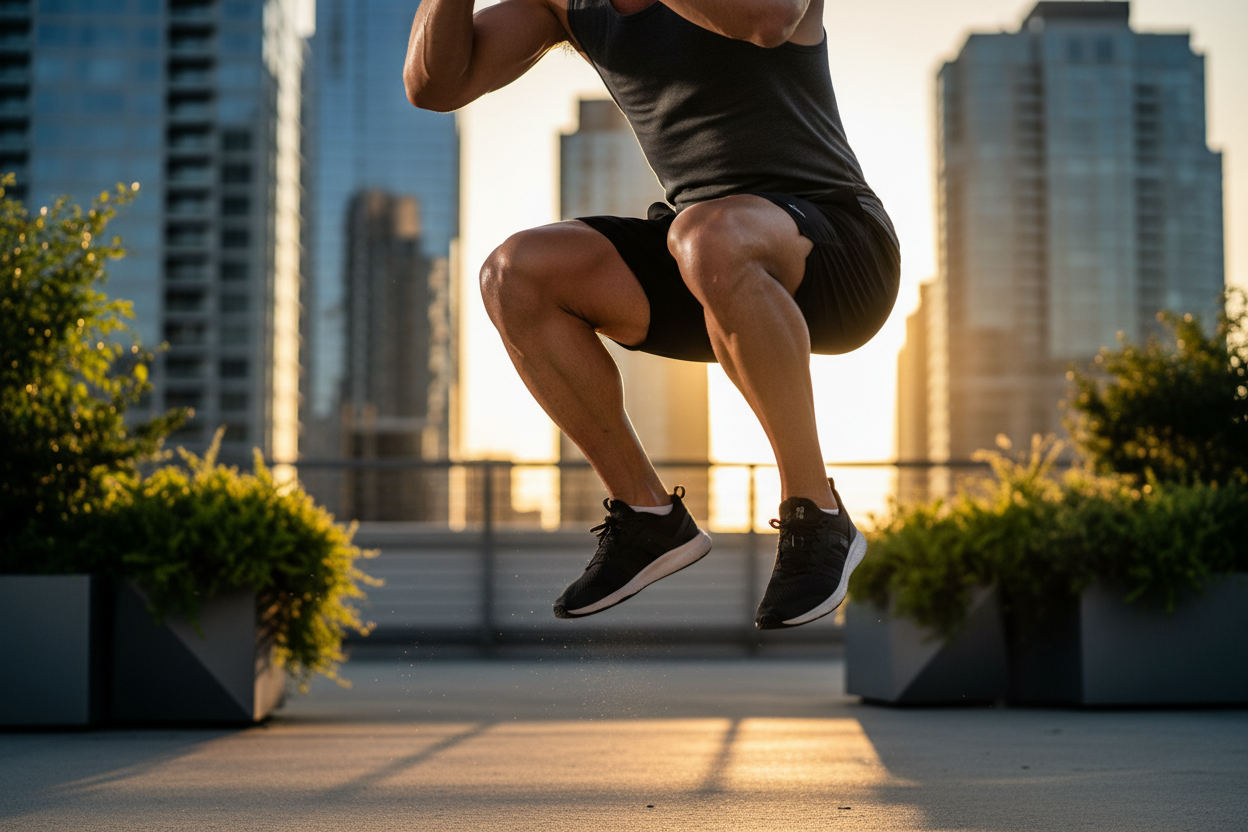
Explosive movements recruit fast-twitch muscle fibers, which have the highest potential for growth. Jumping exercises force your muscles to absorb force (eccentric loading) and release it rapidly. This mimics the intensity of heavy lifting by maximizing force output.
3. Posterior Chain Isolation
The quads get a lot of love in bodyweight training, but the hamstrings and glutes often lag behind because there are no leg curl machines at home. You have to be creative here to ensure you don't end up with knee pain or posture issues from unbalanced development.
Essential Exercises for Mass and Strength
Forget half-hearted lunges. If you want to see changes in the mirror, these are the movements you must master.
The Bulgarian Split Squat
This is arguably the king of leg exercises, weighted or not. Place your rear foot on a couch, chair, or bench. Step your front foot out far enough so that your shin stays relatively vertical as you descend. Lower your hips until your back knee almost touches the floor. Drive back up through the front heel.
This movement places an immense stretch on the glutes and quads. Because balance is required, your stabilizer muscles work overtime. If you can do 15 clean, slow reps per leg without taking a break, your legs will be shaking.
The Pistol Squat
The pistol squat is the ultimate test of mobility and strength. It requires you to squat all the way down on one leg while the other is extended in front of you. Most people cannot do this immediately. Start by sitting down onto a chair with one leg and standing back up. As you get stronger, lower the surface until you are doing it freely.
This exercise is fantastic for the quads. It forces you to handle your entire body weight on a single limb through a full range of motion.
Nordic Hamstring Curl Variations
To hit the hamstrings, you need to flex the knee against resistance. Secure your feet under a heavy piece of furniture or have a partner hold your ankles. Kneel on a soft pad. Keeping your hips extended and back straight, slowly lower your torso toward the floor using only your hamstrings to control the descent. Catch yourself with your hands, push back up, and repeat. This is an eccentric-focused exercise that builds bulletproof hamstrings.
Glute Bridges and Hip Thrusts
Lie on your back with knees bent. Drive your hips toward the ceiling, squeezing your glutes at the top. To make this harder, do it one leg at a time. For even more intensity, elevate your shoulders on a couch (Hip Thrust) to increase the range of motion. This is crucial for posterior power.
Structuring Your Routine
Random exercise selection yields random results. To build leg muscles without weights, you need a structured approach. Perform this routine twice a week with at least two days of rest in between.
- Warm-up: 5 minutes of dynamic stretching (leg swings, bodyweight squats).
- Jump Squats: 4 sets of 8 reps. (Focus on height and soft landing).
- Pistol Squats (or assisted variation): 3 sets of 5-8 reps per leg.
- Bulgarian Split Squats: 3 sets of 10-12 reps per leg. (2 seconds down, 1 second up).
- Single-Leg Hip Thrusts: 3 sets of 15 reps per leg. (Hold the squeeze at the top for 2 seconds).
- Sliding Leg Curls (use a towel on a smooth floor): 3 sets of 12 reps.
- Single-Leg Calf Raises: 4 sets of 20 reps per leg. (Do these on a step to get a full stretch).
How to Apply Progressive Overload Without Iron
Since you cannot add a 10lb plate next week, you must change other variables to keep progressing. If you do the same workout for months, your growth will plateau.
Manipulate Tempo: Instead of a standard tempo, try lowering yourself for 4 seconds. Pause at the bottom for 2 seconds. Explode up. This increases time under tension significantly.
Decrease Rest Times: If you usually rest 90 seconds between sets, cut it to 45 or 60. This increases metabolic stress, a key driver of hypertrophy.
Increase Range of Motion: Elevate your front foot during split squats or lunge deeper. A greater stretch usually equals greater muscle damage and subsequent repair.
Diet and Recovery
Training provides the stimulus, but food provides the building blocks. You cannot build muscle out of thin air. Ensure you are consuming enough protein to support repair—generally around 0.7 to 1 gram per pound of body weight. Sleep is equally critical; growth hormone is released during deep sleep cycles. If you are hammering your legs with high-volume calisthenics but sleeping five hours a night, you won't see the results you want.
Consistency is the final piece of the puzzle. Bodyweight training requires discipline because it is easy to skip a workout when you don't have to drive to a gym. Treat your living room floor with the same respect you would a weight room, and your legs will reflect that dedication.
Frequently Asked Questions
Can you actually build mass with just bodyweight, or will I just get toned?
You can absolutely build mass. Hypertrophy occurs when muscles are fatigued and repaired. By using high-intensity unilateral exercises like pistol squats and split squats, you can generate enough tension to trigger significant muscle growth, not just "toning."
How often should I train legs without weights?
Because bodyweight training generally places less systemic stress on the central nervous system than heavy spinal loading (like 400lb squats), you can often train more frequently. A frequency of 2 to 3 times per week is ideal for most people to maximize protein synthesis.
What if I have bad balance?
Balance is a skill that improves with practice. Start by holding onto a wall or a sturdy chair during single-leg movements. As your stabilizer muscles get stronger, slowly reduce the amount of assistance you use until you can perform the movements freely.