Quit Skipping Leg Day: How to Build Size and Power in Your Living Room
There is a persistent myth in the fitness industry that you cannot build a truly impressive lower body without a squat rack, a leg press machine, and hundreds of pounds of iron. This misconception leads many to neglect their lower half whenever they can't make it to a commercial gym. The reality is that gravity, leverage, and intensity are the only real requirements for growth. You can construct a powerful set of wheels right in your living room if you understand how to manipulate mechanical tension and metabolic stress.
Finding an effective exercise for your legs at home is less about the equipment you possess and more about your willingness to endure discomfort. When you remove heavy external loads, you must replace them with higher volume, stricter tempo, and unilateral (single-leg) movements. By shifting the focus to single-leg stability and explosive power, you can trigger hypertrophy and strength gains that rival any machine-based workout.
The Reality of Home Training: A Personal Perspective
A few years ago, I found myself without gym access for three months due to a relocation. I was terrified of losing the strength I had built on the barbell back squat. With nothing but a pair of adjustable dumbbells and a sturdy chair, I was forced to pivot. I committed to mastering the Bulgarian Split Squat. The first few sessions were humbling; I realized that while my bilateral strength was high, my stability and single-leg endurance were practically non-existent. By the time I returned to the gym, not only had I not lost muscle, but my squat numbers actually went up because I had fixed the imbalances in my hips and glutes. That experience taught me that home training isn't a downgrade—it's just a different, often more painful, stimulus.
Structuring the Best Leg Workout to Do at Home
To get the most out of your floor space, you need a plan that covers the primary movement patterns: the squat (knee dominant), the hinge (hip dominant), and the lunge (unilateral). A haphazard collection of jumping jacks won't cut it. The best leg workout to do at home requires a structured approach that fatigues the muscle fibers completely.
You should aim for a mix of compound movements to hit the large muscle groups and isolation exercises to finish them off. Since you likely don't have a 300lb barbell, you will need to utilize "progressive overload" differently. Instead of just adding weight, you will add reps, decrease rest times, or slow down the eccentric (lowering) phase of the movement to three or four seconds. This increases time-under-tension, a key driver for muscle growth.
1. The King of Home Legs: Bulgarian Split Squats
If you do only one movement, make it this one. Place one foot on a couch or chair behind you and step the other foot forward. Lower your back knee toward the ground while keeping your torso upright (for quads) or slightly leaned forward (for glutes). This movement exposes weaknesses instantly. It removes the ability of your dominant leg to take over and places the entire load on one quadricep and glute. It is grueling, effective, and requires zero equipment to be challenging.
2. The Hamstring Savior: Single-Leg Romanian Deadlifts
The posterior chain often gets neglected outside the gym. The Single-Leg RDL corrects this. Stand on one leg with a slight bend in the knee. Hinge at your hips, sending your back leg straight out behind you like a lever. Keep your back flat. You should feel a deep stretch in the hamstring of the standing leg. This is vital for knee health and athletic performance. If you have balance issues, you can hold onto a wall lightly for support.
Integrating Weight Training for Legs at Home
Bodyweight is fantastic, but eventually, you may want to increase the intensity. Weight training for legs at home doesn't require an Olympic set. A pair of dumbbells, a kettlebell, or even a backpack filled with water bottles or books can serve as sufficient resistance. The key is how you hold the weight.
The "Goblet" hold is particularly effective for home workouts. by holding a weight against your chest, you force your core to engage and help maintain an upright torso. This turns a standard squat into a full-body stability challenge. For the Single-Leg RDL mentioned earlier, holding a weight in the hand opposite to the working leg increases the demand on the glute medius, helping to stabilize the hip.
When adding load, focus on the "squeeze" at the top of the movement. Without maximal weights, the mind-muscle connection becomes paramount. You must actively contract the muscle you are targeting rather than just moving from point A to point B.
Designing an Athlete Leg Workout at Home
If your goal is performance—jumping higher, running faster, or moving more explosively—your routine needs to change. An athlete leg workout at home focuses on plyometrics and rate of force development. You aren't just trying to build size; you are trying to teach your nervous system to fire rapidly.
Plyometric movements should be done at the start of the workout when your legs are fresh. This ensures you maintain proper form and maximum explosiveness. A standard athletic home session might look like this:
- Squat Jumps: Lower into a squat and explode upward, landing softly. Perform 3 sets of 5-8 reps, focusing on height rather than speed.
- Lateral Heiden Jumps (Skater Jumps): Jump sideways from one leg to the other, landing with stability. This builds lateral power crucial for court sports.
- Nordic Hamstring Curls: Anchor your feet under a couch or have a partner hold them. Lower your torso toward the ground as slowly as possible using only your hamstrings. This is arguably the best injury-prevention exercise for athletes.
Sample Routine: Putting It All Together
Here is a comprehensive routine that combines strength, hypertrophy, and stability. Perform this circuit 3 to 4 times, resting 90 seconds between rounds.
- Bodyweight Squats (Warm-up): 20 reps with a slow tempo.
- Bulgarian Split Squats: 12-15 reps per leg. (Hold weight if available).
- Sliding Leg Curls: Lie on your back on a smooth floor with socks on (or use a towel). Bridge your hips up and slide your heels out and back in. 15 reps.
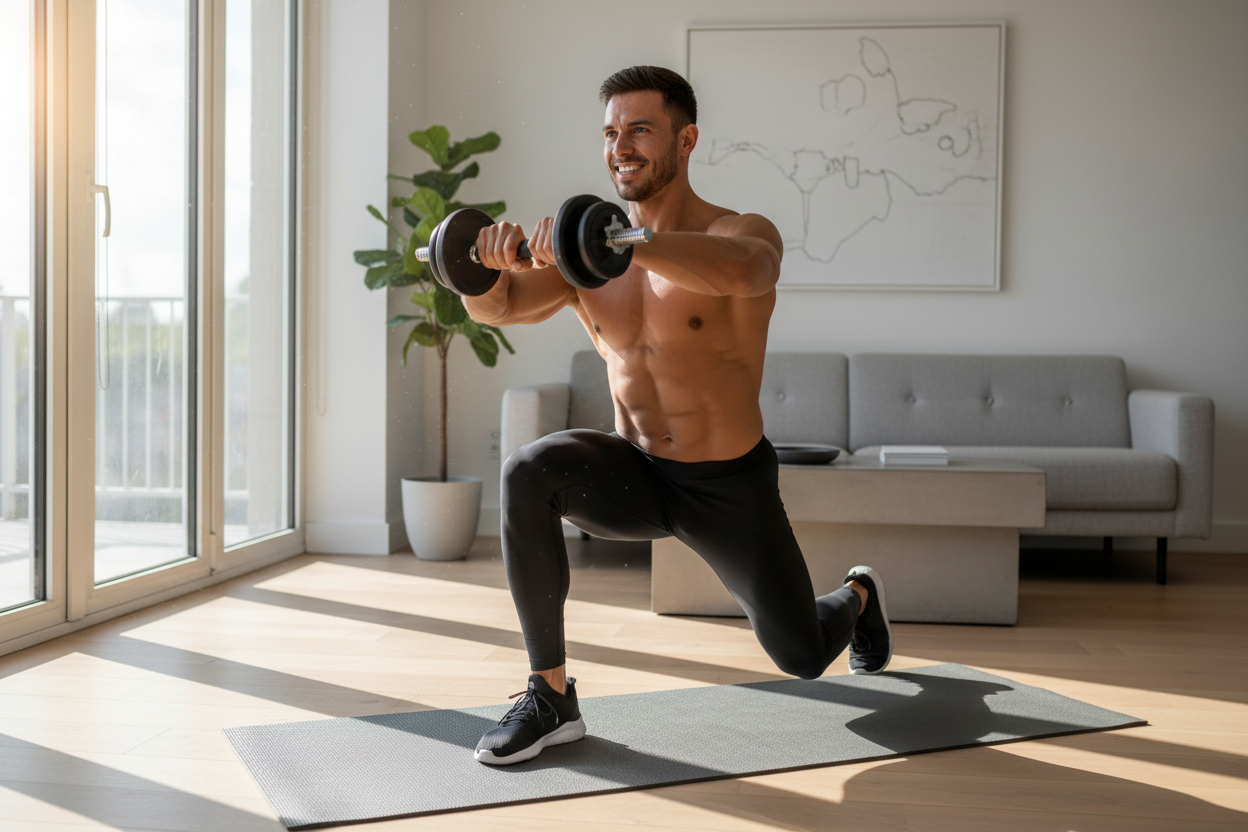
- Walking Lunges: 20 steps total. Keep constant tension; do not lock out the knees at the top.
- Calf Raises on a Step: 20 reps per leg. Pause at the top and bottom.
Leg workouts in home environments offer a unique advantage: you can train barefoot. Training without shoes strengthens the small muscles in the feet and improves ankle stability, which translates to better balance and force transfer when you do put your shoes back on.
Consistency and Recovery
The convenience of home training removes the biggest barrier to entry: travel time. However, it also introduces the temptation to slack off. Treat your living room like a gym the moment you start your timer. Put your phone away, play your music, and focus.
Because leg workouts in home settings often involve higher repetitions to achieve failure, you might experience significant Delayed Onset Muscle Soreness (DOMS). This is normal. Ensure you are consuming enough protein and staying hydrated. Consistency is the magic pill; doing a mediocre workout three times a week is infinitely better than doing the "perfect" workout once a month.
Frequently Asked Questions
Can I actually build mass with just bodyweight leg exercises?
Yes, but you must train close to failure. High-repetition training (20-30 reps) builds muscle just as effectively as heavy low-repetition training, provided you push yourself until you cannot complete another rep with good form. Utilizing unilateral exercises like pistol squats also increases the relative load on the muscle.
How often should I train legs at home?
Since home workouts typically cause less central nervous system fatigue than heavy barbell training, you can train legs more frequently. A frequency of 2 to 3 times per week is ideal for most people, allowing for 48 hours of recovery between sessions to maximize protein synthesis.
What if I have bad knees?
Home training is actually excellent for bad knees because it usually involves less absolute load on the joint. Focus on posterior chain exercises like glute bridges and Romanian deadlifts to support the knee. For squats, limit the range of motion to what is pain-free and focus on slow, controlled tempos rather than explosive movements.