Quick Effective Home Workouts: The Hybrid Complex Strategy
It is 6:00 AM. The kids are asleep, your first Zoom meeting is at 7:30, and you are staring at a pair of dusty dumbbells in the corner of your cramped apartment living room. You only have 20 minutes to train, which usually means skipping the workout altogether because you think it is not enough time to make a difference. As a trainer who has built and tested routines in dozens of minimalist home gyms, I see this exact scenario constantly. The solution is not doing faster bicep curls. The solution is completely rethinking how you structure your movements. If you want quick effective home workouts, you need to master the hybrid movement complex.
Quick Takeaways for Hybrid Training
- Combine 2-3 exercises into a single seamless repetition to cut workout time in half.
- Target multiple muscle groups simultaneously to spike your heart rate to 150+ BPM without a treadmill.
- Ditch the bro-split isolation exercises in favor of full-body functional mechanics.
- Invest in slip-resistant flooring to safely handle dynamic, multi-directional transitions.
- Use an AMRAP or EMOM timer to keep your rest periods strict and your intensity high.
The Power of the Hybrid Movement Complex
A hybrid movement complex takes two or three distinct exercises and fuses them together into one fluid repetition. Instead of doing a set of squats, resting, and then doing a set of overhead presses, you blend them into a single motion. You squat down, and as you drive up, you use that momentum to press the dumbbells overhead. One rep, two major movement patterns, zero wasted time.
I started implementing this strategy with my busiest clients—mostly parents and traveling executives—who physically could not fit a 60-minute session into their day. What we found was astonishing. By linking movements together, we drastically increased the cardiovascular demand. Your heart has to pump blood from your legs up to your shoulders and back down again, which creates an intense metabolic effect. You are essentially getting a heavy resistance training session and a high-intensity cardio workout at the exact same time.
When I test these routines myself, my heart rate routinely hits 160 BPM within the first four minutes. You do not need a massive rack of weights or a bulky elliptical machine. By forcing your body to transition smoothly between different planes of motion under load, you recruit secondary stabilizing muscles that traditional straight sets completely ignore. It is the ultimate time-slashing strategy for anyone who wants serious results without living in the gym.
Why Isolation Routines Fail the Busy Trainee
Traditional gym programming usually revolves around body part splits. Monday is chest and triceps, Tuesday is back and biceps, Wednesday is legs. This works incredibly well if you have 90 minutes to spare five days a week. But for the average person training in their living room, isolation routines are a massive waste of precious time.
If you only have 20 minutes and you spend it doing lateral raises and tricep kickbacks, you are burning very few calories and only stimulating a tiny fraction of your total muscle mass. Furthermore, isolation exercises require a lot of equipment. You need multiple dumbbell increments to properly isolate small muscles. Designing a quick effective workout at home requires the exact opposite approach. You need overlapping muscle activation.
When you perform a hybrid complex, you are treating your body as one cohesive unit rather than a collection of separate parts. A lunge-to-curl-to-press engages your quads, glutes, core, biceps, and shoulders in a span of five seconds. This overlapping activation forces your nervous system into overdrive. You are burning more calories per minute, stimulating a massive hormonal response for muscle growth, and building real-world functional strength. The busy trainee cannot afford to isolate; they must integrate.
Setting Up Your High-Efficiency Workout Space
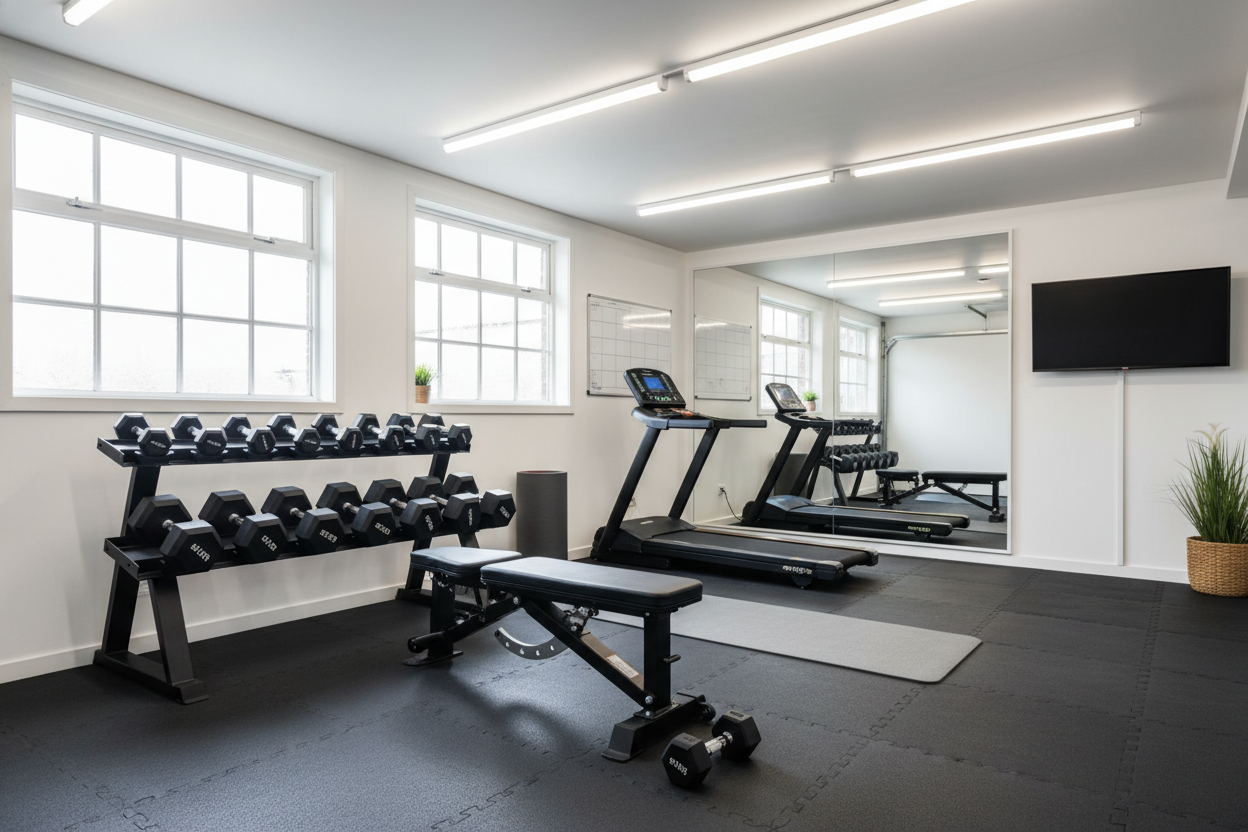
To safely execute hybrid complexes, your physical environment needs to be dialed in. You do not need a two-car garage, but you do need a dedicated, safe footprint. I usually recommend clearing a 6x6 foot area. Because hybrid movements require you to shift your center of gravity rapidly—like dropping from a standing row into a push-up—the surface you train on is critical.
Doing these movements on hardwood floors is a recipe for bruised knees, and doing them on plush living room carpet leads to rolled ankles. You need a stable, high-density surface. I always tell my clients to invest in a large exercise mat for home gym setups. A 7mm thick PVC mat provides the exact right balance of joint cushioning and shoe grip, ensuring you do not slide out during a heavy transition.
Once your flooring is sorted, you need to look at your gear. Hybrid training thrives on minimalism. You do not need kettlebells, barbells, and medicine balls all cluttering your space. A single pair of adjustable dumbbells—ideally a set that ranges from 5 to 52.5 lbs—is the gold standard. This allows you to quickly scale the weight up or down depending on the complex. If you are looking to curate your space, focusing on effective at home gym equipment that serves multiple purposes will save you money and keep your workout area clean and functional.
Three Core Hybrid Movements to Master Today
If you are ready to try this strategy, here are three foundational hybrid complexes I program for almost every client.
1. The Thruster (Squat to Overhead Press)
Hold a pair of dumbbells at your shoulders in a front rack position. Drop into a deep squat, keeping your chest up and core braced. As you explode upward out of the hole, use the momentum generated by your legs to drive the dumbbells straight overhead. Lower the weights back to your shoulders as you descend into the next squat. This torches your quads, glutes, and shoulders while spiking your heart rate instantly.
2. The Renegade Push-Up (Row to Push-Up)
Start in a high plank position gripping your dumbbells. Perform a strict push-up. At the top of the movement, brace your core to prevent your hips from rotating, and row the right dumbbell to your ribcage. Lower it, perform another push-up, and row the left dumbbell. This is a masterclass in anti-rotation core stability. If you want a killer chest and back workout with dumbbells, this single sequence delivers it better than almost anything else.
3. The Reverse Lunge to Bicep Curl
Stand tall with dumbbells at your sides. Step your right foot back into a deep reverse lunge, hovering your back knee just off the floor. As you push off your front heel to return to a standing position, simultaneously perform a bilateral bicep curl. Lower the weights as you step back with your left leg. This complex challenges your balance heavily while providing a great arm pump.
Structuring Your 20-Minute Complex Routine
Knowing the movements is only half the battle; how you program them dictates your results. For a 20-minute window, I prefer using an EMOM (Every Minute On the Minute) format. It forces you to stay disciplined with your rest periods.
Set a timer for 20 minutes. At the start of minute one, perform 10 Thrusters. This should take you about 35 seconds. You then rest for the remaining 25 seconds of that minute. At the start of minute two, perform 8 Renegade Push-Ups per side. Rest the remainder of the minute. At the start of minute three, do 10 Reverse Lunges to Curls. Minute four is a dedicated rest minute. Repeat this 4-minute circuit five times.
To make this work seamlessly, you need your gear laid out perfectly. I have my clients place their dumbbells at the top of their 6x8ft exercise mat so they can transition between standing and floor work without tripping over their weights. The EMOM structure guarantees you will finish exactly at the 20-minute mark, completely exhausted and fully trained.
Common Mistakes When Combining Exercises
While hybrid complexes are incredibly efficient, they come with a few distinct pitfalls. The most common mistake I see is overweighting the weak link. In any complex, you are only as strong as your weakest movement. For example, you might be able to squat 50 lbs, but if you can only overhead press 20 lbs, you must use 20 lbs for your Thrusters. If you try to use 30 lbs, your form on the press will break down, risking shoulder injury.
Another honest downside to this training style is how quickly it degrades your form if you aren't paying attention. Because these movements gas you out fast, it is easy to get sloppy during the transition phases. Do not rush the rep just to get it over with. Pause for a microsecond between the lunge and the curl to ensure your balance is set. Drop your ego, lower the weight by 10%, and focus on the fluidity of the movement.
Maximizing Every Minute of Your Home Fitness
Time constraints are no longer a valid excuse to skip your training. By adopting the hybrid movement complex, you can achieve a massive stimulus in a fraction of the time it takes to drive to a commercial gym. You force your muscles to work together, you challenge your cardiovascular system, and you build functional, real-world strength. Clear a space on your floor, grab a moderate pair of dumbbells, set your timer for 20 minutes, and get to work.
Frequently Asked Questions
Can I build muscle with just 20-minute hybrid workouts?
Absolutely. Muscle growth requires mechanical tension and metabolic stress. Hybrid complexes deliver high levels of both by keeping your muscles under tension for longer durations during each combined rep.
How heavy should my dumbbells be for complexes?
Select a weight based on the weakest movement in the chain. If you are doing a row-to-push-up, use a weight you can comfortably row for 10-12 reps without twisting your spine.
Is it okay to do hybrid complexes every day?
I do not recommend it. Because these movements are so neurologically and physically demanding on the whole body, you need recovery time. Aim for 3-4 days a week, alternating with active recovery or light cardio on your off days.