
Power Rack or Functional Trainer? I Tested Both So You Don't Have To
Walking into a gym or browsing home fitness equipment can feel overwhelming, especially when you're faced with two impressive pieces of kit that seem to do similar things. I remember standing in my garage, measuring tape in hand, trying to decide which piece of equipment deserved that precious floor space. The power rack looked solid and serious, while the functional trainer seemed sleek and versatile. Sound familiar?
Here's the thing: both pieces of equipment are brilliant, but they serve different purposes. Understanding what each one brings to your fitness journey will help you make the right choice for your goals, space, and budget. Let me break it down for you in a way that actually makes sense.
What Makes a Power Rack Special
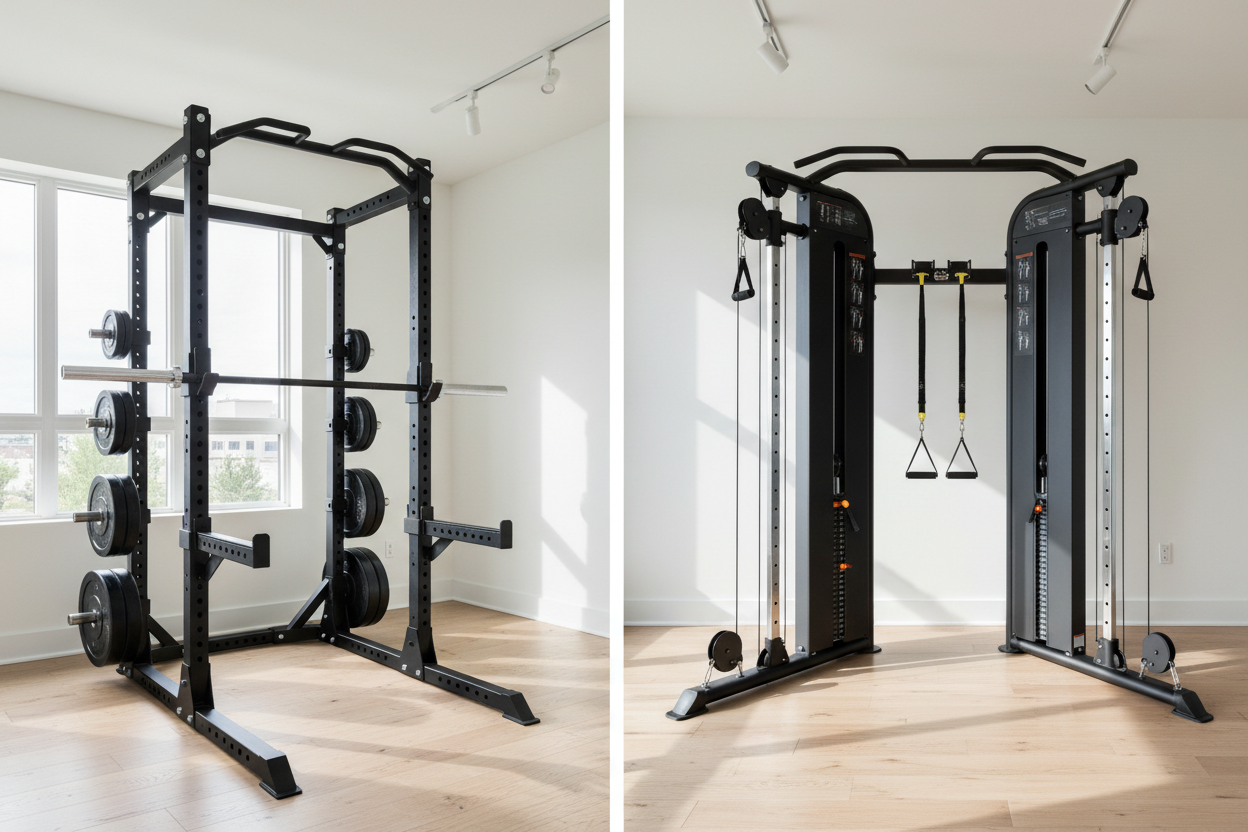
A power rack, sometimes called a squat rack or power cage, is essentially a sturdy metal frame with adjustable safety bars and J-hooks. It's designed primarily for barbell training, and it's been a staple in gyms for decades because it works.
The beauty of a power rack lies in its simplicity and safety. You can load up a barbell with serious weight and know that if you fail a rep during squats, bench press, or overhead press, those safety bars will catch the barbell. This means you can push yourself without needing a spotter, which is gold when you're training at home.
Most quality power racks come with a pull-up bar at the top, and many have attachments for dips, landmine exercises, and resistance band work. The focus here is on compound movements—exercises that work multiple muscle groups at once. We're talking squats, deadlifts, bench press, overhead press, and rows. These are the exercises that build serious strength and muscle mass.
Understanding the Functional Trainer
A functional trainer is a completely different beast. Picture two weight stacks on either side with adjustable pulleys that can move up, down, and sometimes rotate 360 degrees. The cables allow you to pull resistance from virtually any angle, which opens up hundreds of exercise possibilities.
What I love about functional trainers is how they mimic real-life movements. When you're lifting shopping bags, playing with your kids, or moving furniture, you're rarely moving in perfectly straight lines. Functional trainers let you train rotation, diagonal movements, and unilateral exercises that build balanced strength and improve coordination.
These machines shine for isolation work too. Want to target your chest from different angles? You can do cable flyes high, low, or at chest height. Need to work on shoulder stability? Face pulls, wood chops, and rotational exercises are all at your fingertips. The constant tension from the cables also means your muscles are working throughout the entire range of motion.
Power Rack vs Functional Trainer: The Strength Building Battle
When we compare functional trainer vs power rack for pure strength development, the power rack takes the crown. There's simply no substitute for heavy barbell work when you want to build maximum strength. The ability to progressively overload with small weight increments, combined with the stability of a barbell, makes compound lifts unbeatable for getting stronger.
I've seen people transform their physiques with nothing but a power rack, a barbell, and plates. The big compound movements recruit massive amounts of muscle fiber, trigger hormonal responses that support muscle growth, and build functional strength that carries over to everyday life.
That said, functional trainers aren't slouches in the strength department. You can absolutely build muscle and get stronger using cable resistance. The difference is that you're typically limited by the weight stack size (often maxing out around 200-300 pounds per side), whereas with a power rack, you can keep adding plates as you get stronger.
Functional Trainer vs Power Rack: Versatility and Exercise Variety
This is where the functional trainer really shines. The number of exercises you can perform is staggering. From chest presses and rows to bicep curls, tricep extensions, leg work, core exercises, and sport-specific movements—the options are nearly endless.
The adjustable pulleys mean you can target muscles from angles that are impossible with free weights alone. This is particularly valuable for rehabilitation work, addressing muscle imbalances, or adding variety to prevent training plateaus.
Power racks, while more limited in exercise variety, excel at what they do. Yes, you're primarily doing barbell movements, but these movements are incredibly valuable. With the right attachments, you can expand the exercise library to include pull-ups, dips, and even some cable work if you add a pulley system.
Space and Practical Considerations
Let's talk about the elephant in the room: space. A standard power rack typically has a smaller footprint than a functional trainer. You're looking at roughly 4 feet by 4 feet for a basic rack, though you'll need clearance around it for loading plates and moving safely.
Functional trainers are wider because of the dual weight stacks, usually requiring 6 to 8 feet of width. They're also quite deep when you factor in the space needed to actually use the cables. However, they often don't require as much additional equipment—no need for a separate bench, barbell, or weight plates.
Cost is another factor. Power racks can range from a few hundred pounds for a basic model to several thousand for commercial-grade equipment. But remember, you'll also need a barbell, weight plates, and probably a bench, which adds to the total investment. Functional trainers typically start at a higher price point but come as a more complete package.
Who Should Choose What
If your primary goal is building maximum strength and muscle mass, and you enjoy the simplicity of barbell training, a power rack is probably your best bet. It's ideal for powerlifting enthusiasts, those following strength-focused programs, or anyone who wants to master the fundamental compound lifts.
Choose a functional trainer if you value exercise variety, are interested in sport-specific training, need lower-impact options due to joint concerns, or prefer the feel of cable resistance. It's also brilliant for those who want an all-in-one solution without buying separate equipment.
Honestly? If space and budget allowed, having both would be the dream setup. I've trained with both extensively, and they complement each other beautifully. Heavy barbell work on the power rack for strength, then isolation and mobility work on the functional trainer. But since most of us have to choose, think about what excites you most about training and which movements you'll actually do consistently.
Making Your Decision
The power rack vs functional trainer debate doesn't have a universal right answer. Both pieces of equipment can help you build strength, muscle, and fitness—they just take different approaches.
Consider your training style, available space, budget, and long-term goals. If you're still unsure, think about which piece of equipment would make you most excited to train. That enthusiasm matters more than any technical specification because the best equipment is the one you'll actually use.
Whatever you choose, commit to learning proper form, follow a structured program, and stay consistent. That's where the real magic happens, regardless of whether you're pulling cables or lifting barbells.


