No Gym Required: The Only Floor Leg Workout You Need to Sculpt and Tone
You do not need a squat rack, heavy dumbbells, or a gym membership to build strong, defined legs. In fact, relying solely on gravity and your own body weight can sometimes target muscles that heavy lifting misses. A comprehensive leg exercise on mat routines can isolate smaller stabilizing muscles, improve muscular endurance, and torch your lower body without putting excessive stress on your joints. Whether you are recovering from an injury, traveling, or simply prefer training in the privacy of your living room, the floor is often the best piece of equipment you own.
I remember a specific period a few years back when I was traveling extensively for work. I spent weeks in hotels that either had no gym or just a broken treadmill. I was terrified of losing the leg definition I had worked so hard for. Out of necessity, I started experimenting with high-repetition floor mat leg exercises. I expected it to be a "light" maintenance phase. I was wrong. The burn I felt from slowing down the movements and focusing on time-under-tension was different—and in some ways more intense—than my heavy squat days. By the time I got back to the gym, my hip mobility had improved, and my glute activation was better than ever.
Why Mat Leg Workouts Are Effective
Many people underestimate the power of a mat workout for legs because they associate effectiveness with heavy iron. However, floor exercises force you to stabilize your core and hips in ways that machines often do not. When you perform a leg workout on mat, you are usually working against gravity in a way that creates constant tension. This is particularly effective for the glutes and the outer hips (abductors), areas that are notoriously lazy during standard standing exercises.
Furthermore, mat leg workouts are incredibly versatile. By adjusting the angle of your leg, pointing or flexing your toe, or simply slowing down the tempo, you can drastically change which muscle fibers are firing. This allows for a level of precision that helps correct muscle imbalances, which is essential for long-term joint health.
The Essential Glute Mat Exercises
The posterior chain is the powerhouse of your lower body. Developing a strong backside isn't just about aesthetics; it is vital for lower back health and athletic performance. Here are the most effective moves for a glute workout on mat.
1. The Quadruped Hip Extension (Donkey Kick)
This is a staple for a reason. It isolates the gluteus maximus without engaging the hamstrings too much if done correctly. Start on all fours with your hands directly under your shoulders and knees under your hips. Keep your knee bent at 90 degrees and lift your foot toward the ceiling. The key here is to squeeze at the top without arching your lower back. If your back sags, you are using your spine, not your glutes.
2. Fire Hydrants
These mat glute exercises target the gluteus medius, the muscle on the side of your hip responsible for stability. From the same all-fours position, lift your bent knee out to the side. Imagine a dog at a fire hydrant. Control the descent; don't just let gravity pull your leg down. Doing this slowly will set your outer hips on fire.
3. Single-Leg Glute Bridges
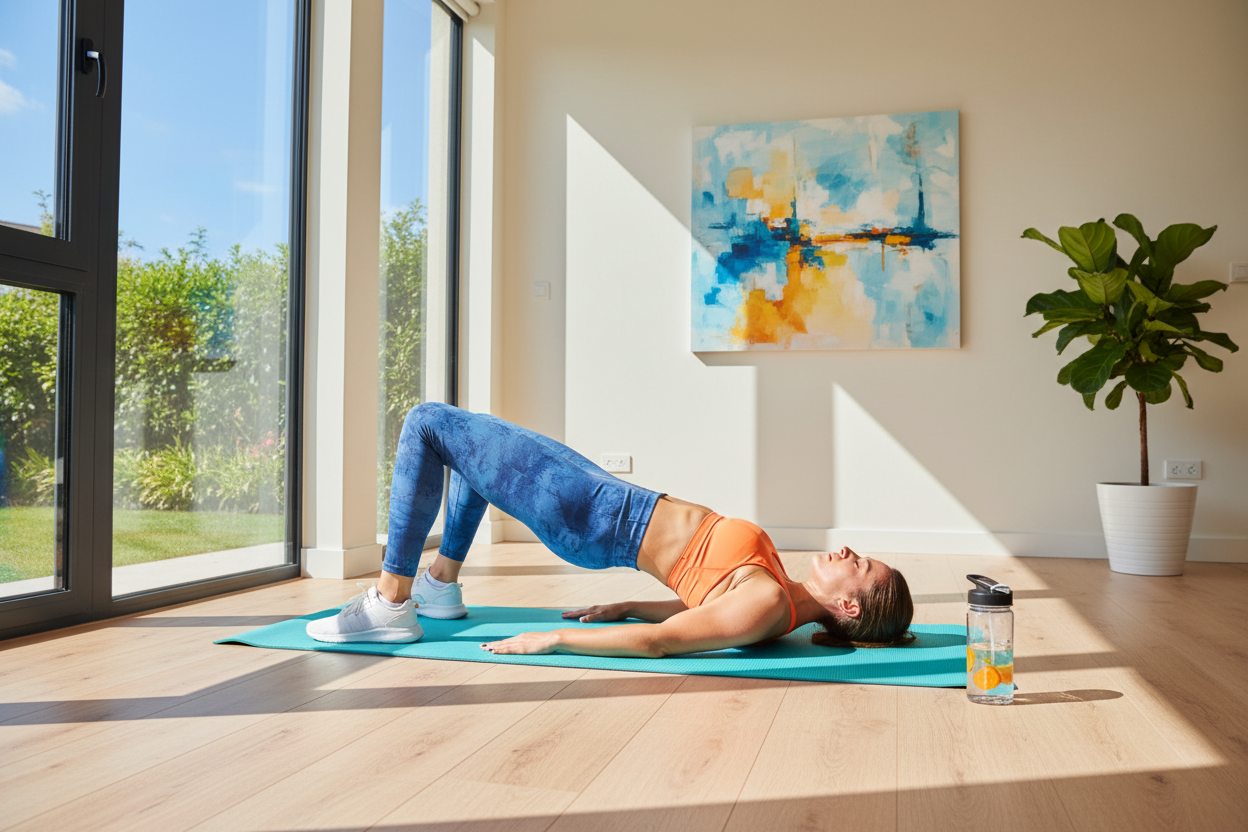
While standard bridges are great, the single-leg variation is the king of mat exercises for glutes. Lie on your back, knees bent, feet flat. Extend one leg straight out. Drive through the heel of the planted foot to lift your hips. This forces one side to do all the work, quickly exposing and correcting any strength asymmetries between your left and right side.
Sculpting the Thighs: Mat Leg Exercises
Once your glutes are activated, shift your focus to the thighs. A well-rounded legs workout on mat needs to address the quadriceps, hamstrings, and the often-neglected inner thighs (adductors).
1. Side-Lying Leg Raises
Lie on your side, legs stacked. Support your head with your hand. Lift the top leg straight up toward the ceiling. It looks simple, but this is one of the most effective mat leg exercises for the outer thigh and hip. To make it harder, do not let your feet touch between reps. Keep the working leg hovering an inch above the resting leg to maintain constant tension.
2. Inner Thigh Lifts
Stay on your side. Cross your top leg over the bottom leg, placing that foot flat on the floor in front of your bottom knee. Now, extend the bottom leg straight and lift it off the floor. This targets the adductors specifically. Most gym machines for adductors are awkward and uncomfortable; this floor variation feels more natural and is highly effective for toning the inner thigh.
3. Prone Hamstring Curls
Lie on your stomach with your hands folded under your forehead. Bend one knee to bring your heel toward your glutes, then lower it back down with control. To make this a viable leg exercise on mat without weights, you must create your own resistance. Squeeze your hamstring as hard as you can on the way up, and imagine you are pushing against a heavy weight on the way down.
Structuring Your Mat Leg Workouts
To get the best results, you shouldn't just perform these movements randomly. Structure them into a circuit. This keeps your heart rate up and ensures muscle fatigue. A solid mat leg workout routine might look like this:
- Warm-up: 5 minutes of light movement or dynamic stretching.
- Circuit 1 (Right Side): Perform Donkey Kicks, Fire Hydrants, and Side Leg Raises continuously on the right leg without resting. Do 15 to 20 reps per move.
- Circuit 2 (Left Side): Repeat the sequence on the left leg.
- Circuit 3 (Supine/Prone): Perform Glute Bridges, Inner Thigh Lifts, and Prone Hamstring Curls.
Repeat the entire cycle three times. Because you aren't using heavy weights, the volume (number of reps) needs to be higher to stimulate change. Aim for that "burning" sensation—that is the metabolic stress required for muscle toning.
Common Mistakes to Avoid
Even though floor mat leg exercises seem safer than heavy lifting, form still matters. The most common error is rushing. Momentum is the enemy of progress in mat Pilates or floor aerobics. If you swing your leg up, you are using physics, not muscle. Slow down. Count to two on the way up and two on the way down.
Another issue is core disengagement. Just because you are doing a mat workout for legs doesn't mean your abs get a vacation. Keep your belly button pulled toward your spine to protect your lower back, especially during quadruped (all-fours) movements.
Progression: When Bodyweight Isn't Enough
Eventually, you might find that 20 reps feel too easy. That is a good problem to have—it means you are getting stronger. You don't necessarily need to join a gym at this point. You can intensify your mat leg workouts by adding resistance bands or ankle weights. A simple loop band placed above the knees during bridges or clamshells can increase the difficulty exponentially.
Consistency is the final piece of the puzzle. You can do this routine anywhere, so excuses are hard to come by. Whether you are in a hotel room, watching TV, or letting a face mask set, there is always time for a quick session. By prioritizing proper form and high engagement, a simple mat routine can deliver results that rival any complex machine circuit.
Frequently Asked Questions
Can I really build muscle with just mat exercises?
Yes, but up to a point. Mat exercises are excellent for building muscular endurance, tone, and initial strength, especially if you are a beginner or recovering from injury. To continue building significant muscle mass over time, you will eventually need to add resistance, such as ankle weights or resistance bands, to maintain progressive overload.
How often should I do this leg routine?
Since bodyweight exercises place less stress on the central nervous system than heavy lifting, you can perform them more frequently. Aim for 3 to 4 times per week, allowing at least one rest day in between sessions to let the muscles recover and repair.
Is this workout safe for people with bad knees?
Generally, yes. Mat exercises are low-impact and non-weight-bearing, meaning they put significantly less stress on the knee joint compared to squats or lunges. However, always listen to your body; if a specific movement causes sharp pain, stop immediately and consult a physical therapist.