My Brutal Search for the Best Full Body Workout Machine for Home
I remember staring at my credit card statement after another month of 'convenience fees' at the local big-box gym and deciding enough was enough. I went online and bought the first multi-gym that looked decent in the photos. Two weeks later, I was staring at a pile of 14-gauge steel that wobbled if I breathed on it too hard. Finding the best full body workout machine for home isn't about finding the one with the most attachments; it's about finding the one that won't snap a cable while you're mid-set.
Quick Takeaways
- Avoid anything made with thin, 14-gauge steel; it lacks the stability for heavy lifting.
- Prioritize aluminum pulleys over plastic to ensure a smooth, friction-free movement.
- Ensure the machine has at least a 200-lb weight stack if you plan on progressing.
- Measure your 'working space,' not just the machine's footprint, to avoid hitting walls.
The Infomercial Lie We All Want to Believe
We've all seen the late-night ads. A smiling model performs twenty different exercises on a machine that looks like it's made of coat hangers and rubber bands. The industry loves selling the dream of a 'total body transformation' in a single 4x4-foot corner. The reality? Most of these machines fail the basic laws of biomechanics. They force your joints into awkward angles and use resistance curves that drop off exactly when you need them to be heaviest.
If a machine claims to do 100 exercises, it probably does 95 of them poorly. I've tested units where the 'chest press' felt more like a tricep extension because the handles were positioned for a toddler. When you're looking for the best all-around workout machine, you have to look past the stickers and evaluate the frame. If it weighs less than you do, it's not going to hold up to a real workout.
What Actually Makes the Best All-Around Workout Machine?
A legitimate home gym needs to mimic the feel of commercial equipment. This comes down to three things: the frame, the cables, and the weight stack. I look for 11-gauge steel—that's the thick stuff you find in college weight rooms. It doesn't flex, and it doesn't tip when you're pulling from the high pulley.
Resistance ratios are also huge. A 2:1 ratio means 100 lbs on the stack feels like 50 lbs in your hand. This is great for accessory work, but if you're a heavy hitter, you might find yourself maxing out the stack on day one. Always check the 'effective resistance' before you drop two grand.
It Must Handle Heavy Leg Days Without Tipping
This is where the best all body exercise machine candidates usually fall apart. Most home units are top-heavy. When you try to do a standing leg curl or a heavy cable squat, the whole rig wants to pull toward you. I once tested a budget tower that actually lifted off the ground during a set of rows. That's a one-way ticket to the emergency room.
Look for a machine with a wide, stabilized base or one that can be bolted to the floor. If you're serious about legs, you need a dedicated leg press attachment or a Smith bar that can handle at least 300 lbs without the bearings grinding.
Smooth Pulls for the Ultimate Upper Body Pump
If the cables feel 'crunchy,' you're going to hate using the machine. Cheap nylon pulleys create friction, which ruins your mind-muscle connection. You want sealed ball bearings and aluminum pulleys. This smoothness allows you to focus on the best upper body workout at home by utilizing slow eccentrics and explosive concentric movements without the cable jerking.
I’ve found that high-quality guide rods—the vertical poles the weights slide on—make a massive difference. If they aren't polished steel, the weights will chatter. A little bit of silicone spray helps, but it won't fix a poorly machined rod.
The 3 Legitimate Contenders for Your Floor Space
After years of assembly and disassembly, I've narrowed the best home full body workout equipment down to three categories that actually work: Functional Trainers, Smith Machine Combos, and Leverage Gyms. Each has a specific 'vibe' depending on how you like to train.
The Functional Trainer: The Versatility King
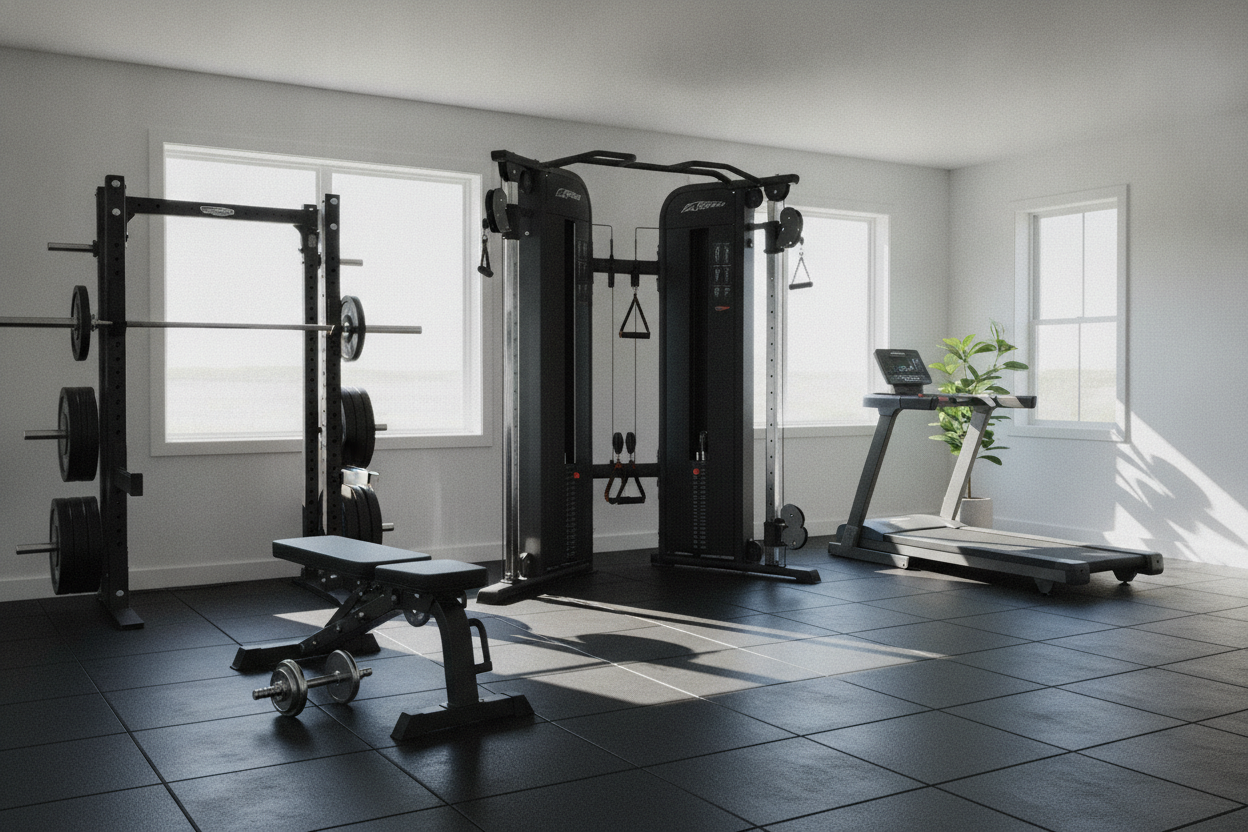
If I could only have one piece of equipment, it would be a dual-stack functional trainer. It’s the closest you’ll get to the freedom of dumbbells with the safety of a machine. You can do everything from cable crossovers to face pulls. The key is the adjustable pulleys; they should slide up and down the uprights effortlessly. This is the gold standard for anyone who prioritizes range of motion and 'functional' strength over raw powerlifting totals.
The Smith/Rack Combo: The Heavy Lifter's Choice
For the person who wants to move heavy iron but trains alone, the Smith/Rack combo is the winner. It combines a plate-loaded Smith machine with a standard power rack. You get the safety of a fixed bar path for those 'to failure' sets, but you still have the J-cups to do free-weight squats. It’s bulky, but it’s the only way to truly train for maximal strength in a spare bedroom without a spotter.
Measuring Twice Before You Buy
The biggest mistake I see people make is forgetting about the 'working envelope.' A machine might be 5 feet wide, but if you're doing lateral raises, you need at least 9 feet of clearance. I once set up a beautiful functional trainer in my garage only to realize I couldn't do a full-range lat pulldown because the ceiling was two inches too low. I had to sit on the floor like a kid to get my sets in.
Check your ceiling height, especially if the machine has a pull-up bar. You need at least 12 inches of clearance above the bar so you don't scalp yourself on the rafters. Understanding how to actually pick the best home workout machine for your space means mapping out your movements with a tape measure before you hit 'buy.'
My Final Verdict on the Ultimate Do-It-All Setup
I’ve wasted thousands on 'as-seen-on-TV' junk that ended up as a place to hang my gym towels. If you want a machine that actually changes your physique, don't go cheap. If you have the space, a Smith/Rack combo is the most robust option. If you’re tight on room but want variety, the functional trainer is the smartest play.
My personal fail? I once bought a machine with 'power rods' because it looked futuristic. Within six months, the rods lost their tension, and my '100-lb' bench press felt like I was pushing air. Stick to actual weight stacks or iron plates. Your muscles don't care about fancy marketing; they care about tension and load.
FAQ
Can I build real muscle with just one machine?
Absolutely. As long as the machine provides enough resistance to keep you in the 6-12 rep range for hypertrophy, your body doesn't know the difference between a cable and a barbell.
Are home machines harder to assemble than they look?
Yes. Budget at least 4-6 hours, and have a real socket wrench set ready. The 'tools' they include in the box are usually garbage and will strip your bolts.
Do I need to bolt my machine to the floor?
If it’s a lightweight power tower or a narrow cable machine, yes. If it’s a 400-lb functional trainer with a wide base, you’re usually fine, but always check the manufacturer’s safety specs.