Muscle Up: How to Do Your First Muscle Up (Progression Guide)
Quick answer: A muscle up combines an explosive pull up and a dip into one movement: you pull yourself high enough to bring your chest over a straight bar (or rings), lean forward through the transition, then press out to straight arms above the bar. Most people need 8–12 strict pull ups and 10–15 dips, plus chest-to-bar high pull ups, before their first muscle up. Train the parts separately: explosive pull ups, straight bar dips and transition drills with a resistance band.
Key takeaways
- Pull high, not just hard: aim to pull the bar to your lower chest or waist.
- Pull back and around the bar, not straight up into it.
- The transition is the hard part; practice it on its own.
- Strength first: 8–12 pull ups and 10–15 dips is a good benchmark.
- Space matters: you need room above the bar.
Bar muscle up vs ring muscle up
| Bar muscle up | Ring muscle up | |
|---|---|---|
| Grip | Overhand, regular grip | Usually a false grip |
| Path | Body moves around a fixed bar; more swing | Rings move with you; more vertical |
| Hardest part | Getting the chest over the bar | Strength through the deep dip transition |
| Often learned first? | Yes, with a kip | Often learned strict |
How many pull ups before a muscle up?
| Benchmark | Target |
|---|---|
| Strict pull ups | 8–12 |
| Chest-to-bar pull ups | 3–5 |
| Bar or parallel bar dips | 10–15 |
| Straight bar dips | 5+ |
These are guidelines, not rules. Explosive pulling power and technique matter as much as basic strength.
Muscle up progression
| Step | Exercise | Why |
|---|---|---|
| 1 | Strict pull ups and dips | Basic strength |
| 2 | High pull ups (bar to lower chest) | Pulling height |
| 3 | Explosive pull ups with the hips driving back | Power and the right bar path |
| 4 | Straight bar dips | Pressing out above the bar |
| 5 | Low-bar or band-assisted transitions | Learn the lean over the bar |
| 6 | Negative muscle ups (from the top, lower slowly) | Control through the transition |
| 7 | Kipping bar muscle up | Your first muscle up |
| 8 | Strict and slow bar muscle ups | Advanced strength |
Pull-up basics: chin-up vs pull-up. Dip technique: how to do dips.
How to do a bar muscle up
- Grip the bar overhand, slightly wider than shoulder width, thumbs around the bar.
- Swing: a small hollow-to-arch swing builds momentum.
- Pull explosively from the arch, driving your hips toward the bar and pulling the bar toward your waist, not your chin.
- Transition: as the bar reaches your chest, snap your elbows over it, rotate your wrists and lean your chest forward over the bar.
- Press out: finish with a straight bar dip to locked arms.
- Lower with control back to a hang.
Common mistakes
| Mistake | Fix |
|---|---|
| Pulling only to the chin | Train high pull ups to the lower chest |
| Pulling straight up into the bar | Pull back and around; hips toward the bar |
| Chicken wing (one arm over at a time) | Build straight bar dip strength; keep elbows even |
| Too much uncontrolled swing | Use a small, tight swing |
| Poor form from too many attempts when tired | Short, fresh practice sessions |
Sample muscle up training plan
| Day | Exercises |
|---|---|
| A | Explosive pull ups 5 × 3; straight bar dips 4 × 5; hollow body hold 3 × 30 sec |
| B | Band-assisted transitions 5 × 3; negative muscle ups 3 × 2; dips 3 × 8 |
| C | Weighted or strict pull ups 4 × 5; chest-to-bar pull ups 4 × 3; toes to bar 3 × 5 |
Rest at least a day between sessions. Muscle ups are hard on the elbows, wrists and shoulders, so build volume slowly. Core guides: hollow body hold and toes to bar.
Training for muscle ups at home
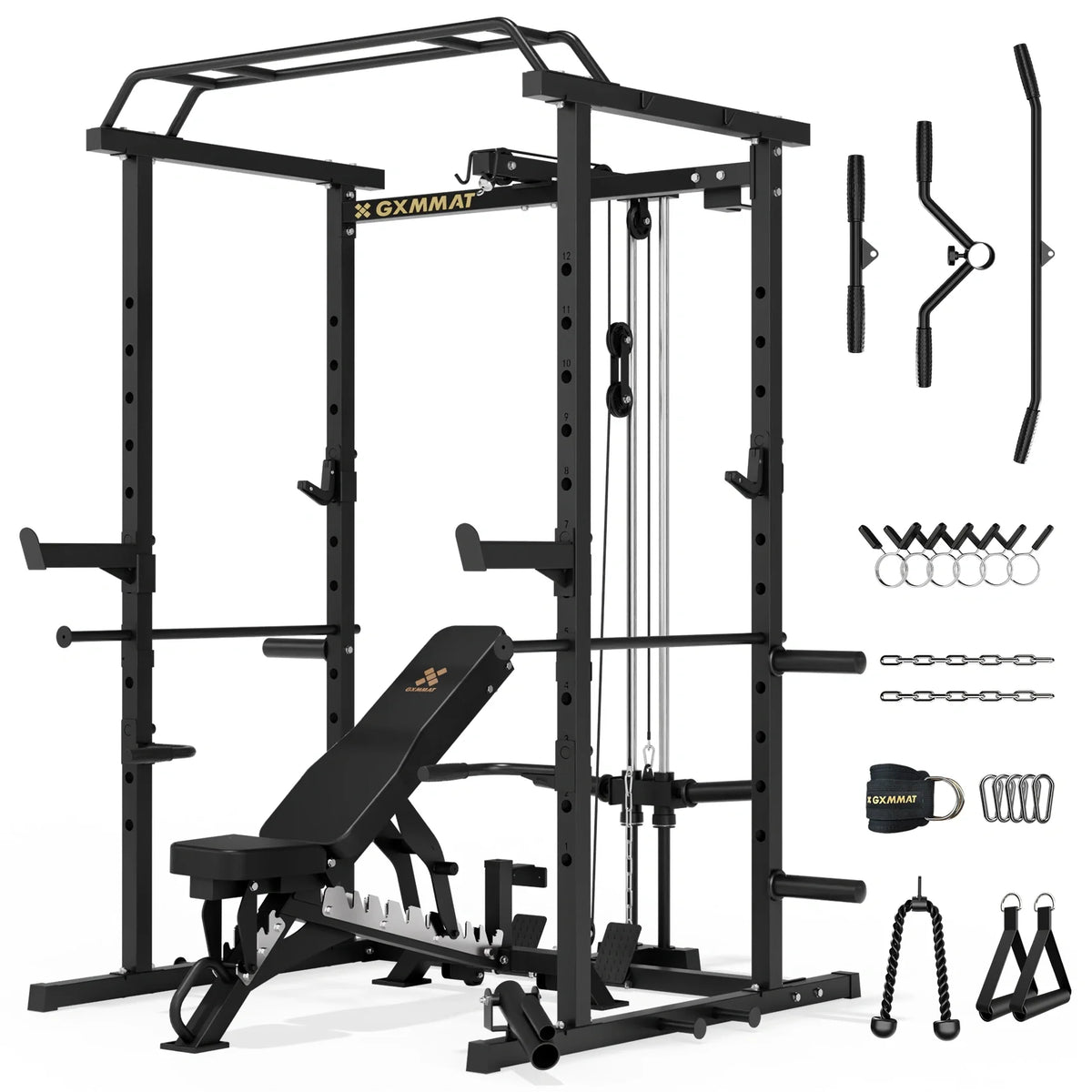
- Strength work: the pull-up bar and dip bars on the G5, V6 and X6 power racks cover pull ups, chest-to-bar work, dips and band-assisted drills. Weight them with a kettlebell on a dip belt as you get stronger.
- The full muscle up: most home power racks don't have enough height or clearance above the pull-up bar for a safe full muscle up, and a kipping swing can rock the rack. Practice the full movement on a tall outdoor bar, gym rig or rings, and use the rack for the building blocks.
- Floor: a large exercise mat under the bar for dismounts.
- More options: calisthenics equipment for home.
FAQ
How many pull ups do I need for a muscle up?
Most people need 8–12 strict pull ups and a few chest-to-bar pull ups, plus solid dips.
How long does it take to learn a muscle up?
From 10 pull ups, many people get a kipping bar muscle up in a few weeks to a few months of focused practice.
Is a bar or ring muscle up easier?
Most people find the kipping bar muscle up easier to learn first; ring muscle ups need a false grip and more pressing strength.
What muscles does the muscle up work?
The lats, upper back, biceps, chest, triceps, shoulders and core.
Can I do muscle ups on a power rack?
Usually not safely. Most racks are too short, with a crossbar too close above. Use the rack for pull ups, dips and transition drills, and a taller bar or rings for full reps.
Written by Yuvien Royer for GXMMAT. This article is general fitness information, not medical advice.