Mobilization of Shoulder Joint: The Definitive Guide for 2025
If you have ever tried to force a stiff shoulder into an overhead position through stretching alone, you know the frustration. You pull, you crank, but the joint feels like it hits a brick wall. That isn't a muscle length issue; it is a joint capsule issue. To fix it, you need to stop stretching and start mobilizing.
Mobilization of shoulder joint is the missing link between a frozen, painful range of motion (ROM) and fluid mechanics. Whether you are a clinician treating adhesive capsulitis or an athlete trying to unlock overhead stability, understanding the convex-concave rule and specific directional glides is non-negotiable. Let's break down the mechanics, the techniques, and the tactile reality of getting the glenohumeral joint moving again.
Key Takeaways: The Cheat Sheet
If you are looking for a quick reference on which glide fixes which restriction, use this rule of thumb based on the convex-concave rule:
- Inferior (Caudal) Glide: Best for improving shoulder abduction.
- Posterior Glide: Essential for improving flexion and internal rotation.
- Anterior Glide: Used to increase external rotation and extension.
- Distraction: A general technique to relieve pain and separate joint surfaces before gliding.
The Mechanics: Why Standard Stretching Fails
The glenohumeral (GH) joint is a ball-and-socket mechanism. The humeral head (the ball) is convex, and the glenoid fossa (the socket) is concave. According to arthrokinematics, when a convex surface moves on a concave surface, the roll and glide occur in opposite directions.
This is why simple overhead stretching often fails. When you raise your arm (abduction), the humeral head rolls up. If it doesn't simultaneously glide down (inferior glide), it jams into the acromion process, causing impingement. Shoulder mobilization techniques are designed to manually restore that glide.
Mastering the Inferior Glide (Caudal Glide)
The inferior glide of shoulder is arguably the most common technique used in clinics because restriction in abduction is so prevalent.
Technique Execution
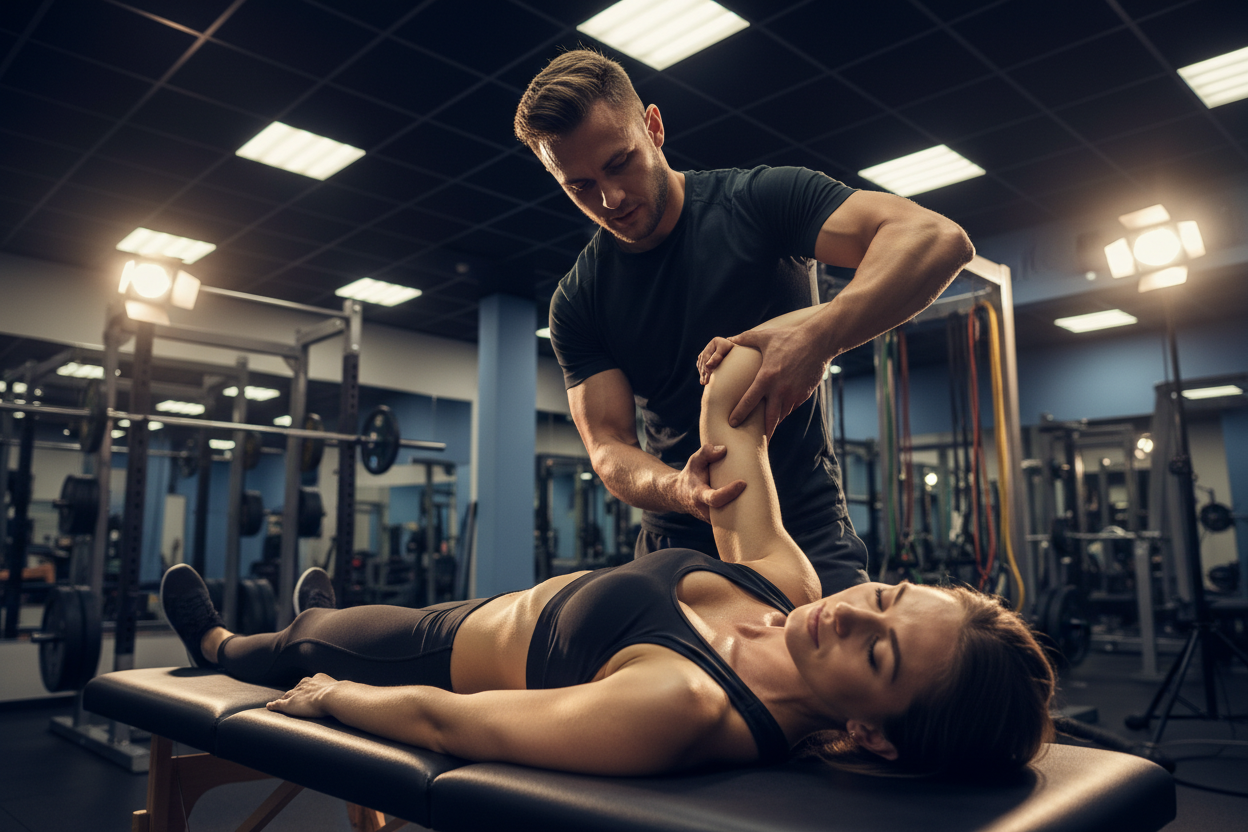
To perform a caudal glide of shoulder, the patient usually lies supine. You stabilize the scapula in the axilla (armpit) and grip the humerus distally. The force is applied directly downward, parallel to the long axis of the glenoid fossa.
Why it works: This shoulder caudal glide creates space in the subacromial region. If you are trying to restore overhead reach, you must clear the path for the greater tuberosity to pass under the acromion.
Posterior Glide for Flexion and Internal Rotation
If reaching behind the back or tucking a shirt in is painful, the posterior capsule is likely tight. A posterior glide of shoulder is the gold standard here.
Many clinicians default to stretching the posterior capsule (like the cross-body stretch), but a glenohumeral posterior glide is often more effective and less irritating to the rotator cuff. By pushing the humeral head posteriorly while the scapula is stabilized, you stretch the posterior capsule without compressing the subacromial tissues.
Anterior Glide: The External Rotation Unlock
Restoring external rotation is critical for athletes, especially throwers and weightlifters. The anterior glide of shoulder targets the anterior capsule.
A word of caution: Be extremely careful with glenohumeral anterior glide techniques. The anterior shoulder is inherently unstable in many people. If a patient has a history of dislocation, aggressive anterior glides are generally contraindicated. Always assess stability before applying force here.
Mobilization With Movement (MWM)
Static mobilization is great, but mobilisation with movement shoulder techniques (popularized by Brian Mulligan) bridge the gap between passive treatment and active function.
In this approach, the therapist applies a sustained shoulder glide (usually posterior or inferior) while the patient actively moves the arm into the restricted range. This "reprograms" the movement pattern, often resulting in immediate pain-free ROM. It is particularly effective for painful arcs.
My Training Log: Real Talk
I want to share something about shoulder mobs that textbooks usually leave out: the physical toll and the "feel" of the end range.
I remember treating a powerlifter with a frozen shoulder (adhesive capsulitis). I was attempting a Grade IV inferior glide of shoulder improve his abduction. In the diagrams, it looks like a smooth push. In reality? It felt like wrestling a leather belt. There was this gritty, unyielding resistance that didn't feel stretchy like a muscle—it felt abrupt, like hitting a doorstop.
My hands were cramping specifically in the web space between my thumb and index finger because maintaining that distraction force while trying to glide a sweaty, muscular arm requires immense grip endurance. I had to switch to using a mobilization belt just to save my own joints. The biggest lesson? If you don't feel that "clunk" or subtle give of the capsule, you aren't actually mobilizing the joint; you're just moving skin. You have to get deep past the deltoid bulk to actually influence the capsule.
Conclusion
Effective rehab isn't just about pulling on limbs; it's about respecting joint geometry. Whether you are utilizing a reverse distraction technique shoulder maneuver or a standard glenohumeral mobilization, the goal is always to restore the natural slide and glide of the humeral head. Start with the glides, restore the joint play, and then load the tissue.
Frequently Asked Questions
What is the difference between Grade III and Grade IV mobilization?
Grade III involves large amplitude rhythmic oscillating movements performed up to the limit of the available range to stretch the capsule. Grade IV involves small amplitude rhythmic oscillating movements performed at the very end of the range. Grade IV is more aggressive and typically used to break adhesions.
Can I do shoulder mobilization techniques on myself?
Yes, using bands. You can anchor a heavy resistance band to a rig and loop it around the head of your humerus to create a shoulder distraction mobilization or lateral glide while you move through a range of motion. This mimics the therapist's hands.
Is mobilization safe for a torn rotator cuff?
It depends on the severity and timing. In acute phases, aggressive mobilization is avoided to protect the repair. However, gentle Grade I or II shoulder joint glides are often used early on to modulate pain and prevent the joint from freezing up without stressing the tendon repair.