Men Strength Over 50: 5 Classic Movement Blueprints, Joint-Conscious Loading, and Home Floor Staging
The Strategic Architecture of Men Strength Training Over 50
Advancing past the age of fifty does not require abandoning heavy resistance training, but it does demand a sharper focus on biomechanical efficiency and joint preservation. Sustainable men strength development shifts the emphasis away from maximum single-repetition limits toward controlled multi-joint compound movement vectors that build muscular balance, reinforce connective tissues, and support postural stability.
A well-designed routine prioritizes movement quality over sheer loading volume. By standardizing movement tempos, utilizing joint-friendly grip angles, and anchoring every lift on a stable, non-slip footing surface, lifters can develop formidable functional capacity while mitigating unnecessary wear across vulnerable hinges like the shoulders, lumbar spine, and knees.
5 Classic Movement Blueprints for Sustainable Male Strength
Foundational male strength relies on five timeless movement archetypes: squatting, hinging, horizontal pushing, horizontal pulling, and loaded carrying. Executing these patterns with precise setup mechanics ensures comprehensive muscular recruitment without joint irritation.
Movement 1: The Box Squat for Controlled Lower-Body Power
The box squat provides a repeatable reference point for depth while eliminating the aggressive stretch-reflex bounce at the bottom of the movement. By sitting back into the hips and pausing briefly on a sturdy bench or plyometric box, the lifter reduces anterior shear stress on the patellar tendons and directs mechanical tension into the glutes, hamstrings, and quadriceps.
Maintain an active core brace throughout the movement, and plant the entire foot flat against dense matting to preserve stable arch support. For lifters working around acute joint sensitivities, pairing bodyweight and free-weight squat patterns with dedicated lower body strength machines offers an accessible way to build lower-body capacity under guided paths of motion.
Movement 2: The Trap Bar or Dumbbell Hinge for Posterior Chain Durability
The hip hinge is indispensable for reinforcing the posterior chain, including the erector spinae, gluteal complex, and hamstrings. Using a neutral-grip trap bar or a pair of heavy dumbbells places the center of mass closer to the body compared to a traditional straight barbell, significantly reducing the moment arm on the lower back.
Initiate the hinge by pushing the hips toward the rear wall while maintaining a soft knee bend and a rigid, neutral spine. Keep the shoulder blades engaged down and back to protect the mid-back, and drive through the heels to return to a tall standing posture without hyperextending at the lumbar spine.
Movement 3: The Floor Press and Incline Dumbbell Push for Shoulder Health
Traditional flat barbell bench pressing can place the anterior shoulder capsule in an overextended, vulnerable position under heavy loads. The dumbbell floor press and low-incline dumbbell press provide natural alternative pressing angles that allow the shoulder blades to move dynamically while keeping the elbows at a joint-friendly tuck.
The floor press naturally establishes a safe range-of-motion floor stop, preventing the upper arms from traveling behind the torso. Lifters looking to expand their upper-body pushing repertoire can review detailed programming insights in our guides on effective chest workouts for men as well as targeted dumbbell chest training strategies.
Movement 4: The Chest-Supported Row for Upper Back and Postural Control
A balanced upper body requires substantial pulling volume to counteract the forward-rounded posture common in daily life. The chest-supported row eliminates momentum and removes compressive spinal loading, isolating the rhomboids, latissimus dorsi, and posterior deltoids.
Set an adjustable bench to an incline, rest the torso firmly against the pad, and use a neutral or semi-pronated grip. Pull the dumbbells back toward the hip pockets, initiating each rep by retracting the shoulder blades rather than yanking with the biceps. For broader programming principles regarding structural pulling and pressing balance, consult our balanced upper-body programming guide.
Movement 5: The Farmer's Walk for Grip, Core, and Gait Stability
Loaded carries serve as a dynamic test of whole-body integrity, challenging grip strength, shoulder stability, anti-lateral core bracing, and gait alignment. Carrying heavy dumbbells or kettlebells forces the deep abdominal musculature to stabilize the spine against shifting forces with every stride.
Keep the chest tall, pack the shoulders, and take deliberate, controlled heel-to-toe steps along a dedicated path. Whether performed bilaterally with two weights or unilaterally as a suitcase carry, this exercise reinforces rotational stability and functional endurance.
Home Gym Floor Staging and Surface Protection for Heavy Loading
Executing heavy compound lifts at home requires an intentional approach to equipment placement and ground surface engineering. When moving substantial weights, standard residential floors need protective layering to handle localized point loads and absorb the mechanical feedback of working sets.
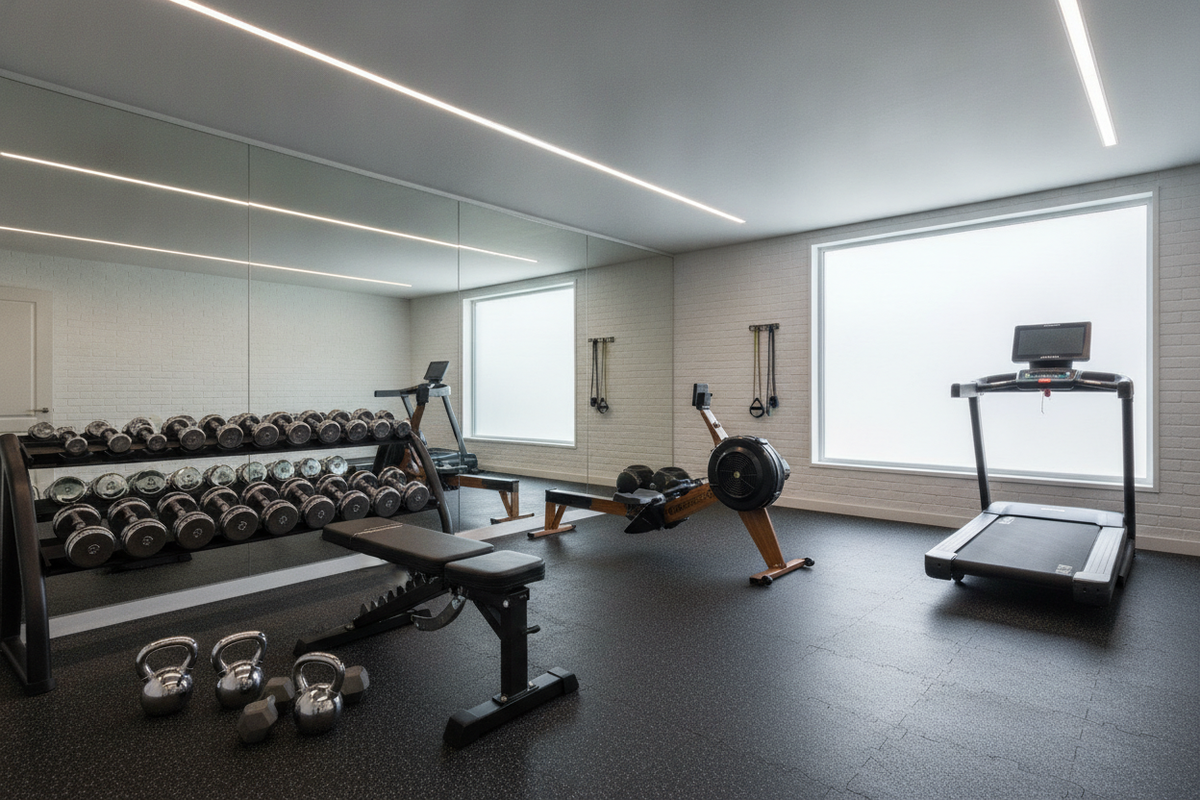
High-density gym mats provide the rigid, non-deforming base required for barbell and dumbbell training. Unlike soft foam padding that compresses unpredictably and destabilizes foot balance, dense rubber mats ensure solid ground reaction force transmission during heavy squats, hinges, and carries. Staging heavy home strength equipment over durable matting also protects underlying subfloors from point-load cracking and reduces structural vibration throughout the home.
Weekly Programming Blueprints and Recovery Integration
Sustainable progress for mature lifters depends on balancing progressive loading with deliberate recovery windows. Structuring workouts across non-consecutive training days allows connective tissues adequate time to adapt between demanding sessions.
- Full-Body Split (3 Days per Week): Rotate through the five foundational patterns, emphasizing one primary compound lift per session followed by supplementary movements.
- Upper/Lower Split (4 Days per Week): Dedicate two days to pressing and pulling patterns and two days to knee- and hip-dominant loading alongside loaded carries.
- Tempo and Repetition Control: Favor sets in the moderate repetition bracket with controlled descending phases and crisp, explosive ascending movements.
- Floor Maintenance and Mat Care: Keep training surfaces clean and dry to maintain consistent surface traction and preserve mat material integrity.
By pairing disciplined movement mechanics with a well-staged, high-traction training environment, mature lifters can continue building dependable, long-term strength with confidence.