Mastering the Squat in Machine: The Guide to Safer Leg Growth
For years, gym purists have argued that if you aren't under a free barbell, you aren't training hard. They are wrong. The squat in machine is not a crutch for beginners; it is a precision tool for hypertrophy. When your goal is tearing down muscle fibers rather than stabilizing a wobbly bar, machines offer a distinct advantage: stability.
Whether you are working around a lower back injury or simply want to isolate your quads without your core giving out first, understanding the mechanics of machine-based squatting is essential. This guide cuts through the noise and teaches you how to leverage fixed-path resistance for maximum growth.
Key Takeaways: Quick Summary
- Stability Equals Output: Machines remove the need to balance, allowing you to direct 100% of your effort into pushing the weight.
- Foot Placement Matters: Unlike free weights, you can adjust your feet forward to target quads or higher to target glutes without falling over.
- Safety Failure: Most squat machines allow you to train to failure safely without a spotter.
- Constant Tension: The fixed path allows for a smoother tempo, keeping tension on the muscle throughout the rep.
Understanding the Hardware: Which Machine?
When we talk about a squat machine workout, we are usually referring to one of two pieces of equipment: the Hack Squat or the Smith Machine. While they differ in mechanics, the principles of force production remain similar.
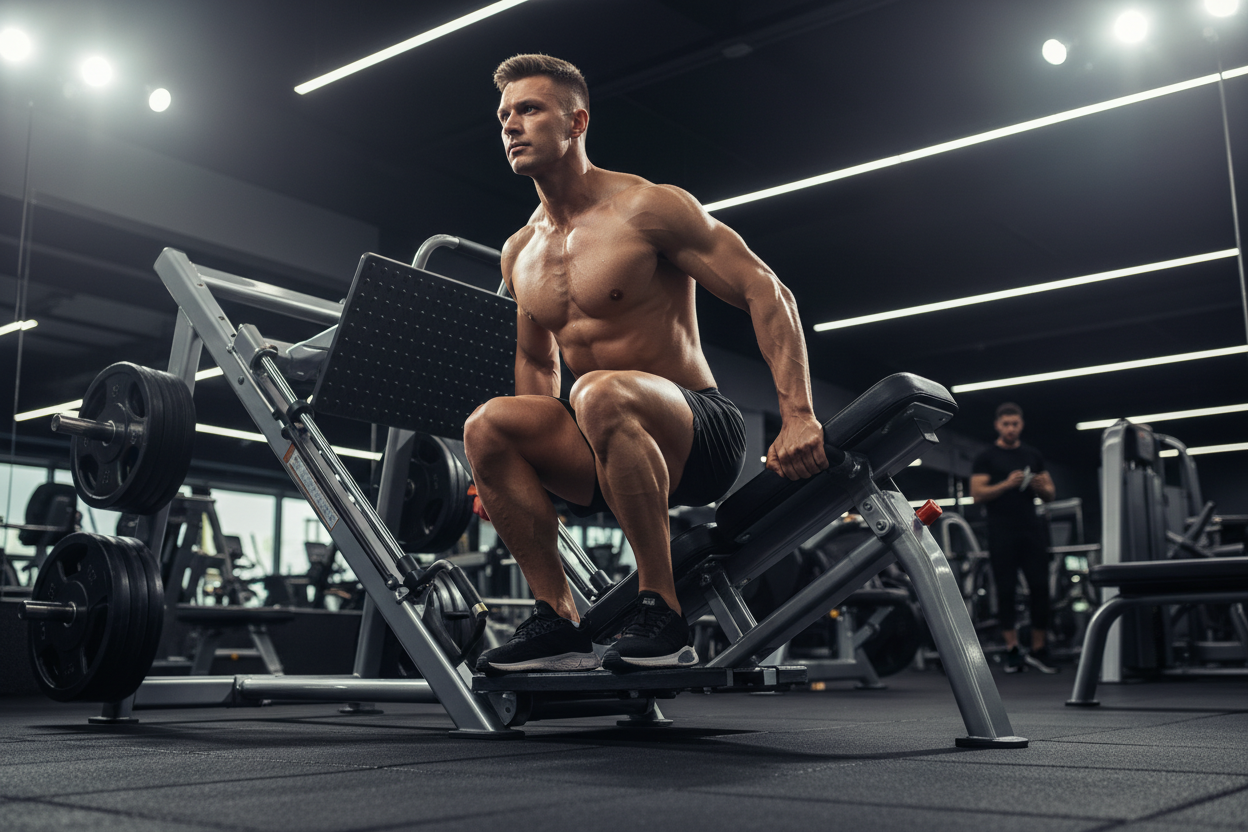
The Hack Squat places the load directly on your shoulders at an angle, removing significant strain from the lumbar spine. The Smith Machine mimics a barbell squat but on a fixed vertical (or slightly angled) rail. Both allow for a machine squat exercise that prioritizes leg strength over full-body coordination.
How to Use Squat Machine Equipment Correctly
Many lifters hop on, load up plates, and move the weight from point A to point B. To get the most out of it, you need intentionality. Here is how to use squat machine setups for optimal results.
1. The Setup and Foot Position
Step under the pads or bar. Your foot placement is your steering wheel here. If you place your feet narrow and low on the platform, you will bias the quads. If you place them wider and higher, you will recruit more glutes and hamstrings.
Ensure your back is flat against the pad. Do not let your lower back round at the bottom of the movement. This is a common error in squat machine use that leads to injury.
2. The Descent (Eccentric)
Unlock the safeties. Lower the weight slowly. Because you don't have to balance, you might be tempted to drop quickly and bounce out of the hole. Don't. Control the descent for a 3-second count. Stop just before your hips tuck under.
3. The Drive (Concentric)
Drive through your whole foot. Keep your knees aligned with your toes; do not let them cave inward. Push until your legs are straight, but stop just short of locking your knees. Keeping a "soft knee" at the top maintains tension on the quads and protects the joint.
Common Mistakes Killing Your Progress
Even with a fixed path, things can go wrong. Here are the pitfalls to avoid during your squat machine how to use learning curve.
Ego Lifting and Range of Motion
Because the machine provides stability, you can likely lift more weight than you can with a free bar. However, loading up so many plates that you only move three inches is useless. Drop the weight and aim for full depth—at least parallel.
Ignoring the Safety Stops
Every squat machine has adjustable safety stops. Set them. If you fail a rep, you want the machine to catch the weight, not your spine. This psychological safety net actually helps you train harder.
My Training Log: Real Talk
Let me share a specific detail about the squat in machine that most tutorials gloss over: the friction factor.
I remember training at an old-school bodybuilding gym in Ohio. They had an ancient vertical leg press/hack squat combo. I loaded it up for a heavy set of 8. On the third rep, I realized the rails hadn't been oiled in probably a decade. The movement wasn't smooth; it was stuttering.
This "stutter" created micro-shocks on my knees during the eccentric phase. I learned the hard way that machine maintenance matters as much as form. Now, before I load heavy, I do a dry run with just the sled. If it feels like dragging a stone over gravel, I grab the silicone spray or switch exercises. Also, on Hack Squats specifically, the shoulder pads often dig into your traps painfully once you pass three plates. I've started wearing a hoodie specifically on leg day just to add a layer of cushion between the cheap vinyl and my skin.
Conclusion
The squat machine is not an inferior substitute for the barbell; it is a different tool for a different purpose. If your goal is raw athleticism and balance, use free weights. If your goal is looking at your legs and seeing deep separation and mass, the machine is your best friend. Respect the mechanics, control the tempo, and don't be afraid to train to failure.
Frequently Asked Questions
Is the squat machine bad for your knees?
Not inherently. In fact, it can be safer than free weights because you can adjust your foot position to reduce shear force on the knee joint. However, locking your knees out forcefully at the top of the movement can cause injury.
Can I replace barbell squats with machine squats?
Yes, especially if your goal is hypertrophy (muscle growth) rather than powerlifting strength. Machine squats allow for greater isolation of the leg muscles because the stabilizing muscles are not the limiting factor.
How much does the squat machine bar weigh?
This varies by manufacturer. A standard Smith Machine bar usually has a starting resistance of 15 to 25 lbs due to the counterweight system, whereas a standard Olympic barbell weighs 45 lbs. Always check the machine's label if you are tracking specific numbers.