Mastering the Life Fitness Functional Trainer for Total Body Strength
Most home gym equipment locks you into a single plane of motion. You sit down, push a lever, and the machine dictates the path. That might be safe, but it isn't how your body moves in the real world. The life fitness functional trainer solves this biomechanical puzzle by blending safety with total freedom of movement.
Whether you are trying to replicate the commercial gym experience or simply want a single footprint that covers every muscle group, this machine is often the gold standard. But is it worth the premium price tag compared to budget competitors? Let’s break down the mechanics, the feel, and the results.
Key Takeaways: Quick Summary
- Unrestricted Movement: Unlike fixed-path machines, the independent pulleys allow for multi-planar training, mimicking real-life activities and sports performance.
- Consistent Tension: High-quality bearings and cable ratios ensure the resistance remains constant throughout the entire range of motion, increasing time-under-tension.
- Space Efficiency: Despite its size, it replaces roughly 10-15 standard gym machines, making it a cornerstone for serious home gyms.
- Commercial Durability: Built with the same components found in luxury health clubs, ensuring longevity even with heavy daily use.
The Mechanics of True Versatility
The primary reason athletes gravitate toward this equipment is the pulley system. Life Fitness typically utilizes a 1:2 or 1:4 cable ratio. What does this mean for you? It means the weight stack feels lighter than the number on the plate, but the cable travels further.
This is intentional. A lower inertia ratio allows for explosive movements—like a woodchopper or a baseball swing simulation—without the weight stack "jumping" and slamming back down. You get smooth, fluid resistance that protects your joints while still overloading the muscle.
The "Lifetime Fitness" Standard
If you have ever trained at a high-end club, you have likely used a lifetime fitness functional trainer setup. These facilities don't choose equipment based on what is cheapest; they choose based on what doesn't break.
The Life Fitness models found in these clubs are engineered to withstand 24/7 abuse. When you bring this grade of equipment into a home environment, you are essentially buying a machine that will outlast you. The cables are aircraft-grade, and the pulleys swivel effortlessly to follow your hand path, preventing the cable from rubbing against the housing—a common failure point in budget trainers.
Optimizing Your Workout Structure
Owning the machine is step one. Using it correctly is step two. Many users treat a functional trainer like a standard cable crossover, only using it for chest flys. You are leaving gains on the table if that is your approach.
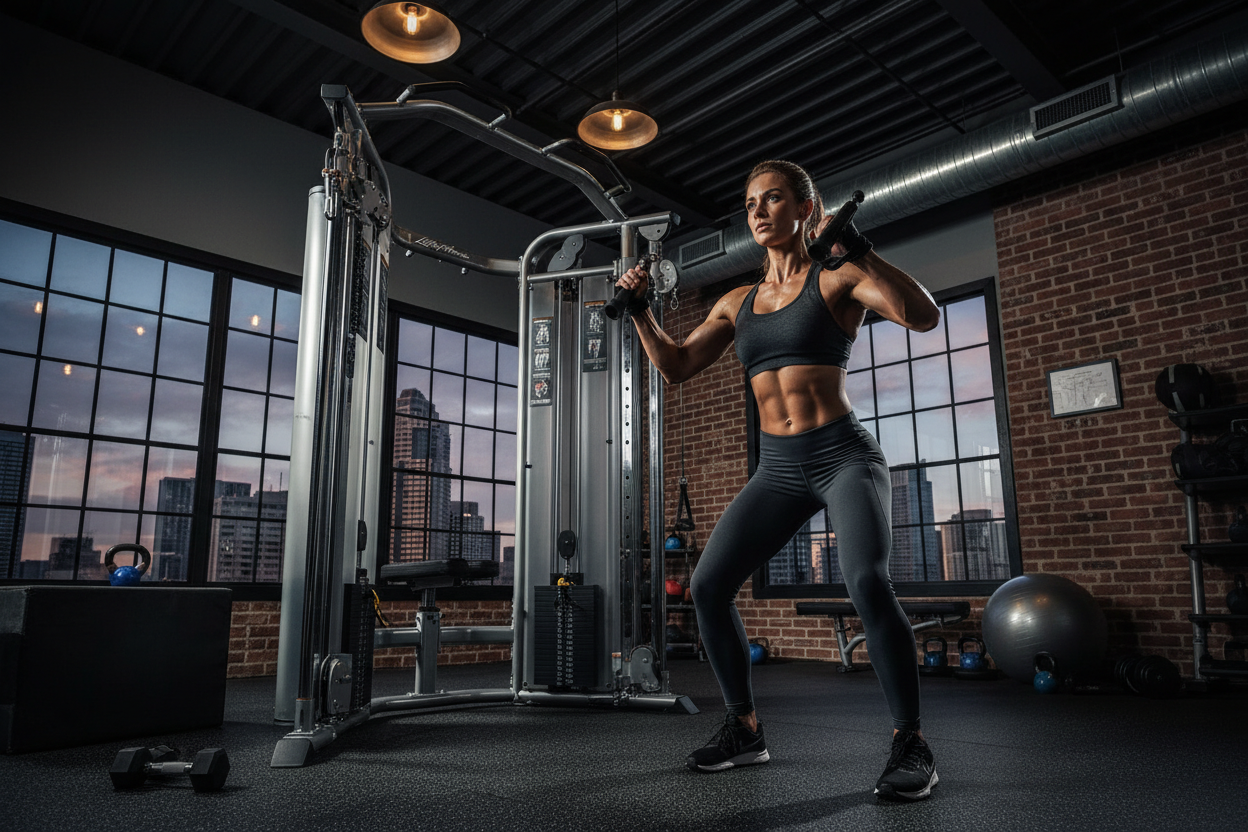
Because the pulleys adjust vertically, you should be utilizing this for compound movements. Think cable squats, lunges with overhead presses, and deadlift variations. The instability provided by the cables forces your core to engage significantly more than a Smith machine or a barbell ever could. You aren't just pushing weight; you are stabilizing it.
Common Mistakes to Avoid
The biggest error I see is proper positioning relative to the machine. Because the cables allow freedom, your body position dictates the line of pull.
If you are doing a press, you need to step forward enough that the weight stack is suspended before you even start the rep. If the plates touch between reps, you lose tension. Conversely, stepping too far out changes the leverage and can put unnecessary torque on your lower back during rotational movements.
My Training Log: Real Talk
I want to step away from the specs and talk about what it actually feels like to use a Life Fitness G7 and their commercial DAP units. I’ve logged hundreds of hours on these, and there are nuanced details you only notice when you’re three sets deep into failure.
The first thing is the sound—or lack thereof. On cheaper trainers, you hear a distinct "zip-zip" friction noise of the cable dragging over plastic pulleys. With the Life Fitness unit, the motion is almost silent, just the faint hum of the bearings. It sounds minor, but that friction on cheaper machines creates a "sticking point" at the start of the pull (the concentric phase).
On this machine, the pull is buttery smooth from the very first millimeter. Also, let's talk about the adjustment pin mechanism. On budget gear, I’m often fighting to align the pin with the hole, wiggling the carriage to get it to click. The Life Fitness carriage glides on the chrome uprights and locks in with a satisfying, heavy mechanical thud. It doesn't wobble. When I’m doing heavy face pulls, I don't feel the machine tipping or vibrating, which gives me the confidence to actually pull with max effort.
Conclusion
The Life Fitness functional trainer is an investment, not a casual purchase. It demands floor space and a significant budget. However, if your goal is to replicate the biomechanics of a high-end health club and build a physique that is as functional as it is aesthetic, this machine remains the benchmark. It removes the limitations of fixed iron and lets your body move the way it was designed to.
Frequently Asked Questions
How much space do I really need for a functional trainer?
You need more than just the machine's footprint. While the unit might be 4-5 feet deep, you need an additional 2-3 feet of clearance in front of the machine to fully extend the cables and step into lunges or flys without hitting a wall.
What is the difference between a 1:2 and 1:4 cable ratio?
A 1:2 ratio means lifting 100lbs feels like 50lbs. A 1:4 ratio means it feels like 25lbs. Life Fitness often uses these ratios to allow for longer cable travel and faster movement speeds, which is ideal for sports performance training rather than pure powerlifting.
Does the machine require maintenance?
Minimal, but yes. You should wipe down the guide rods with a silicone-based lubricant (never oil or grease) every few months to keep the weight stack moving smoothly. Check the cables annually for any fraying of the rubber coating.