Mastering the Best Shoulder Exercises for Strength: The Ultimate Guide
Most lifters obsess over chest day, chasing a bigger bench press while neglecting the very foundation that makes a strong upper body possible: the shoulders. If you want a V-taper that stretches your shirts and the functional power to press heavy loads, you cannot treat shoulder training as an afterthought. To build a truly bulletproof physique, you need to prioritize the best shoulder exercises for strength.
Shoulder training isn't just about moving weight from point A to point B. The shoulder joint is the most mobile joint in the body, which also makes it the most unstable. Strength here requires a blend of raw power, stability, and precise mechanics. This guide cuts through the fluff and focuses on the biomechanics that actually drive hypertrophy and strength gains.
Quick Summary: The Core Movements
If you are looking for the most effective movements to add to your routine immediately, here is the hierarchy of shoulder development. These form the backbone of any serious strength program.
- Standing Barbell Overhead Press: The primary mass builder for the entire shoulder girdle.
- Seated Dumbbell Press: Offers greater range of motion and independent limb stabilization.
- Egyptian Lateral Raises: Superior to standard raises for keeping constant tension on the side delt.
- Face Pulls: Essential for rear delt strength and rotator cuff health.
- Arnold Press: Hits all three heads of the deltoid through a dynamic range of motion.
Understanding the Anatomy of a Strong Press
Before grabbing the dumbbells, you need to understand what you are working. The deltoid is a three-headed muscle, and the best shoulder workouts for strength address all three.
The Anterior (Front) Delt handles vertical pushing. The Lateral (Side) Delt creates width and the "capped" look. The Posterior (Rear) Delt is responsible for stability and posture. Most people have overdeveloped front delts from bench pressing and severely underdeveloped rear delts. True strength comes from balancing these three.
The King of Moves: The Overhead Press (OHP)
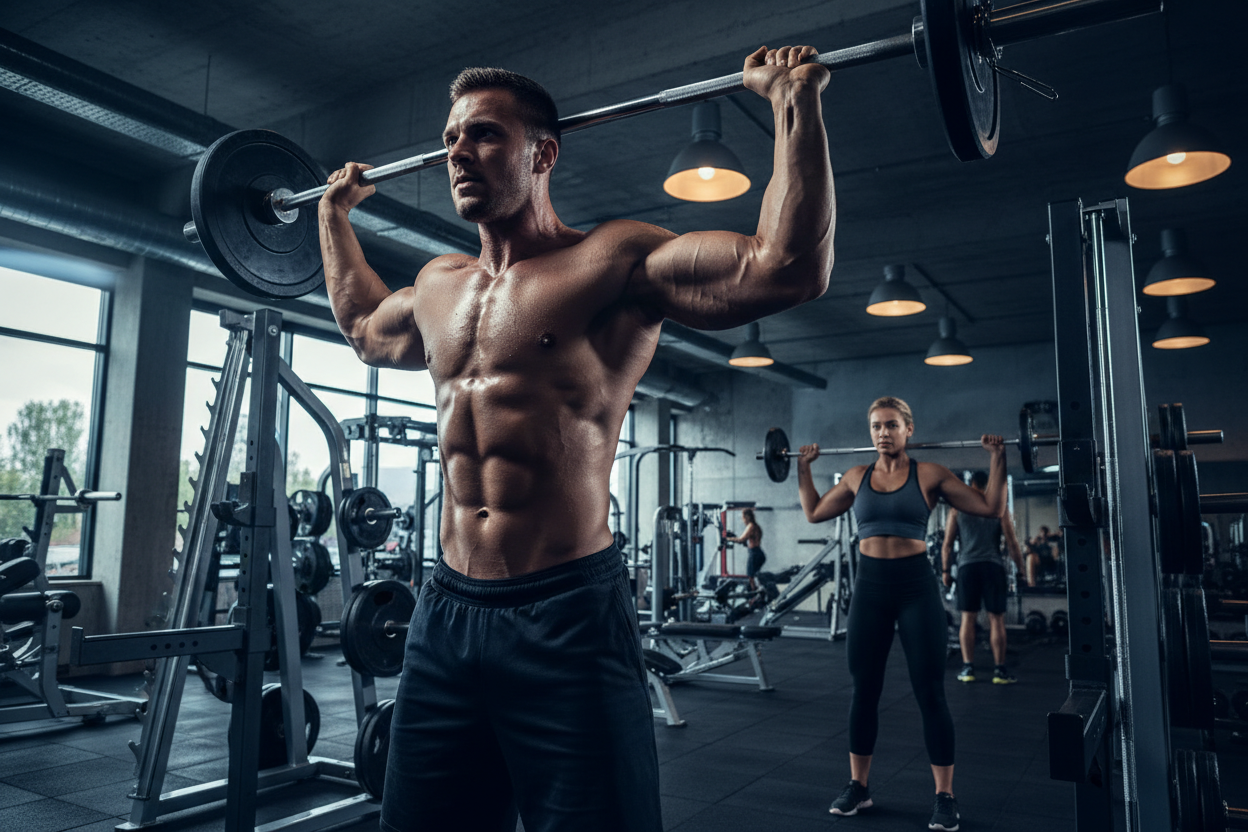
When discussing the best shoulder strength exercises, the Standing Barbell Overhead Press is non-negotiable. It is a kinetic chain movement that starts at your feet and ends at the lockout.
Why It Works
Unlike seated variations, the standing press forces your core, glutes, and lower back to stabilize the load. This recruits more overall muscle fibers and allows for heavier loading than any isolation movement.
The Technical Nuance
Many lifters fail here because they press the bar around their face. The correct path is a straight vertical line. You must tuck your chin and move your head back to let the bar pass, then push your head "through the window" at the top. If your lower back hyperextends, your glutes aren't tight enough.
Building Width: Lateral Raises Done Right
You cannot build wide shoulders with heavy presses alone. You need abduction. However, the standard lateral raise is often butchered with momentum.
Stop trying to lift the dumbbells straight out to your sides (90 degrees). This can cause impingement in the shoulder capsule. Instead, move in the "Scaption" plane—about 30 degrees forward of your torso. Think about pushing your hands out toward the walls, not just up.
The Unsung Hero: Face Pulls
If you want to press heavy without blowing out your rotator cuff, you need Face Pulls. This is arguably the most important corrective exercise for modern lifters who spend all day hunched over computers.
Use a rope attachment. Pull the rope toward your forehead while externally rotating your hands (thumbs pointing back behind you). This targets the rear delts and the external rotators, providing the counter-balance needed for heavy chest and shoulder pressing.
Structuring Your Programming
To get the most out of these movements, don't cram them all into one day randomly. The best shoulder workouts for strength usually start with a heavy compound movement (like the OHP) in the 3-6 rep range to target the central nervous system. Follow this with accessory work (dumbbell presses, lateral raises) in the 8-12 rep range for hypertrophy, and finish with rear delt work in the 15-20 rep range to focus on metabolic stress and posture.
My Training Log: Real Talk
I want to be transparent about my own journey with the best shoulder exercises for strength. Early in my lifting career, I was obsessed with the Seated Dumbbell Press because I could move heavier dumbbells than I could a barbell. I thought I was strong, but my stabilizers were weak.
I remember the specific moment I realized I had to change. I was attempting a standing overhead press max. As the bar cleared my chin, my lower back arched aggressively—I felt that distinct, sickening pinch near my lumbar spine, and my knees started to wobble. The bar stalled halfway up, and I had to dump it forward. It was embarrassing, but it was a wake-up call.
I dropped the ego lifting. I went back to just the empty bar to fix my "rack position." I realized that if I didn't squeeze my glutes so hard they cramped, I had no base to push from. I also learned that the specific pain of a heavy OHP isn't in the shoulders—it's the pressure in the wrists if you don't stack them directly over your elbows. Once I fixed that wrist alignment and stopped letting my wrists roll back, the power transfer was instant. It took me six months to get back to my previous weights, but this time, the bar moved like it was on a track.
Conclusion
Building massive, strong shoulders requires patience and respect for biomechanics. By prioritizing the overhead press for raw power and using targeted accessories for stability and width, you will build a frame that is as functional as it is aesthetic. Stop chasing the pump and start chasing progressive overload on the big lifts.
Frequently Asked Questions
How often should I train shoulders for maximum strength?
For most natural lifters, training shoulders twice a week is optimal. One day can focus on heavy overhead pressing (low reps), and the second day can focus on hypertrophy and rear delt health (higher reps). This manages fatigue while ensuring enough volume for growth.
Can I build shoulder strength with just dumbbells?
Absolutely. While barbells allow for higher absolute loads, dumbbells require more stabilization. The best shoulder strength exercises using dumbbells, like the Arnold Press, can actually be safer for the joints and fix muscular imbalances between your left and right sides.
Why do my shoulders click when I do lateral raises?
Clicking usually indicates that the tendon is rolling over a bone or that there is a lack of space in the shoulder joint (impingement). Try moving your arms slightly forward (into the scapular plane) rather than directly out to the side. If pain accompanies the clicking, stop immediately and consult a physical therapist.