Mastering the Base 10 Home Workout Movement Matrix
I remember training a client in a 400-square-foot apartment in the dead of winter. He had a pair of adjustable 5-52.5 lb dumbbells, a cramped living room, and a severe case of program hopping. He was trying to do 30 different exercises a week, constantly tweaking his routine based on the latest social media clip. His joints were aching, his elbows were inflamed, and his floor press was stubbornly stuck at 135 lbs.
That is when I introduced him to the movement matrix. By stripping everything down and forcing him to master a core 10 home workout foundation, he finally started making real progress. We stopped trying to replicate a commercial gym in his living room and started focusing on biomechanics. Within three months, his joint pain vanished, and his strength metrics shot up.
Quick Takeaways
- Mastering a core set of 10 fundamental movements yields significantly better results than constantly juggling 50 variations.
- Neurological adaptation requires repetition; changing your exercises every week kills your strength gains.
- Proper flooring and spatial setup are non-negotiable for joint health during heavy compound lifts at home.
- A 12-week programming cycle allows for progressive overload without causing connective tissue burnout.
The Trap of Infinite Exercise Variations
When you train at home, it is easy to fall into the trap of thinking you need to constantly trick your muscles to see growth. The fitness industry pushes the idea of muscle confusion, but from a biomechanical standpoint, your central nervous system thrives on predictability. When you constantly swap out exercises, your nervous system never gets the chance to become efficient at the movement pattern.
If you are doing a goblet squat on Monday, a Bulgarian split squat on Wednesday, and a reverse lunge on Friday, your brain is spending all its energy figuring out balance and coordination. It cannot recruit the maximum number of muscle fibers because it is too busy trying to keep you from falling over. This leads to stalled progress, especially for home trainees who are working with limited weights.
By restricting yourself to a base matrix of 10 exercises, you force your body into a state of deep neurological adaptation. You learn how to brace your core properly, how to root your feet into the floor, and how to fire the exact muscle groups needed to move the weight. This efficiency is what actually builds dense, functional muscle tissue over time.
Defining the Base 10 Home Workout Matrix
The concept of the base 10 matrix is simple: select one highly effective exercise for each of the primary human movement patterns and stick to them exclusively for a training block. You do not need five different chest exercises if you are executing one horizontal push with absolute perfection.
The matrix consists of the following foundational patterns: a horizontal push, a horizontal pull, a vertical push, a vertical pull, a squat, a hip hinge, a unilateral leg movement, a loaded carry, core anti-rotation, and core anti-extension. By filling these 10 slots with movements that suit your specific body type and available equipment, you create an unbreakable routine.
For a home trainee using adjustable dumbbells, this might look like: floor presses, bent-over rows, seated overhead presses, pull-ups, goblet squats, Romanian deadlifts, reverse lunges, farmer's walks, Pallof presses, and ab wheel rollouts. This specific combination hits every single muscle fiber in your body without requiring a massive footprint or complex machinery.
Upper Body Push and Pull Essentials
Your upper body matrix needs to balance pushing and pulling to keep your shoulders healthy. If you do 100 push-ups a week but zero rows, your posture will suffer, and your rotator cuffs will eventually pay the price. I always program a 1:1 ratio of pulling to pushing.
For the horizontal push, the dumbbell floor press is king in a home setup. It protects the shoulders by limiting the range of motion and requires zero bench space. Pair this with a heavy dumbbell row. Once you have the heavy compound pushing movements dialed in, you might want to isolate smaller muscle groups. If you are looking to finish off your arms, throwing in a tricep workout at home with dumbbells is a smart way to add volume without overloading the shoulder joints.
Lower Body Hinge and Squat Mechanics
Lower body training at home usually fails because people lack the weight to challenge their legs. However, if you master the mechanics of a deep goblet squat and a strict Romanian deadlift, you can create massive tension with surprisingly light weights through slow eccentrics and pauses.
Doing wide-stance sumo squats or heavy kettlebell swings requires serious grip on the floor. Slipping even a fraction of an inch under a loaded hinge pattern can tweak your lower back in an instant. That is why I always have my clients train on a high-density 6x8ft exercise mat gym flooring to ensure their feet stay planted and their knees track properly over their toes.
Setting Up Your Matrix Environment
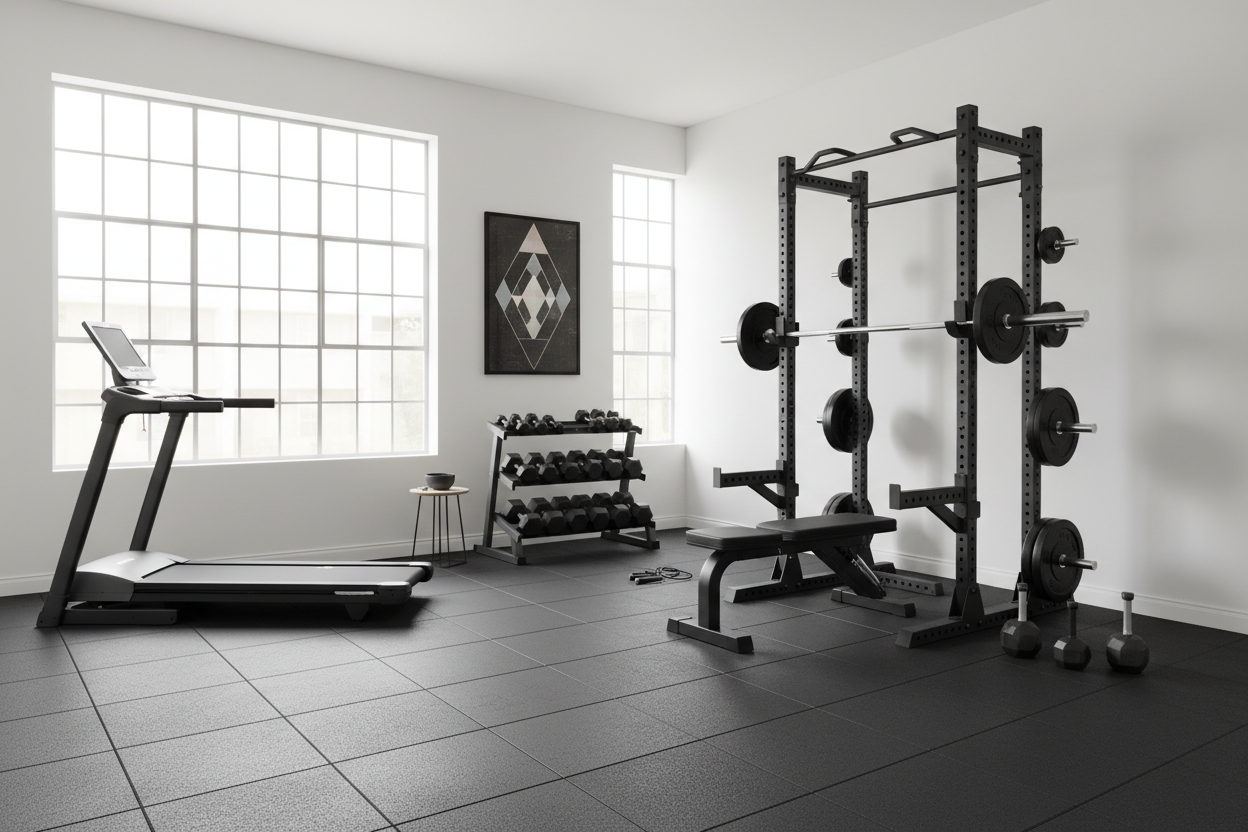
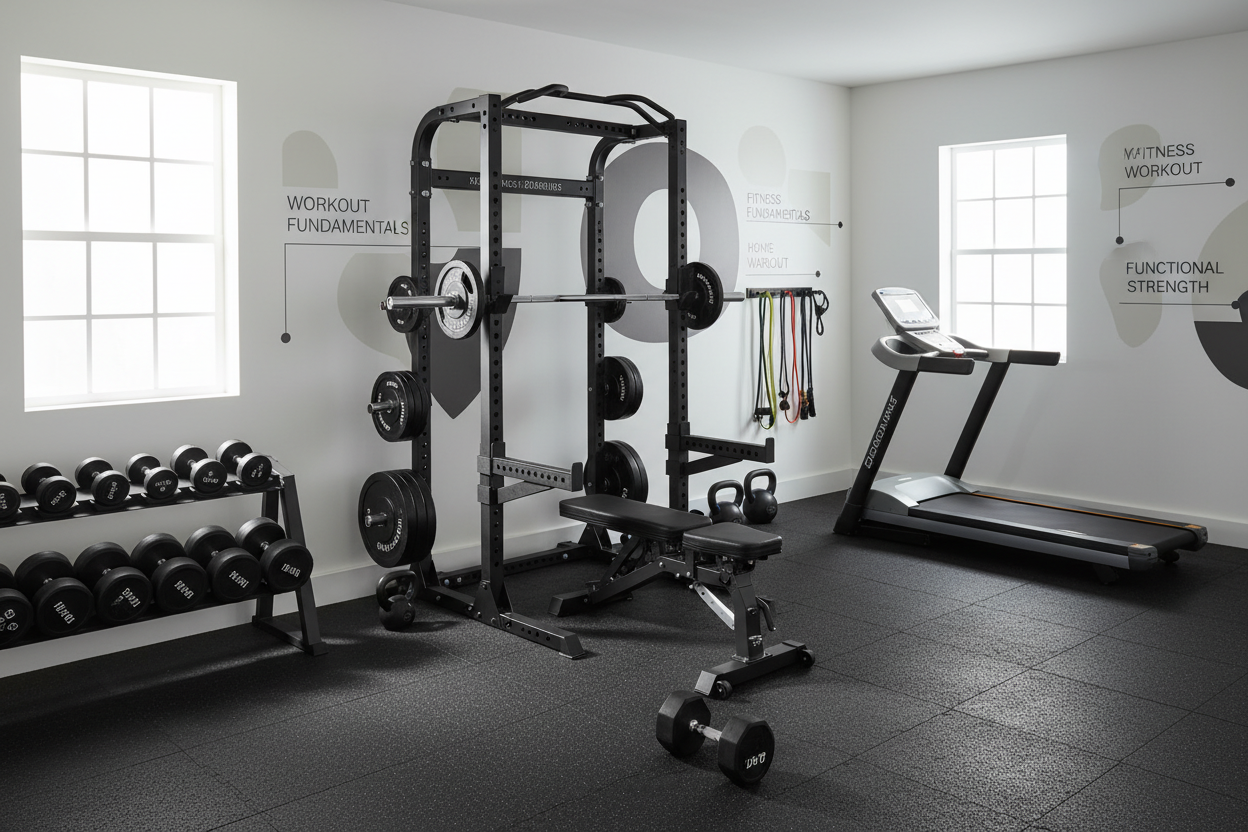
Your physical environment dictates the quality of your movement. You cannot perform a heavy, dynamic reverse lunge if you are worried about kicking your coffee table or slipping on hardwood floors. I recommend clearing a dedicated space that is at least 6x6 feet. This gives you enough room for full-body extension without modifying your natural biomechanics.
Flooring is the most overlooked piece of home gym equipment. When you are doing dynamic reverse lunges or heavy floor presses, you need enough continuous surface area so you are not stepping off the edge of a tiny yoga mat. Investing in a large exercise mat for home gym setups protects your subfloor from dropped weights and saves your wrists during high-rep push-ups or plank variations.
Keep your environment distraction-free. The matrix requires focus. If you are doing a heavy set of Romanian deadlifts, you need to feel the stretch in your hamstrings and the brace in your core. A cluttered room leads to a cluttered mind, which translates to sloppy reps and potential injury.
Integrating Equipment into the Core 10
You should start your matrix with bodyweight movements to master the raw mechanics. A bodyweight squat, a strict push-up, and an inverted row are prerequisites before you touch a dumbbell. Once you can hit 15 clean reps of the bodyweight variations, it is time to introduce external loads.
Adjustable dumbbells are the most efficient tool for loading the matrix. A set that goes up to 50 or 80 lbs per hand will keep you challenged for years. Focus on progressive overload by adding reps, slowing down the tempo, or increasing the weight by small increments.
Eventually, you might outgrow your adjustable dumbbells. While barbells are great, some trainees eventually want to scale up their matrix by looking into full body workout machines that fit into a garage or spare bedroom to handle heavier loads safely, especially for movements like the vertical pull or heavy leg presses.
Programming Your Matrix for Longevity
I program the base 10 matrix in 12-week cycles. For the first four weeks, focus purely on form and muscular endurance, working in the 10-15 rep range. Do not push to failure; leave two reps in the tank. This builds the connective tissue strength required for heavier loads.
In weeks five through eight, drop the reps to 8-10 and increase the load. This is where the real hypertrophy happens. You will notice that because you are doing the exact same 10 movements, your confidence under the weight increases dramatically.
For the final four weeks, push the intensity. Work in the 5-8 rep range for your compound lifts. After the 12 weeks are up, take a deload week. You can then swap out a few of the matrix movements for close variations—like switching from a goblet squat to a front rack dumbbell squat—and start the cycle over.
My Experience Testing the Base 10 Protocol
I ran this exact 10-movement matrix for six straight months in my own garage using nothing but a pair of 80 lb adjustable dumbbells and a pull-up bar. The results surprised even me. My nagging shoulder impingement cleared up because I was finally balancing my push-to-pull ratio, and my core got significantly stronger from the heavy loaded carries.
The one honest downside I experienced was the limitation on maximum absolute strength for the lower body. At a certain point, holding 160 lbs in dumbbells for a squat becomes a grip and upper back exercise rather than a true leg builder. That is when I had to start utilizing advanced techniques like 1.5 reps and 4-second negative descents to keep my legs growing without heavier weights.
Frequently Asked Questions
How often should I change the 10 exercises?
Keep the exact same 10 exercises for at least 8 to 12 weeks. Changing them sooner prevents your nervous system from adapting and stops you from applying true progressive overload.
Can I build muscle with just 10 movements?
Absolutely. Muscle growth requires mechanical tension, metabolic stress, and muscle damage. You can achieve all three by progressively loading these 10 foundational movements over time.
What if I do not have enough weight for squats?
If your weights feel too light, change the tempo. Take 4 seconds to lower into the squat, pause for 2 seconds at the bottom, and explode up. You can also switch from bilateral squats to unilateral movements like Bulgarian split squats to double the load on a single leg.