Mastering Bodyweight Exercises for Legs: Movement Patterns, Progression, and Home Setup
Why Bodyweight Lower Body Training Builds Real Strength
Training the lower body without external barbells or machines is often misunderstood as merely light cardio or an entry-level routine. In reality, mastering bodyweight exercises for legs establishes an exceptional foundation of movement quality, joint control, and functional strength. The human lower body contains some of the largest muscle groups, including the quadriceps, hamstrings, gluteal complex, and calves. Performing movements that rely purely on body weight forces these muscles to coordinate with the core and stabilizing stabilizers in natural, multi-planar patterns.
Unlike fixed-path gym machines that isolate specific muscle groups while external structures support the torso, bodyweight leg training requires the nervous system to maintain balance, control center of mass, and stabilize joints through dynamic ranges of motion. Exploring a structured bodyweight leg exercise guide demonstrates how bodyweight patterns emphasize full hip articulation, ankle mobility, and trunk engagement, creating functional lower body capability that translates directly to everyday movements and athletic performance.
Core Movement Patterns: The Foundation of Calisthenic Leg Training
A balanced lower body routine relies on a combination of foundational movement patterns: knee-dominant knee bends, unilateral single-leg actions, hip-dominant hinges, and ankle plantarflexion. Incorporating exercises across these categories ensures symmetrical development between anterior and posterior musculature.
Squat Variations for Quadriceps and Glute Engagement
The squat serves as the primary bilateral knee-dominant movement. When external load is absent, variation in foot positioning, depth, and cadence dictates muscular tension:
- Standard Air Squats: Feet placed roughly shoulder-width apart with toes slightly turned out. Focusing on maintaining an upright chest and initiating the movement by sitting back and down drives balanced quadriceps and glute recruitment.
- Narrow-Stance Squats: Bringing the feet closer together shifts emphasis toward the outer quadricep sweep while challenging ankle dorsiflexion.
- Sumo Squats: Adopting a wider stance with toes flared outward increases engagement across the adductors and inner glute fibers.
- Tempo and 1.5 Rep Squats: Lowering slowly over several seconds, rising halfway, descending again, and then standing fully extends time under tension without adding weight.
Unilateral Movements for Balance and Stability
Single-leg work is arguably the most effective tool for driving lower body overload with body weight alone. Unilateral exercises reduce bilateral deficits, enhance balance, and double the effective resistance placed on the working limb:
- Reverse Lunges: Stepping backward into a lunge provides controlled deceleration and protects knee tracking compared to forward momentum, making it an exceptional movement for quad and glute control.
- Lateral Lunges: Shifting weight side to side develops frontal-plane strength, stretching the adductor of the trailing leg while loading the quadricep and hip of the bending leg.
- Split Squats and Bulgarian Split Squats: Keeping one foot elevated behind on a low bench or chair places almost all body mass onto the front leg, demanding high levels of stability and deep hip flexion.
- Step-Downs: Standing on a low platform and slowly lowering the non-working heel toward the floor trains eccentric quadriceps control and strengthens the stabilizing structures around the knee.
Posterior Chain Mechanics: Hinges and Bridges
Developing the back of the legs—namely the hamstrings and glutes—requires deliberate hip flexion and extension movements:
- Single-Leg Glute Bridges: Lying supine with one knee bent and the other leg extended, driving through the planted heel contracts the gluteus maximus and reinforces pelvic stability.
- Bodyweight Good Mornings: With hands behind the head and soft knees, hinging forward from the hips with a flat spine builds active hamstring stretch and posterior chain awareness.
- Hamstring Bridge Slides: By resting the feet on a smooth towel or slider surface on a hard floor, extending and pulling the heels toward the hips provides intense eccentric and concentric hamstring loading.
Creating Progressive Overload Without External Weights
The principle of progressive overload is not limited to adding iron plates to a barbell. In bodyweight training, progress is achieved through manipulating biomechanical leverage, movement tempo, range of motion, and volume density.
Slowing down the eccentric (lowering) phase increases the structural challenge of each repetition. Incorporating isometric pauses at the bottom of a squat or split squat eliminates elastic momentum, forcing muscle fibers to generate force from a dead stop. Furthermore, advancing from bilateral movements to challenging unilateral progressions—such as progressing from a standard squat to an airborne lunge or assisted pistol squat—significantly escalates the resistance experienced by individual muscles.
For those seeking subtle tension adjustments while keeping a calisthenic focus, pairing bodyweight movements with items from a strength training collection—such as light resistance loops, mobility wedges, or suspension straps—allows fine-tuned progressive loading without requiring heavy machinery.
Optimizing Your Home Space: Flooring, Grip, and Stability
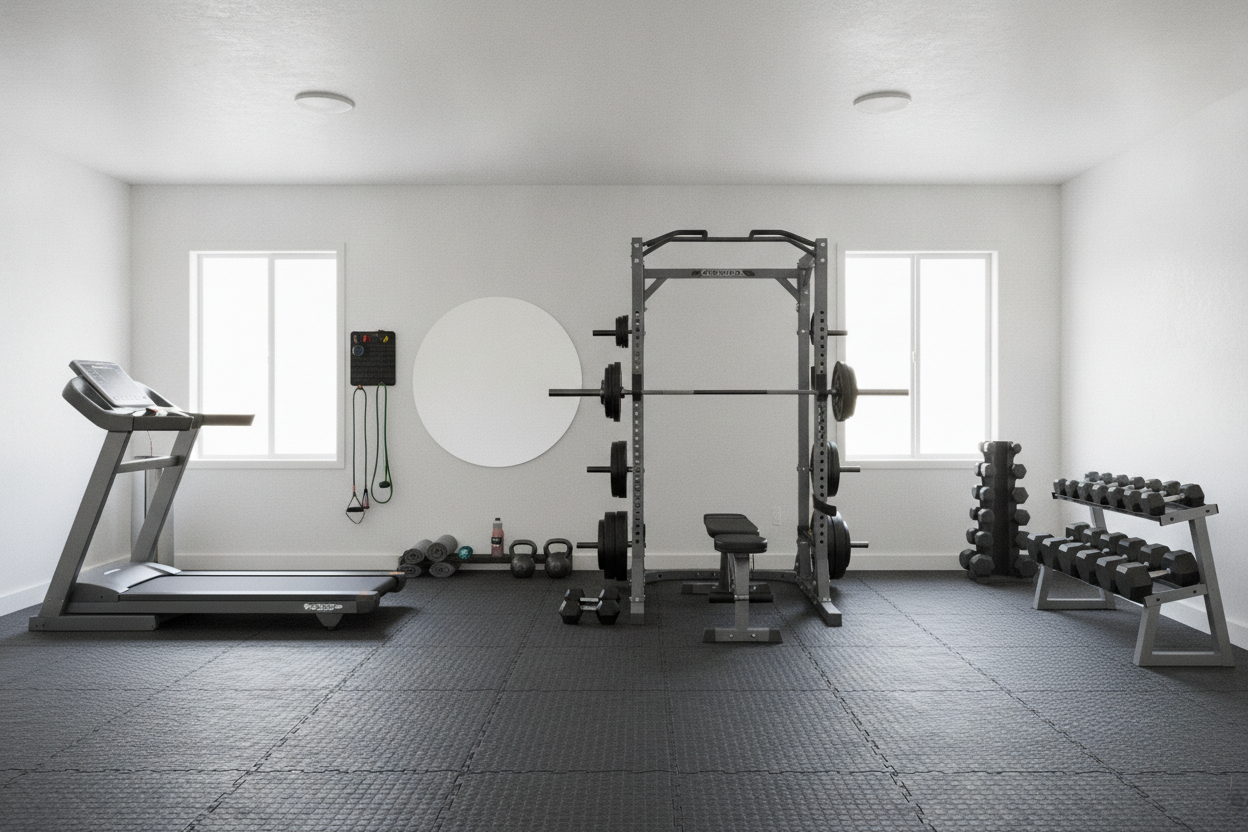
Executing bodyweight leg workouts at home demands a safe, stable, and resilient floor setup. Dynamic movements such as alternating lunges, broad jumps, and lateral strides place lateral shear forces onto the floor surface. Training on bare hardwood or slick tile can cause slipping, while thin yoga mats tend to bunch, stretch, or slide during explosive foot strikes.
A dedicated, high-density surface such as an expansive exercise workout product provides essential ground traction, preventing shoe slippage during deep lunges and wide-stance squats. In addition, quality exercise flooring offers moderate subfloor cushioning that absorbs joint impact during jumping variations and protects domestic flooring from wear and tear. A secure, non-slip base ensures proper foot anchoring, allowing you to focus entirely on muscle contraction and form adherence.
Sample Bodyweight Leg Workout Routines for Home Spaces
Structuring your bodyweight lower body sessions with clear work-to-rest parameters keeps training intensity high. Below are two adaptable routine templates designed for home training environments.
Routine A: Full Lower Body Calisthenic Circuit
Perform the following exercises in sequence with minimal rest between movements. Rest for 90 to 120 seconds at the end of the circuit, completing 3 to 4 total rounds:
- Tempo Air Squats: 15 repetitions (3-second lowering, 1-second pause at bottom).
- Reverse Lunges: 12 repetitions per leg (alternating smoothly).
- Single-Leg Glute Bridges: 12 repetitions per leg.
- Lateral Lunges: 10 repetitions per side.
- Calf Raises with 2-Second Hold: 20 repetitions.
Routine B: Unilateral Strength & Control Density Block
Focus on control and stability by performing paired supersets. Complete 3 sets per pair before moving to the next:
- Pair 1: Bulgarian Split Squats (8 to 10 reps per leg) superset with Bodyweight Good Mornings (15 reps). Rest 60 seconds.
- Pair 2: Lateral Step-Downs or Cossack Squats (8 reps per leg) superset with Hamstring Bridge Slides or Long-Lever Bridges (12 reps). Rest 60 seconds.
- Finisher: Wall Sit hold for 45 to 60 seconds, repeated for 2 rounds.
Transitioning from Bodyweight to Hybrid Training
Once you have developed solid movement mechanics, balance, and joint durability through weightless training, you can smoothly transition into hybrid training methodologies. Adding external resistance to established movement patterns creates new avenues for strength and muscle development.
You can review a comprehensive leg exercise weight guide to understand how foundational mechanics carry over when introducing dumbbells, kettlebells, or barbells into your lower body days. For dedicated home gym builders seeking progressive resistance tools, exploring options within a lower body strength collection can complement your calisthenic routine with targeted loading stations, providing a complete spectrum of lower body training possibilities.