Mastering Basic Gym Machines: The Beginner’s Guide to Strength
Walking into a commercial gym for the first time often feels like stepping into the cockpit of an alien spaceship. You see cables, pulleys, levers, and people making strange noises. It is intimidating. But here is the truth: you don't need to start with complex barbell movements to see results. Starting with basic gym machines is not just 'okay'—it is often the smartest strategic move for building a foundation.
Machines provide a fixed path of motion. This removes the need for you to balance the weight, allowing you to focus entirely on the muscle contracting. For a novice, this stability is the key to safety and confidence. Let's strip away the confusion and look at the equipment that actually matters.
Quick Summary: The Essential Starter Pack
If you are looking for the most effective workout machines for beginners, focus on these five staples. They cover every major muscle group with minimal risk of injury.
- Leg Press: The safest way to load heavy weight onto your legs without stressing your lower back.
- Lat Pulldown: Essential for building back width and learning how to retract your shoulder blades.
- Seated Chest Press: Teaches proper pressing mechanics without the wobble of dumbbells.
- Cable Row: Targets the mid-back and improves posture (crucial for desk workers).
- Machine Shoulder Press: Builds overhead strength with a fixed safety stop.
Why Weight Machines Are Superior for Learning
There is a stigma among 'gym bros' that machines are inferior to free weights. Ignore that. When looking for weight lifting machines for beginners, understand that the primary goal is motor learning.
Free weights require about 40% of your energy just to stabilize your body. Machines handle that stabilization for you. This allows you to direct 100% of your effort into the target muscle. It creates a mind-muscle connection that is difficult to achieve when you are terrified of dropping a barbell on your face.
The "Big 5" Machines You Should Master
1. The Leg Press (Lower Body Push)
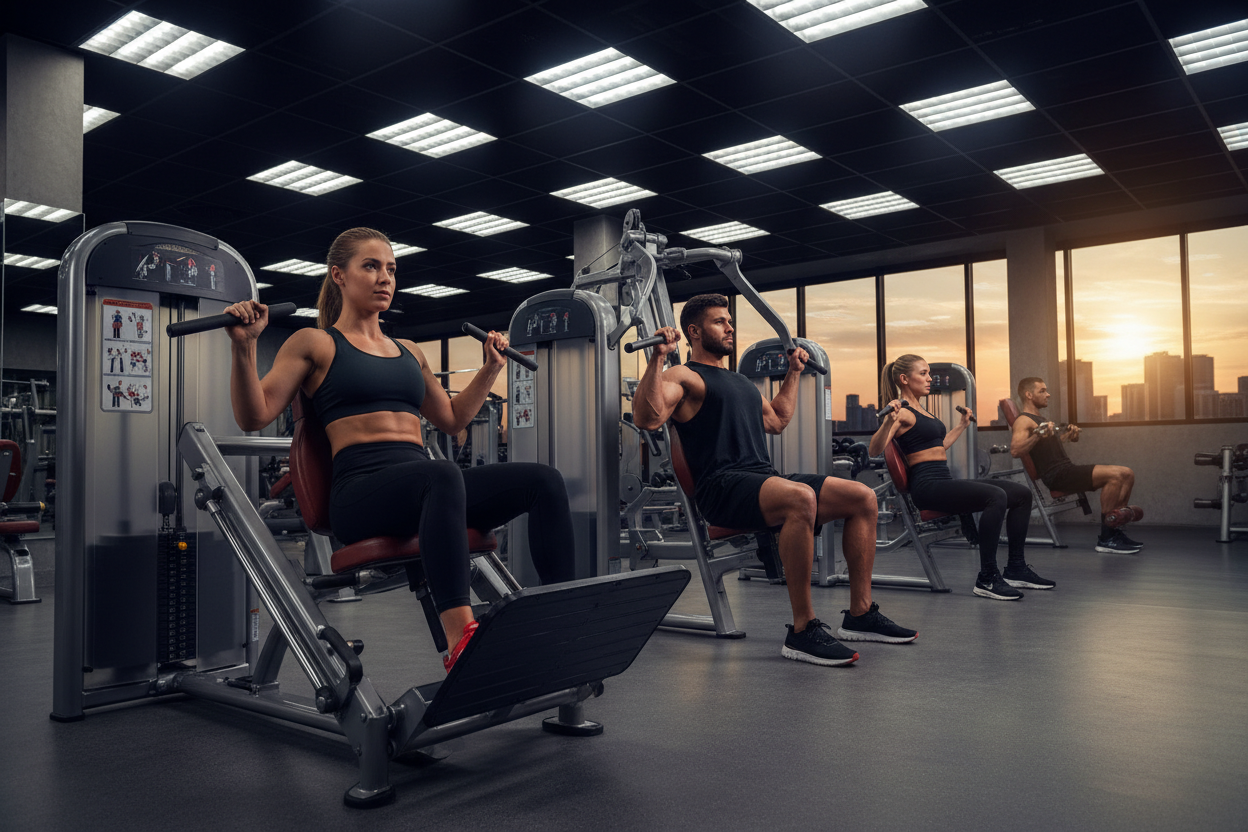
The leg press is the king of weight training machines for beginners. It mimics the squat but stabilizes your hips and spine.
The Technique: Place your feet shoulder-width apart in the center of the sled. Lower the weight until your knees form a 90-degree angle.
The Nuance: Do not lock your knees out at the top. If you lock them, the tension shifts from your muscles to your joints. Keep a 'soft' knee at the peak of the movement.
2. The Lat Pulldown (Upper Body Pull)
This is likely the best gym equipment for beginners aiming to build a wider back. It targets the latissimus dorsi.
The Technique: Grip the bar slightly wider than your shoulders. Pull the bar down to your upper chest—not your belly button.
The Nuance: Imagine pulling with your elbows, not your hands. If your forearms burn out before your back does, you are gripping too tight and using too much bicep.
3. The Seated Chest Press (Upper Body Push)
When asking what machines to use at the gym for beginners, this is the answer for upper body strength. It targets the pectorals, shoulders, and triceps.
The Technique: Adjust the seat so the handles align with the middle of your chest. Push forward and control the return.
The Nuance: Keep your shoulder blades pinned against the back pad throughout the entire movement. If your shoulders roll forward, you risk injury.
4. The Seated Cable Row
While the pulldown builds width, the row builds thickness. It is vital for counteracting the 'hunched over a phone' posture.
The Technique: Sit with a slight bend in your knees. Pull the handle toward your lower stomach.
The Nuance: Pause for one second when your hands reach your stomach. Squeeze your shoulder blades together like you are trying to crack a walnut between them.
Common Mistakes on Weight Machines
Even though weight machines for beginners are safer, you can still mess them up. The most common error is ignoring the adjustment points.
Every machine has colorful pins (usually yellow or red) to adjust seat height and range of motion. If the pivot point of the machine doesn't align with your body's joint (like your knee or elbow), the movement will feel unnatural and jerky. Take the ten seconds to adjust the seat. If the machine clanks loudly every time you lower the weight, you are going too fast and losing tension. Control the negative.
My Training Log: Real Talk
I want to be honest about my own experience with basic gym machines. When I first started, I avoided the free weight section for six months straight. I stuck to the selectorized machines because I was embarrassed to ask for a spot.
I specifically remember the old Nautilus chest press at my local gym. It had these sticky, cracked vinyl seats that smelled like cleaning solution and old sweat. The adjustment pin was always jammed, and I had to wiggle it aggressively just to move the seat down. But the most distinct memory was the feeling in my triceps on the last rep. Because I didn't have to balance the weight, I could push until absolute failure—until the weight stack literally wouldn't move an inch.
That specific safety net—knowing the weight couldn't crush me—allowed me to push harder than I ever would have with dumbbells. That 'grind' is where the muscle is built. Don't let anyone tell you machines are the easy way out. If you use them right, they are brutal.
Conclusion
Building a physique isn't about doing the most complicated circus act in the gym. It is about applying tension to muscle over time. By utilizing these gym machines for beginners, you build a structural base that will serve you for decades.
Start with the Big 5. Adjust the seats to fit your frame. Control the tempo. Once you master these, the transition to free weights will be seamless.
Frequently Asked Questions
Are machines better than free weights for beginners?
For absolute beginners, machines are often better for learning muscle contraction and ensuring safety. Free weights are superior for stabilizer muscles, but machines allow you to build strength without the steep learning curve of balance and coordination.
How often should I use these machines?
A full-body routine using these machines 3 times per week is ideal. Rest at least 48 hours between sessions to allow your muscles to repair and grow.
Can I build real muscle using only machines?
Yes. Your muscles do not know if you are holding a dumbbell or pushing a lever; they only understand tension. As long as you progressively increase the weight or reps over time (progressive overload), you will build significant muscle mass.