Bulletproof Your Shoulders With a Rotator Cuff Exercise Ball
Shoulders are complicated machinery. They offer the greatest range of motion of any joint in the body, but that freedom comes at a cost: stability. If you have been relying solely on heavy overhead presses or lateral raises to build your shoulders, you might be missing the foundational piece of the puzzle. That missing piece is the rotator cuff exercise ball.
Using a stability ball isn't just about core work; it is one of the most effective ways to target the four small muscles that keep your arm bone centered in the shoulder socket. Let’s look at how to use this tool to fix nagging pain and build a bulletproof upper body.
Quick Summary: Why Use a Ball?
If you are looking for the fast answer on why you should incorporate this tool, here is the breakdown:
- Instability Recruitment: The wobble of the ball forces the rotator cuff to fire reflexively to stabilize the joint.
- Proprioception: It improves your brain's awareness of where your shoulder is in space.
- Low Impact: It strengthens tendons and ligaments without the heavy compressive load of iron weights.
- Versatility: It serves as both a strengthening tool and a platform for mobility drills.
The Science of Instability
Most gym equipment is designed to be stable. A bench press machine doesn't move unless you push it. However, the rotator cuff functions primarily as a stabilizer. Its job is to handle chaos and keep the humeral head (the ball of your arm bone) suctioned into the glenoid (the socket).
When you introduce a rotator cuff ball into your routine, you introduce micro-instability. As your hand pushes into the ball against a wall or the floor, the ball tries to roll away. Your rotator cuff muscles—the supraspinatus, infraspinatus, teres minor, and subscapularis—must engage instantly to counteract that movement. This is neuromuscular re-education, and it is far more effective for joint health than static heavy lifting alone.
Essential Rotator Cuff Ball Exercises
You don't need a complicated routine. You need precision. Here are the most effective movements to integrate.
1. The Wall Scour (Clock Circles)
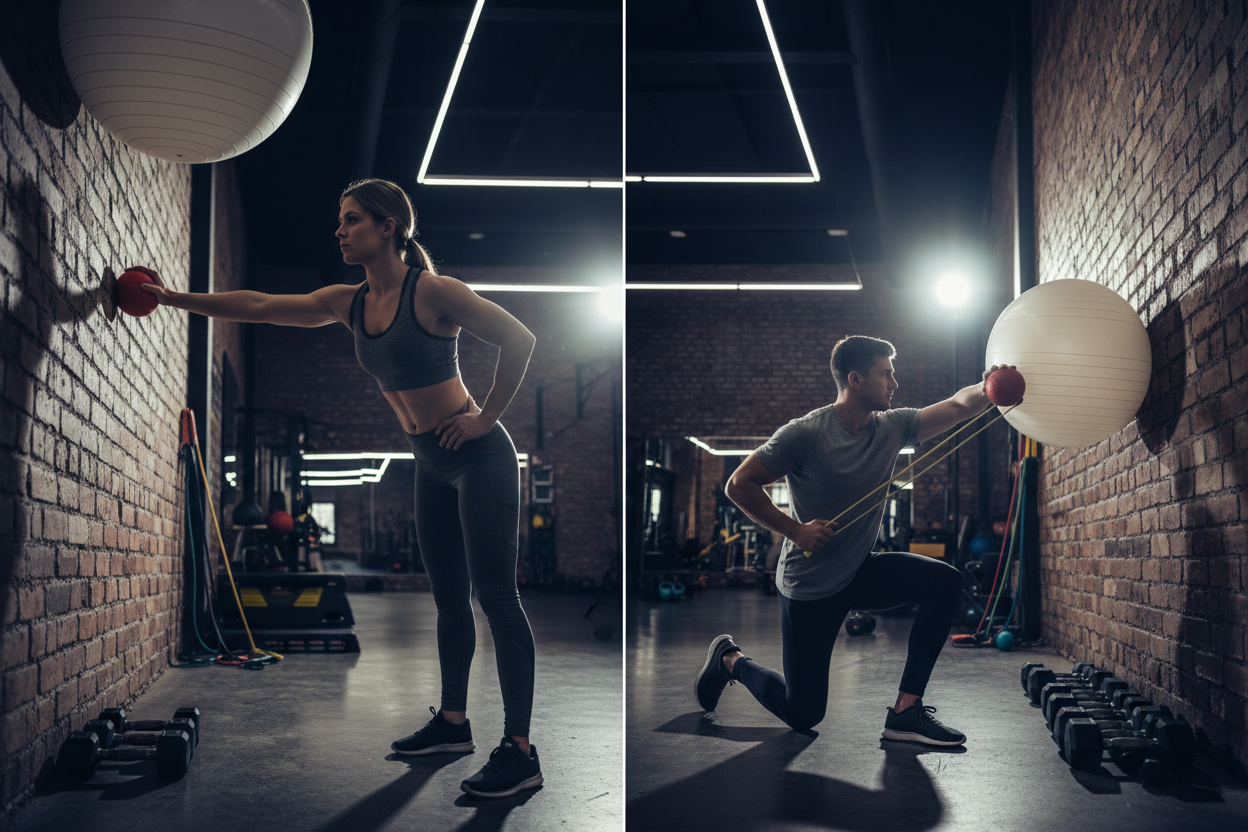
This is the gold standard for early-stage rehab and activation. Stand facing a wall with a small Swiss ball or a specific medicine ball placed between your hand and the wall.
Keep your elbow straight but not locked. Press gently into the ball and roll it in small circles—clockwise and counter-clockwise. The movement should come from the shoulder blade, not just the wrist. You are teaching the cuff to stabilize while the arm is moving.
2. Quadruped Ball Compression
Get on your hands and knees. Place one hand on the floor and the other on the exercise ball. Shift your weight slightly onto the ball.
The goal isn't to do a push-up yet. Just hold that position. You will feel your shoulder shaking. That shake is your nervous system figuring out how to stabilize the joint. This is one of the best rotator cuff ball exercises for beginners.
3. The Reverse Y-T-I on the Ball
Lie chest-down on a large exercise ball. Your feet should be wide for balance. With light weights (or no weights), lift your arms into a 'Y' shape, then a 'T', then an 'I' (arms by your sides).
The ball supports your torso, allowing you to focus entirely on the rear delts and the external rotators of the cuff. Ensure you squeeze your shoulder blades together at the top of every rep.
My Training Log: Real Talk
I want to be honest about the first time I took stability work seriously. I came from a powerlifting background where "stability" just meant bracing your abs. I tried the Wall Scour exercise mentioned above using a standard inflated exercise ball.
The humbling part wasn't the pain; it was the fatigue. It didn't feel like a bicep pump. It was a deep, nagging burn inside the joint that hit me after only 20 seconds. I also recall the specific frustration of the ball slipping against the drywall because I was pressing too hard—a rookie mistake. I learned quickly that the "grit" of the movement is in the finesse, not the force. You have to treat the ball like you're handling an egg; press enough to engage, but not enough to crush. That subtle vibration in the shoulder is where the magic happens, not in the heavy push.
Conclusion
Your shoulders carry the burden of your daily life and your gym PRs. Neglecting the small stabilizers is a one-way ticket to injury. By adding rotator cuff exercise ball drills to your warm-up or cool-down twice a week, you aren't just rehabbing; you are pre-habbing. You are building a foundation that allows you to press heavier and play harder without the fear of a blowout.
Frequently Asked Questions
How often should I perform rotator cuff ball exercises?
Because these muscles are endurance-based stabilizers, you can train them frequently. 3 to 4 times a week is optimal. Since the load is low, they recover relatively quickly compared to large muscle groups.
What size ball should I use for wall exercises?
For wall exercises like circles or scours, a smaller ball (like a soccer ball or a small medicine ball) is often easier to control than a massive Swiss ball. However, a standard 55cm or 65cm Swiss ball works perfectly fine if that is what you have available.
Should I feel pain during these exercises?
No. You should feel fatigue or a deep burning sensation in the muscle, but sharp pain is a red flag. If you feel pinching or sharp pain, stop immediately and consult a physical therapist. You may be compressing an inflamed tendon.