Master the Standing Hip Abductor Machine for Fuller Glutes
You have likely spent hours on the seated abductor, reading on your phone while mindlessly pushing your knees outward. But if your goal is functional strength and that coveted "upper shelf" glute look, the seated version often falls short. The standing hip abductor machine is the functional powerhouse you are probably neglecting.
Most lifters skip this variation because it feels awkward at first, or they simply don't know how to set it up. However, by standing up, you engage the core and stabilizers in a way that sitting simply cannot replicate. It changes the movement from a simple isolation exercise into a functional pattern that improves your squats, deadlifts, and running mechanics.
Key Takeaways: Why Switch to Standing?
If you are looking for the quick answer on why this machine belongs in your routine, here is the breakdown:
- Greater Glute Medius Activation: Standing allows for a fuller range of motion, targeting the upper glutes more effectively than sitting.
- Improved Hip Stability: It forces your non-working leg to stabilize the pelvis, correcting imbalances.
- Functional Carryover: The movement pattern mimics real-world athletics (running, cutting) better than a seated position.
- Reduced Hip Flexor Dominance: Standing helps prevent the TFL (tensor fasciae latae) from taking over the movement, keeping the tension on the glutes.
Why the Standing Abductor Machine Wins
To understand why this machine works, you have to look at anatomy. The gluteus medius and minimus are responsible for hip abduction (moving the leg away from the body) and stabilization.
When you use a standard seated machine, your pelvis is locked in place by the seat. This removes the need for stabilization. While that sounds good for isolation, it isn't how your body moves in reality. Using a standing abductor machine forces you to brace your core and stabilize your pelvis using your own musculature.
The "Glute Shelf" Factor
Many lifters struggle to develop the upper portion of the glutes. This is often because their heavy compounds (squats/deadlifts) are sagittal plane movements (front to back). The standing abduction machine works in the frontal plane (side to side). This lateral tension is exactly what builds that roundness at the top of the hips.
How to Use the Standing Abduction Machine Correctly
Going into this blind is a recipe for utilizing too much momentum. Follow this setup to ensure you are actually using your muscles, not just swinging your leg.
1. The Setup
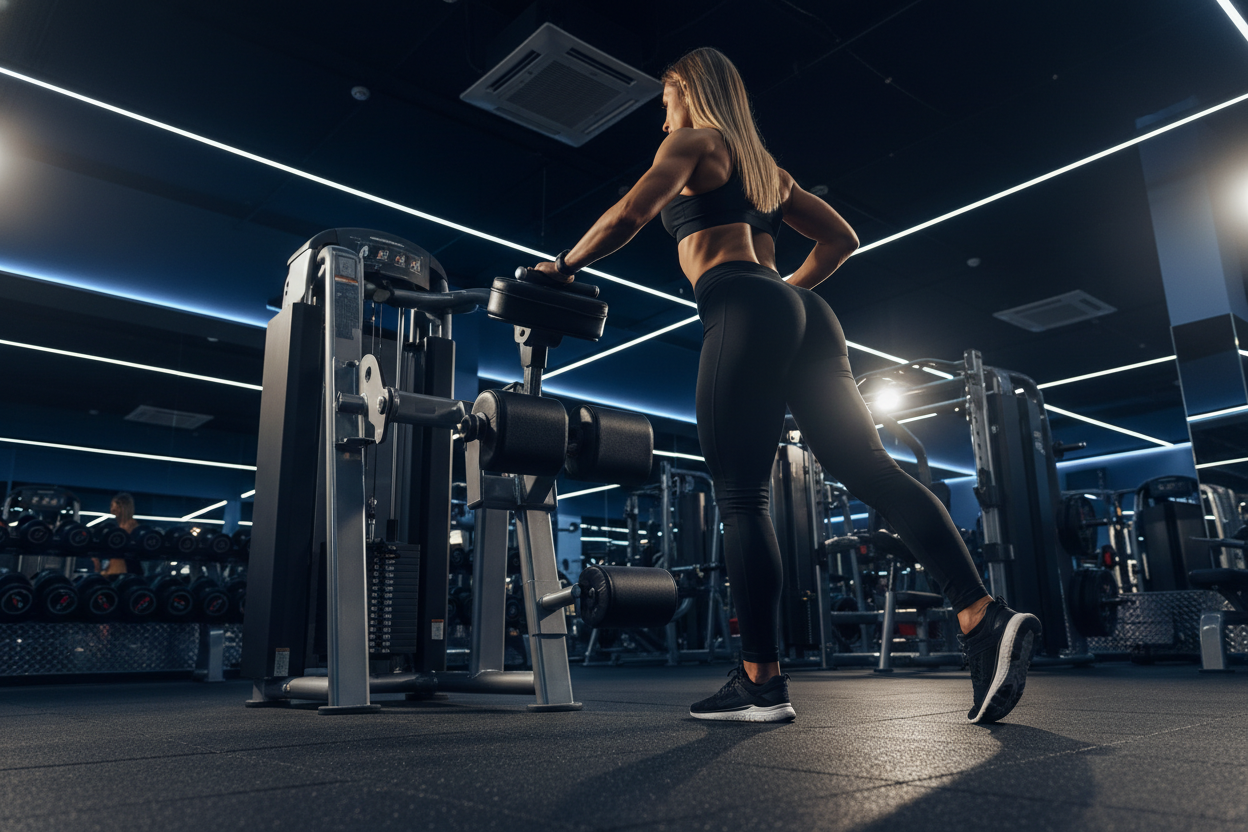
Adjust the pad so it rests just above your knee or on the lower thigh. If the pad is too high (on your hip), you lose leverage. If it's too low (on the calf), you risk knee strain. Stand perpendicular to the machine.
2. The Hinge
Here is the secret sauce: Do not stand perfectly upright. Hinge forward slightly at the hips (about 15 degrees). This slight angle puts the glute medius in a stronger position to contract compared to being perfectly vertical.
3. The Execution
Drive your leg outward against the pad. Focus on leading with your heel rather than your toes. If your toes point up or out excessively, you are likely recruiting your hip flexors instead of your glutes. Control the eccentric (the way back) slowly—do not let the weight stack slam.
Common Mistakes to Avoid
Even with a dedicated standing abductor, I see people getting it wrong constantly. Fix these errors to stop wasting your time.
Using the "Body English" Swing
If you have to throw your entire upper body to the side to get the weight moving, the weight is too heavy. Your torso should remain rigid. The only thing moving is the active leg. If you are leaning hard away from the machine to counterbalance the weight, drop the load.
Ignoring the Stabilizing Leg
On a standing abduction machine, your standing leg is working just as hard as the moving leg. It has to keep you from toppling over. Ensure your standing knee is soft (not locked out) and your foot is planted firmly. If you feel unstable, reduce the weight until you can control your balance.
My Training Log: Real Talk
I want to be honest about the experience of using the standing hip abductor machine because it’s not always comfortable. The first time I swapped my seated reps for standing cable abductions, the thing that failed first wasn't the glute I was trying to work—it was the foot of my standing leg.
There is a specific, cramping burn you get in the arch of your foot and the side of your stabilizing hip because you are balancing on one leg for 45 seconds straight. It’s humbling. You might be able to move the whole stack on the seated machine, but standing? You’ll likely be humbled by half that weight.
Also, a practical tip regarding the equipment: Watch out for the ankle cuff or pad placement. If you are wearing shorts, the velcro or the edge of the pad can chafe the skin on your lower thigh aggressively once you start sweating. I learned the hard way to wear leggings or longer compression shorts on leg day specifically for this movement.
Conclusion
The standing hip abductor machine isn't just a warm-up tool; it's a primary builder for lateral glute strength. By getting off the seat and standing up, you recruit more muscle fibers, improve your stability, and build a more resilient lower body. Start light, focus on the hold at the top of the movement, and stop letting your ego dictate the weight stack.
Frequently Asked Questions
Can the standing abductor replace squats?
No. Squats are a compound movement primarily targeting the quads and glute max in the sagittal plane. The standing abductor isolates the glute medius and minimus in the frontal plane. They are complementary exercises, not replacements.
How often should I use the standing abduction machine?
Since the glute medius is a smaller muscle group with a higher composition of slow-twitch fibers, it recovers relatively quickly. You can train it 2 to 3 times per week, ideally at the end of your leg workouts as a finisher.
Is a machine better than using a cable pulley?
Both are excellent. The standing abductor machine provides a fixed path of motion, which is great for beginners or for safely pushing heavier loads. A cable pulley requires more stabilization and allows for more freedom of movement, which is excellent for advanced lifters focusing on fine-tuning mechanics.