Massive Calves, No Gym Required: The Ultimate Bodyweight Guide
You do not need heavy machinery or a gym membership to build impressive, strong lower legs. The notion that calves are stubborn muscles that only respond to thousand-pound leg presses is a myth that keeps many people from reaching their potential. If you are looking for an effective calf exercise no equipment required, the answer lies in manipulation of gravity, leverage, and time under tension. By utilizing high volume and strict mechanical form, you can stimulate significant hypertrophy right in your living room.
Many lifters neglect their lower legs simply because they do not have access to a seated calf raise machine or a donkey calf raise station. However, the anatomy of the lower leg is designed to carry your body weight all day. To force them to grow, you must subject them to stress they aren't used to. A properly structured calf workout no equipment plan focuses on peak contractions and deep stretches, which often creates a stronger stimulus than mindlessly bouncing weight up and down in a gym.
Why Bodyweight Training Works for Calves
I remember a specific period when I was traveling for three weeks with absolutely no access to a fitness facility. I was worried my legs would shrink, so I committed to doing 100 reps of various calf exercises without equipment every morning. I used nothing but a thick book to create a deficit and a wall for balance. By the end of the trip, not only had I maintained my size, but the definition in my gastrocnemius had actually improved. The burn was unlike anything I had felt with weights because I was forced to slow down and control every millimeter of the movement.
The secret to effective bodyweight exercises for calves is mechanical disadvantage. By shifting your weight to one leg or changing the angle of your knee, you dramatically increase the load on the target muscle. Additionally, because you aren't risking injury with heavy external loads, you can push these muscles to absolute failure safely.
The Anatomy of a Complete Workout
To build a complete calf workout without equipment, you need to understand the two primary muscles you are targeting: the gastrocnemius and the soleus. The gastrocnemius is the large, diamond-shaped muscle visible when you stand on your toes. It crosses the knee joint, meaning it is most active when your legs are straight. The soleus lies underneath and is vital for width and thickness. It is most active when the knee is bent.
Most people only perform standing raises, leaving the soleus underdeveloped. A comprehensive routine must include variations for both. Below are the most effective movements you can perform anywhere.
The Single-Leg Deficit Calf Raise
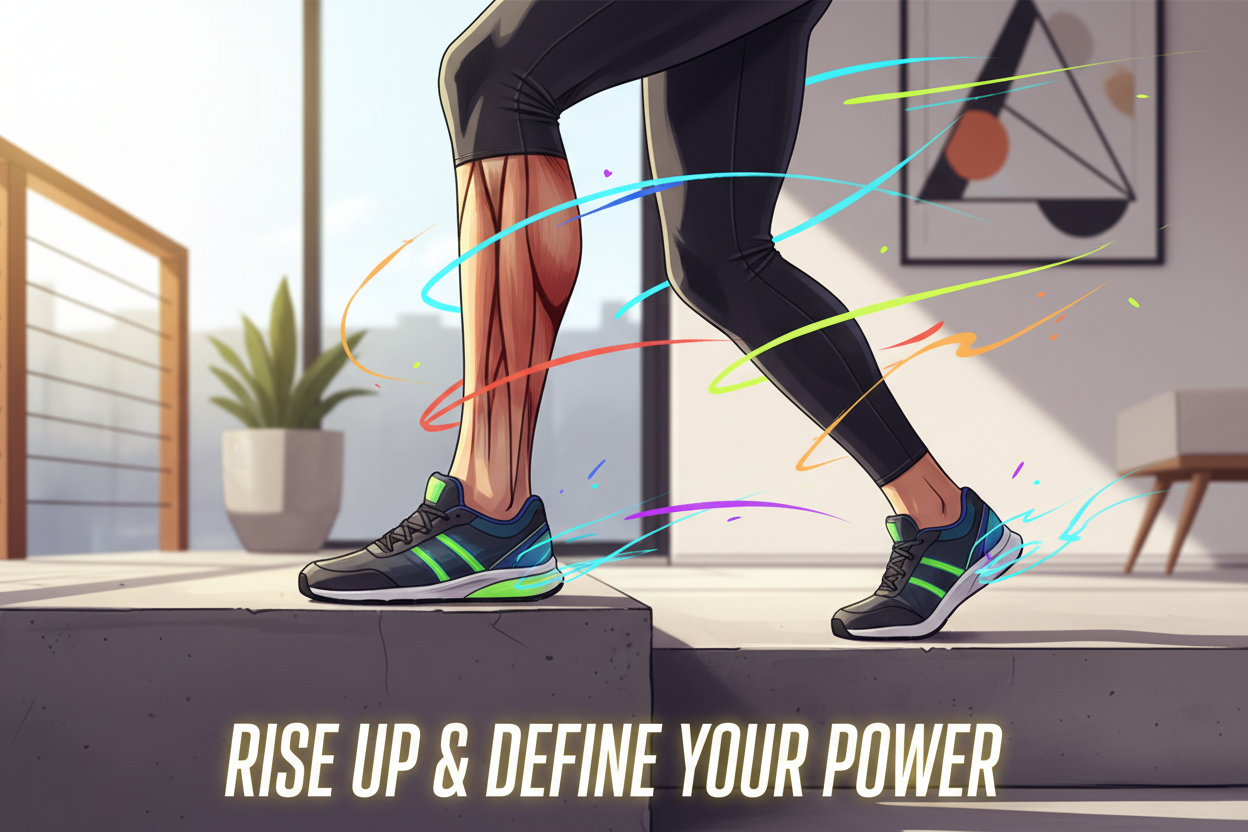
This is the king of bodyweight calf exercises. While two-legged raises are often too easy, shifting your entire body weight onto one foot provides ample resistance for most athletes. To perform this, find a step, a sturdy block, or even a thick textbook. Stand on the edge with the ball of one foot, letting your heel drop as far down as possible. This stretch is crucial.
Drive up onto your big toe, squeezing hard at the top for two seconds. Lower yourself slowly. If you are looking for the single best calf workout without weights, this is it. Aim for high repetitions, somewhere in the 15 to 25 range. The deep stretch at the bottom triggers muscle growth pathways that partial reps simply cannot touch.
The Bent-Knee Soleus Raise
Targeting the soleus usually requires a seated machine, but you can replicate this with bodyweight exercises calves variations. Stand in a squat position, or "wall sit" position, with your knees bent at roughly 90 degrees. From this static hold, perform calf raises. The bent knee disengages the gastrocnemius, forcing the soleus to do the work.
For a more intense version, assume a deep squat position (the "Asian squat") and perform raises from there. This requires balance and mobility but is incredibly effective as a calf bodyweight exercise. You will feel a distinct burn lower in the leg, near the Achilles tendon.
Donkey Calf Raises
Old-school bodybuilders loved this movement for a reason. Hinging at the hips places the gastrocnemius in a fully stretched position, optimizing it for contraction. To do these exercises for calves without equipment, lean forward and rest your hands on a countertop or sturdy table so your torso is parallel to the floor. Perform your calf raises in this position.
If you have a partner or a family member handy, have them sit on your lower back (safely) to add resistance. Even without a partner, the strict angle makes this one of the best calves workout no equipment options available.
Explosive Movements for Fast-Twitch Fibers
While slow, controlled reps build mass, explosive movements improve power and density. Your calves act as springs, and training that elastic recoil is beneficial. Jump rope is a fantastic addition to any calf workouts at home without equipment. It forces the calves to absorb and redirect force rapidly.
Another variation is the "pogo jump." Keep your knees relatively straight (soft lockout) and bounce exclusively using your ankles. This isolates the calves dynamically. Incorporating 3 sets of 30 seconds of pogo jumps into your calves bodyweight exercises routine will fry the muscle fibers that standard raises might miss.
Maximizing Intensity Without Iron
Since you are performing no weight calf exercises, you cannot rely on adding plates to progress. Instead, you must use metabolic stress and time under tension. A standard tempo for lifting weights might be 1 second up, 1 second down. For bodyweight calf workout success, try a 3-1-3 tempo: three seconds lowering, a one-second pause at the bottom stretch, and three seconds raising.
This eliminates the stretch reflex (the bounce) and forces the muscle to contract purely against gravity. The burn will be intense. If you can easily do 50 reps, your tempo is likely too fast. Slowing down turns easy calves workout without equipment into a grueling session.
Sample Home Routine
Here is a structured plan combining these elements. Perform this circuit 2-3 times per week. Rest 60 seconds between sets.
1. Single-Leg Deficit Raises: 3 sets of 15-20 reps per leg. (Focus on the stretch).
2. Bent-Knee Wall Sit Raises: 3 sets to failure. (Targets the soleus).
3. Pogo Jumps: 3 sets of 45 seconds. (Explosive finish).
4. Isometric Hold: Stand on tiptoes for as long as possible. (Burnout).
Consistency is the final piece of the puzzle. Calves recover quickly compared to larger muscle groups like the hamstrings or back. Because you are relying on calf exercises bodyweight protocols, the recovery curve is even faster, allowing for higher frequency training.
You have everything you need to build a set of diamond-shaped calves. It requires grit, a tolerance for the burn, and strict adherence to the full range of motion. Do not let the lack of a gym be your excuse. Start stepping.
Frequently Asked Questions
How often should I train my calves without weights?
Since bodyweight exercises generally cause less systemic fatigue than heavy weighted movements, you can train your calves frequently. For most people, 3 to 4 times a week is optimal to see growth, as calves recover very quickly and respond well to high-volume stimuli.
Can I actually build mass with just bodyweight calf exercises?
Yes, provided you apply progressive overload through higher repetitions, decreased rest times, or slower tempos. The key is reaching muscular failure; if you stop while the reps are still easy, the muscle has no reason to adapt and grow larger.
What should I do if I have bad calf genetics?
While muscle insertion points are genetic (high vs. low calves), muscle thickness is determined by training. You cannot change where the muscle attaches to the tendon, but you can maximize the size of the muscle belly you do have through consistent, high-intensity training and full range of motion.