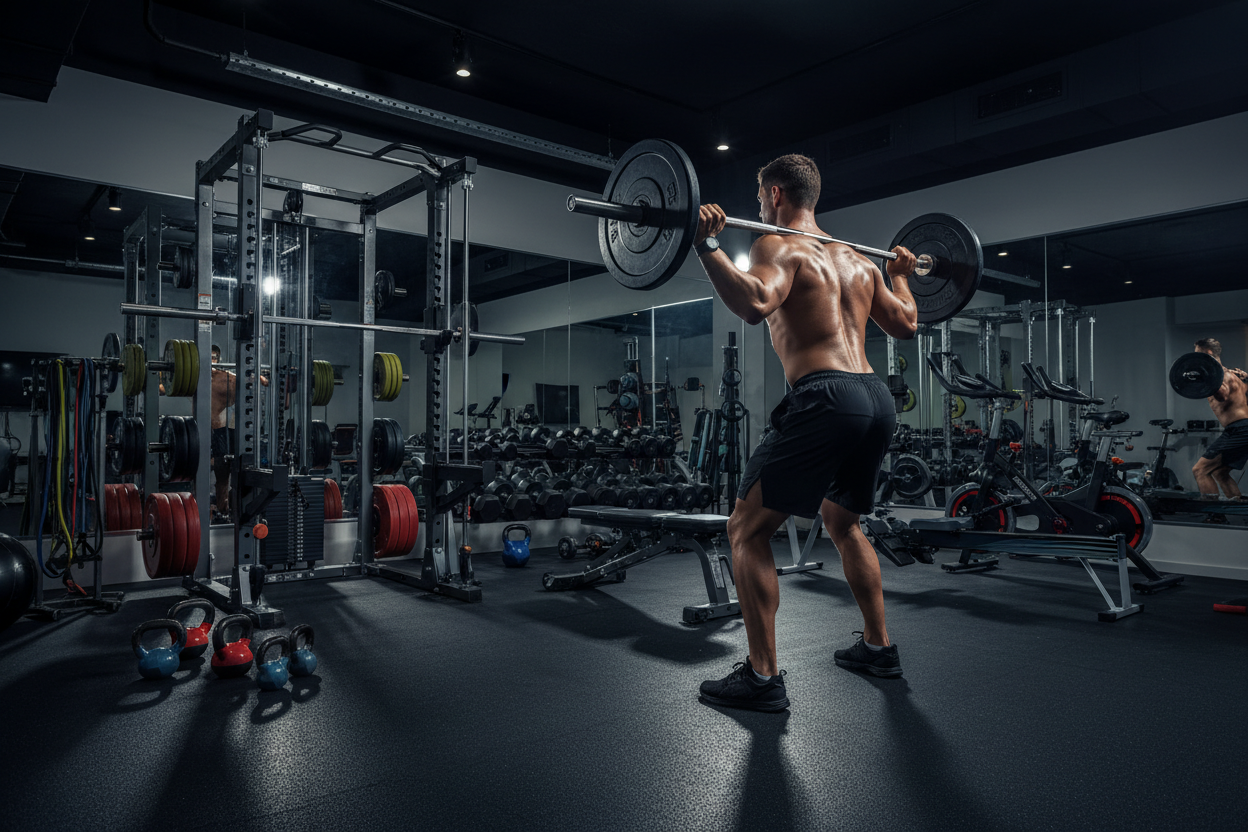
Machine Squat Rack Guide: Is It Right for Your Home Gym?
Building a home gym often forces you to make tough choices between safety, versatility, and floor space. If you train alone in a basement or garage, pushing close to failure on heavy leg days can feel like a risky gamble.
That is exactly where a machine squat rack steps in to bridge the gap. Whether you are looking to isolate your quads, safely max out without a spotter, or consolidate your equipment, this guide will help you decide if a guided rack system belongs in your setup.
Key Takeaways
- Provides a fixed, guided bar path, making it incredibly safe for solo lifters training to failure.
- Requires a dedicated footprint, typically needing at least 7 to 8 feet of ceiling clearance.
- Highly versatile for squats, bench presses, seated shoulder presses, and calf raises.
- Excellent for muscle isolation since you do not need to expend energy stabilizing a free-weight barbell.
Breaking Down the Machine Squat Rack
Guided Rails vs. Free Weights
The defining feature of this equipment is its fixed vertical or slightly angled track. Unlike a traditional power cage where the barbell moves freely in three dimensions, a machine squat rack restricts horizontal movement. This is a massive advantage for hypertrophy (muscle growth) because it allows you to lean back slightly, adjust your foot placement, and isolate the quads or glutes without losing your balance.
Build Quality and Weight Capacity
When comparing models, pay close attention to the linear bearings. Entry-level racks often use nylon bushings, which can feel sticky or jerky under heavy loads. Premium home gym models utilize commercial-grade linear bearings that glide smoothly even when loaded with over 400 pounds. Always check the weight capacity—aim for a rack rated for at least 600 pounds to ensure long-term durability.
Planning Your Gym Layout
The Garage and Basement Test
Space is the ultimate currency in a home gym. A standard machine squat rack requires a significant footprint. You need to account for the width of the machine, plus an extra 12 to 18 inches on each side to comfortably load and unload Olympic weight plates. If you are setting up in a basement, measure your ceiling height carefully. Many of these units stand between 82 and 90 inches tall, meaning low basement ceilings could be an absolute dealbreaker.
From Our Gym: Honest Take
We have tested dozens of rack configurations over the years, and a high-quality guided rack is one of the most misunderstood pieces of equipment. Last winter, I installed a hybrid machine squat rack in our garage facility. At 6 foot 2, I usually struggle with the restricted range of motion on cheaper models, but a rack with an 86-inch internal height gave me plenty of room for deep squats and standing calf raises.
The honest caveat? The maintenance. If you train in a humid garage like I do, you cannot ignore the guide rods. After about six months of heavy use, the bar started to drag slightly during the eccentric phase of my squats. A quick wipe down and a fresh application of silicone-based lubricant on the steel guide rods brought it right back to a buttery-smooth glide. It is a minor chore, but essential for optimal performance.
Frequently Asked Questions
Is a machine squat rack better than a standard power rack?
It depends on your goals. A standard power rack is better for building raw, functional strength and stabilizer muscles. A guided machine rack is superior for muscle isolation, hypertrophy, and safely training to failure without a spotter.
Can I do exercises other than squats on it?
Absolutely. You can place an adjustable bench inside the rack to perform incline presses, flat bench presses, and seated overhead military presses. You can also use it for Romanian deadlifts, shrugs, and inverted rows.
How much space do I need for a machine squat rack?
Plan for a minimum floor space of 6 feet wide by 5 feet deep. You will also need a ceiling clearance of at least 8 feet to comfortably assemble the unit and use it without hitting your head on the top crossmember.