Machine Only Leg Workout: The Blueprint for Safe Hypertrophy
Let’s address the elephant in the room immediately. There is a pervasive myth in the fitness industry that if you aren't suffering under a bending barbell, you aren't training hard enough. That couldn't be further from the truth. In fact, relying solely on free weights can sometimes limit your growth potential due to stability issues and systemic fatigue. A well-structured machine only leg workout is not a regression; it is a strategic tool for isolating the lower body without the spinal compression that comes with heavy squatting.
Key Takeaways
- Stability Equals Output: Machines provide external stability, allowing you to focus 100% of your effort on pushing the weight rather than balancing it.
- Safety at Failure: You can push to absolute muscular failure safely without a spotter, which is critical for hypertrophy.
- Volume Tolerance: A machine only leg day places less stress on the central nervous system (CNS) and lower back, allowing for potentially higher volume or frequency.
- Targeted Isolation: Machines like the leg extension allow you to train muscles in their fully shortened position, something free weights struggle to do.
Why Ditch the Barbell? The Science of Stability
Your muscles do not have eyes. They do not know if you are squatting 315 lbs with a barbell or pushing 500 lbs on a leg press. They only understand mechanical tension. The primary benefit of using machines is the removal of the "balance factor."
When you squat, a significant amount of neural energy is spent stabilizing your torso and hips. When you use a machine, that stability is provided for you. This allows for greater "motor unit recruitment" in the target muscle. Essentially, because you don't have to worry about falling over, your brain allows your quads and hamstrings to contract harder.
The Cornerstone Movements
To execute a successful machine only leg day, you need to replicate the movement patterns of free weights—squat, hinge, and isolation—using mechanical counterparts.
1. The Hack Squat (The Squat Replacement)
This is your primary compound lift. The hack squat mimics the barbell squat but supports your back. This support allows you to place your feet lower on the platform, driving significantly more knee flexion than a traditional low-bar squat. More knee flexion equals more quad stretch, which leads to more growth.
2. The Seated Leg Curl (The Hinge/Hamstring Builder)
While the lying leg curl is popular, the seated variant is superior for hypertrophy. Sitting creates a slight stretch in the hamstrings at the hip joint before you even start the rep. Training a muscle at longer lengths is generally superior for muscle growth.
3. The Leg Press (Volume Driver)
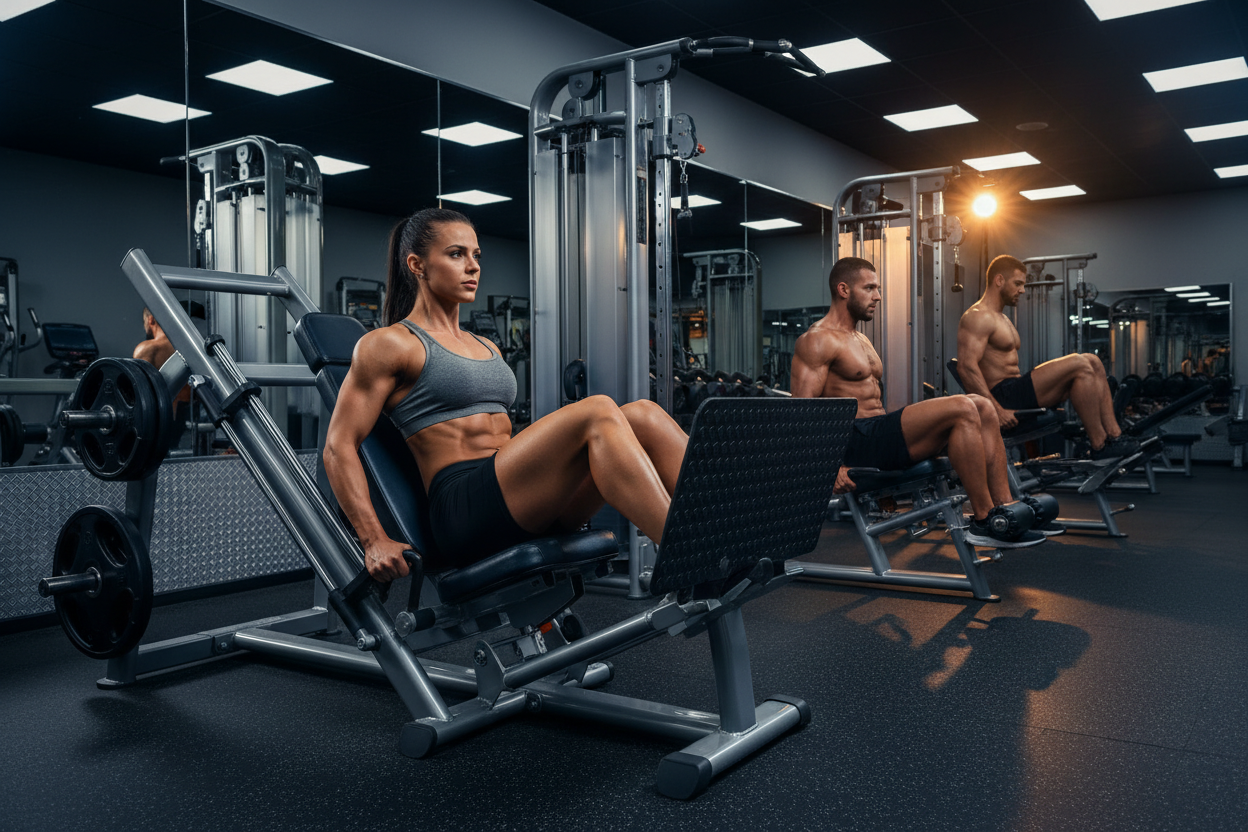
Use this for metabolic stress. Since your torso is locked in, you can safely perform high-rep sets or drop sets. Focus on a controlled eccentric (lowering) phase. Do not bounce the weight off the safety stops; that’s just asking for knee injury.
Intensity Techniques Unique to Machines
One distinct advantage of machines is the ability to use intensity techniques that would be dangerous with free weights.
Mechanical Drop Sets
On a leg press, you can start with your feet low (quad focus). When you hit failure, immediately move your feet higher on the platform (glute/hamstring bias) and continue the set. This extends the time under tension without needing to strip plates.
Partials and Isometrics
On a leg extension, once you can no longer perform a full rep, you can safely grind out partial reps at the bottom to fully exhaust the muscle fibers. Attempting this with a barbell squat often leads to compromised form and injury.
My Training Log: Real Talk
I switched to a strictly machine-based routine for eight weeks last year after tweaking my L4 vertebra during a deadlift. I was skeptical, thinking my legs would shrink. They didn't. They actually grew, but the experience was... different.
Here is the unpolished reality: Machine workouts hurt in a different way. When you squat heavy, you feel a systemic "crushing" feeling. But on the Hack Squat, the pain is incredibly localized. I remember specifically the feeling of the shoulder pads digging into my traps on the final rep of a drop set. It wasn't the "I might die" fear of a squat; it was a searing, acidic burn in the vastus medialis that made me want to vomit.
Also, nobody talks about the friction. On the lying leg curl, if you're wearing loose shorts, the vinyl pad tends to grab the fabric and bunch it up right in the crotch area as you curl up. It’s annoying. I learned quickly to wear compression shorts or leggings. And the leg extension? If you don't set the back pad forward enough, you float out of the seat. I spent the first two sessions awkwardly gripping the handles, knuckles turning white, just to keep my butt in the chair while my quads screamed.
Conclusion
Machines are not a crutch; they are a scalpel. While free weights are fantastic for total body coordination and strength, a machine only leg workout provides the stability required to take your muscles to true failure safely. If your goal is pure hypertrophy (muscle growth) rather than powerlifting total, this approach is not just a viable alternative—it might be the superior choice.
Frequently Asked Questions
Can you really build mass with only machines?
Absolutely. Hypertrophy is driven by mechanical tension and metabolic stress. Machines allow you to maximize both by removing stability constraints, often allowing you to load the target muscle heavier than you could with free weights.
How often should I do a machine only leg day?
Because machines cause less systemic fatigue (less strain on the nervous system) than heavy barbell squats, you can often train legs more frequently. Twice a week is a standard and effective frequency for most lifters.
Is this workout safe for bad knees?
Generally, yes, but setup is key. Machines allow you to adjust foot placement to shift stress. For example, placing feet higher on the leg press platform reduces the degree of knee flexion, shifting the load more toward the glutes and hamstrings and reducing shear force on the knee joint.