Article: Lifting the Line: How to Actually Target Your Lower Glutes
Lifting the Line: How to Actually Target Your Lower Glutes
We have all stared in the mirror and felt that specific frustration regarding the "glute-ham tie-in." You might be squatting heavy and hip thrusting until your hips are bruised, yet that specific area where the glute meets the hamstring—often called the "underbutt"—refuses to pop. The reality of training this area is that you cannot completely isolate the lower fibers of the gluteus maximus from the upper fibers. However, biomechanics tells us that we can bias certain regions by manipulating the angle of the hips and the point of maximum tension.
If you are looking for the short answer, the secret lies in exercises that challenge the glutes while they are fully stretched. Movements that involve deep hip flexion with a long range of motion are superior for this specific goal. While squats are great, they aren't necessarily the magic bullet here. Instead, prioritize deficit reverse lunges, glute-focused step-ups, and Romanian Deadlifts (RDLs). These movements place the highest demand on the glutes when the muscle is lengthened, which is the key to developing that lower curve.
Why Your Current Routine Might Be Failing You
I spent the early years of my lifting journey confused about why my legs were growing but my glute shape wasn't changing the way I wanted. I was obsessed with heavy back squats. I moved impressive weight, but my quads were taking over the movement. My knees shot forward, my torso stayed upright, and my glutes were merely assisting rather than driving the lift. It wasn't until I dropped the ego lifting and shifted my focus to unilateral movements and deep stretches that I saw a change. I had to learn that feeling a burn is different from creating mechanical tension at long muscle lengths.
The lower glute fibers are primarily responsible for hip extension and adduction. To hit them, you need to select movements where the hardest part of the lift happens when your glute is stretched out (think the bottom of a lunge), rather than when it is squeezed short (like the top of a hip thrust).
The King of the Underbutt: Deficit Reverse Lunges
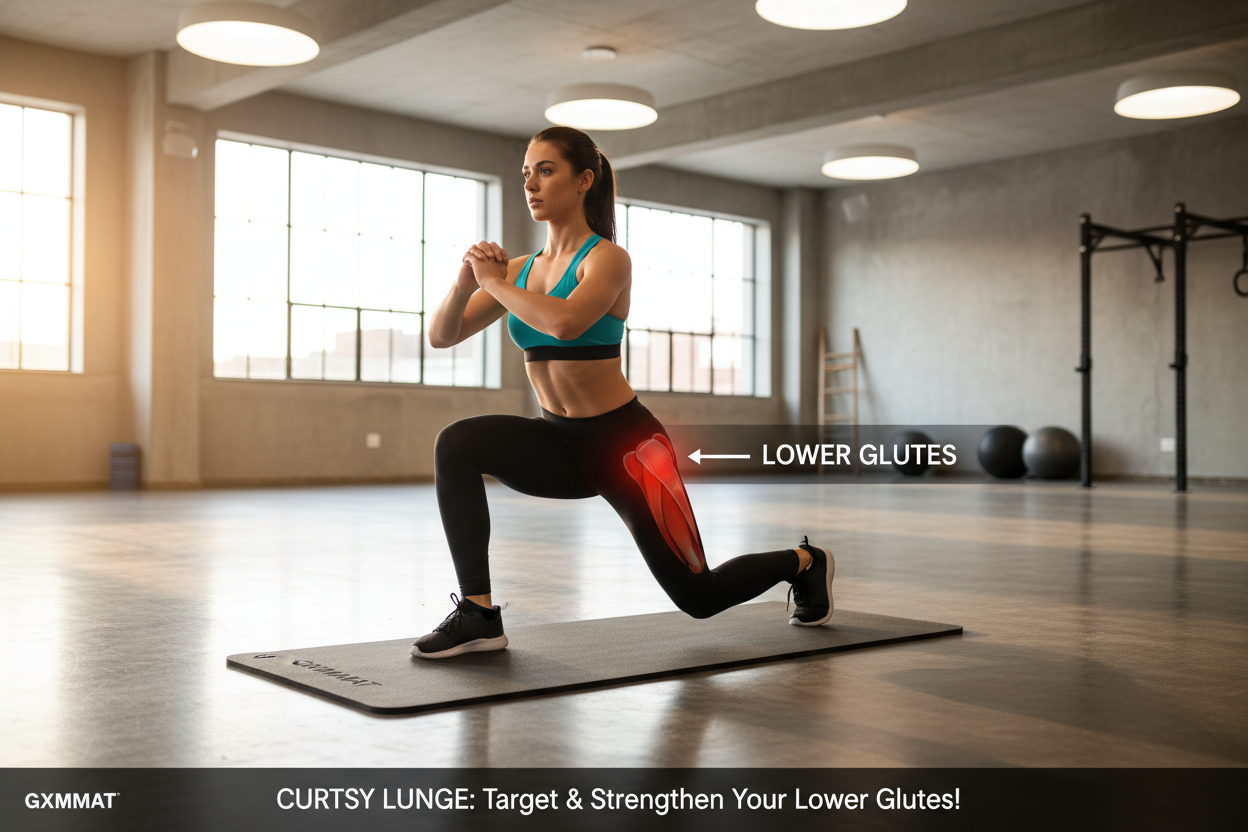
If I had to choose a single movement to transform the posterior chain, the deficit reverse lunge would be the best exercise for lower glutes. The deficit—standing on a small plate or platform—allows your knee to travel lower than your foot, increasing the range of motion and the stretch on the glute.
To perform these correctly, stand on a 2-4 inch platform. Step back with one leg, dropping the back knee toward the floor. Here is the crucial nuance: lean your torso forward slightly (about 30 to 45 degrees) while keeping your back flat. This torso lean shifts the leverage away from the quad and directly onto the glute. Drive through the heel of the front foot to return to the starting position. You should feel a deep tearing sensation (in a good way) right at the glute-ham tie-in at the bottom of the rep.
Glute-Focused Step-Ups
Step-ups often get a bad reputation because they are frequently performed poorly, with people launching themselves up using their back leg. However, when done with strict control, they rank high among the best exercises for lower glutes. The goal here is to minimize assistance from the non-working leg.
Find a box or bench that is roughly knee height. Place one foot on the box. Before you move, hinge at the hips so your chest is over your knee. Now, drive down through the foot on the box to lift your body. Do not push off the floor with the other foot; pretend the floor is lava. Lower yourself slowly, taking 3-4 seconds to reach the ground. The eccentric (lowering) phase is where the magic happens for hypertrophy. If you are not controlling the descent, you are missing half the benefit.
Romanian Deadlifts (RDLs)
While the previous two exercises focus on unilateral movement, the Romanian Deadlift allows for heavier loading. This lift targets the entire posterior chain, bridging the gap between the hamstrings and the glutes. It is essential for creating that separation line.
Keep a slight bend in your knees—just enough to unlock them—and push your hips back as far as possible. Imagine you are trying to close a car door with your butt. Keep the barbell or dumbbells close to your shins. Stop when your hips stop moving back; going lower than that usually just rounds the lower back. The tension should be palpable in the hamstrings and the bottom of the glutes. Squeeze your glutes to drive your hips forward and return to standing.
Structuring Your Leg Day
Knowing the movements is only half the battle; implementing them requires strategy. You don't need to do every exercise every session. A solid approach is to pick two of the best lower glute exercises and make them the focus of your leg day. Start with your heavy compound movement, like the RDL, while you have the most energy. Follow this with your unilateral work, like the deficit lunges or step-ups.
Aim for a rep range that allows for mechanical failure without form breakdown. For RDLs, 8-10 reps works well. For lunges and step-ups, slightly higher reps in the 10-15 range can help you maintain the mind-muscle connection without stability becoming the limiting factor.
The Role of Mind-Muscle Connection
You can do all the right movements and still miss the target if you aren't intentional. "Just moving the weight" often leads to the lower back or quads taking over. Before every set, visualize the specific area you are trying to work. During the eccentric phase of a lunge or RDL, actively think about stretching the glute fibers apart. During the concentric (lifting) phase, think about driving the hips forward rather than just standing up.
Consistency in technique will always trump weight on the bar. If you add fifty pounds to your step-up but start jumping off the back leg, you have effectively made the exercise easier for your glutes, not harder. Leave the ego at the door, slow down the tempo, and respect the stretch.
Frequently Asked Questions
Can I isolate the lower glutes completely?
No, the gluteus maximus is one large muscle, and you cannot isolate the lower fibers entirely. However, you can bias the lower region by choosing exercises that load the muscle in a lengthened position, such as deep lunges and RDLs, which place more tension on the lower fibers compared to the upper shelf.
How often should I train glutes to see results?
For most people, training glutes 2 to 3 times per week allows for sufficient volume and recovery. Since the glutes are a large muscle group, they can handle significant workload, but ensure you have at least 48 hours of rest between heavy sessions to allow the muscle fibers to repair and grow.
Are squats or hip thrusts better for the underbutt?
While both are excellent, neither is the absolute best for the specific "underbutt" area. Hip thrusts target the glutes in the shortened position (upper bias), and squats are often quad-dominant. Deep, stretch-focused movements like deficit reverse lunges are generally superior for targeting the lower glute region.