Leg Extension/Leg Curl: The Definitive Guide to Isolation Training
Squats and deadlifts get all the glory, but if you ignore isolation work, you are leaving significant hypertrophy on the table. The leg extension/leg curl combination is the bread and butter of aesthetic leg development, yet most lifters treat these movements as an afterthought.
You often see people swinging the weight, neglecting eccentric control, or setting up the machine so poorly that their knees scream louder than their muscles. Whether you are using a commercial gym selectorized stack or a home gym combo unit, precision is the only way to get results without injury.
Key Takeaways: Quick Summary
- Targeted Hypertrophy: These are the only exercises that fully isolate the quadriceps and hamstrings without systemic fatigue.
- Knee Health: Contrary to old myths, controlled extensions strengthen the patellar tendon when performed correctly.
- Setup Matters: Aligning your knee joint with the machine's axis of rotation is non-negotiable for safety.
- Seated vs. Lying: Seated leg curls generally offer better hypertrophy due to the stretched position of the hamstrings.
- Programming: Use these for pre-exhaustion before squats or as a high-rep finisher to drive metabolic stress.
The Science Behind the Leg Curl Extension Combo
Compound movements build mass, but isolation movements build detail. The primary function of the leg extension and curl is to target the muscles that cross the knee joint without the limiting factor of lower back strength or cardiovascular fatigue.
For the quads, the leg extension is unique because it loads the rectus femoris in a shortened position—something a squat cannot do. For the hamstrings, the leg curl and extension counterpart (specifically the curl) trains knee flexion, which is biomechanically distinct from the hip extension trained in deadlifts.
Mastering the Leg Extension
Many lifters fear the leg extension due to "shear force" warnings. While high shear forces exist, the danger is exaggerated for healthy knees if the setup is correct.
The Axis of Rotation
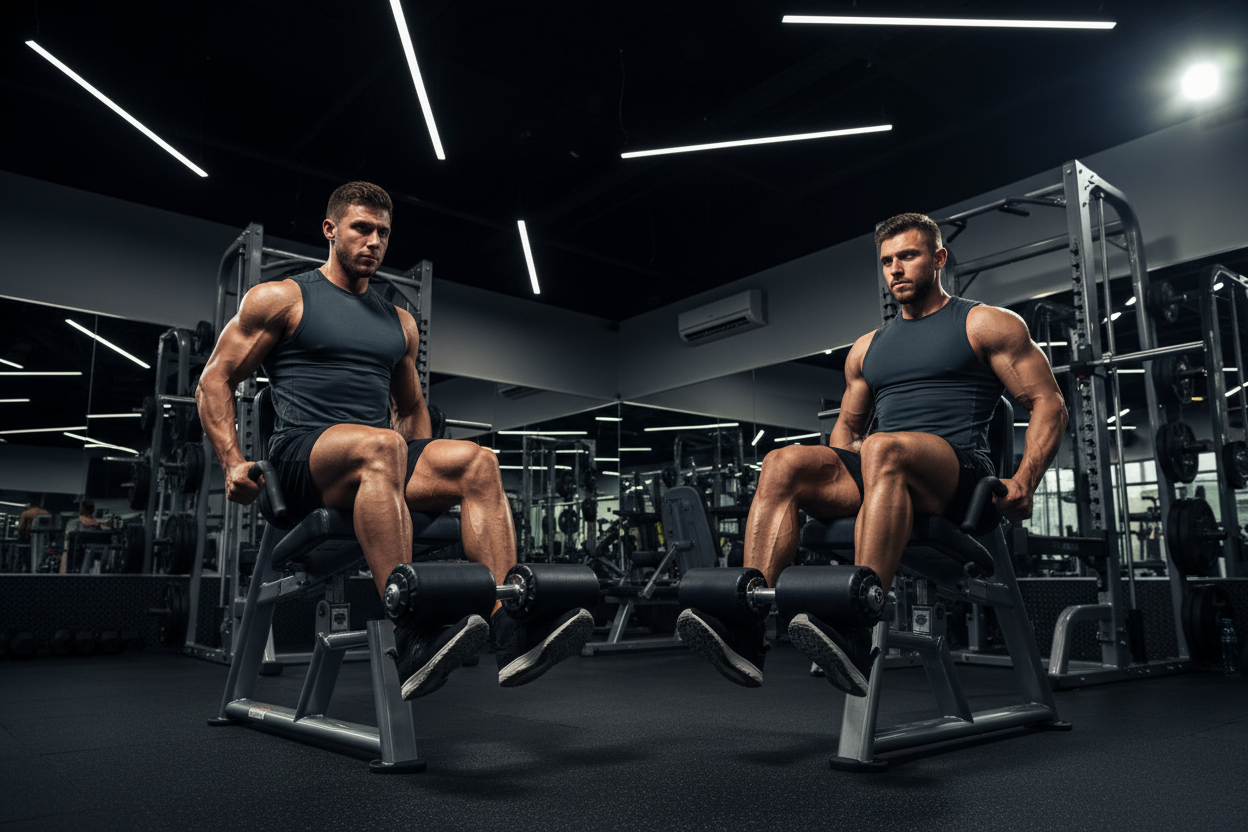
Look at the side of the machine. There is usually a pivot point (a bolt or a red dot). Your knee joint must align perfectly with this point. If your knee is too far forward or back, you create unnecessary leverage against the joint rather than the muscle.
Foot Position and Control
Keep your toes pointed straight up or slightly out. The most crucial part of the leg extension curl dynamic is the tempo. Explode up, hold for a distinct one-second peak contraction, and lower the weight over three seconds. Do not let the stack slam.
Optimizing the Leg Curl
While the lying leg curl is a classic, the seated leg curl is often superior for growth. Why? Because sitting flexes the hip. Since the hamstrings cross both the hip and knee, flexing the hip puts the hamstrings in a stretched position. Muscle tension at long lengths is a potent driver of hypertrophy.
Locking It Down
Whether you are doing a curl extension superset or straight sets, you must lock your body into the seat. If your hips rise off the pad during a lying curl, you are using your lower back and glutes to move the weight. Jam your hips into the pad and keep them there.
Programming the Leg Extension/Leg Curl
There are two effective ways to slot these into your routine.
1. Pre-Exhaustion
Perform the leg extension/leg curl movements first. This warms up the knee joints and fatigues the quads and hams. When you move to squats afterward, your legs will fail before your lower back or lungs do, making the compound lift more targeted.
2. The Finisher
Save them for the end. Your nervous system is fried from heavy compounds, so you don't need to balance a heavy barbell. This is the time to chase the pump. Sets of 15 to 20 reps with short rest periods work best here.
My Training Log: Real Talk
I’ve spent years training in both high-end commercial facilities and garage gyms, and I have a love-hate relationship with the leg extension/leg curl machines. Specifically, I own a plate-loaded combo unit in my home gym.
Here is the gritty reality no manual tells you: on those combo machines, the transition time is a nightmare. You have to pull the pop-pin, swing the arm all the way around, and adjust the thigh pad just to switch from extensions to curls. It absolutely kills the flow of a superset.
Also, on heavy extensions, I’ve noticed that if I’m wearing shorts, the vinyl shin pad gets slick with sweat around rep 12. It starts to roll up my shin, turning a quad exercise into a weird ankle-skin exfoliation session. I actually started wrapping a small towel around the roller or wearing high socks just to keep the friction consistent so I could focus on the VMO rather than the burning sensation on my shins.
Conclusion
The leg extension/leg curl isn't just an accessory; it's a necessity for complete leg development. It fills the gaps that squats and deadlifts leave behind. Focus on your alignment, control the eccentric, and stop worrying about the weight on the stack. Your knees—and your quad sweep—will thank you.
Frequently Asked Questions
Is the leg extension bad for your knees?
Not inherently. If you have existing ACL injuries, you should consult a physio. However, for healthy knees, performing leg extensions with controlled tempo and proper axis alignment actually strengthens the connective tissue surrounding the patella.
Can I superset leg extensions and curls?
Yes, this is an antagonistic superset. Since quads and hamstrings perform opposite functions, one rests while the other works. This is an excellent way to increase workout density and pump blood into the entire upper leg.
Should I do leg curls seated or lying?
If you have access to both, prioritize the seated leg curl. The seated position places the hamstrings in a greater stretch, which research suggests leads to greater muscle growth. Use the lying curl for variation.