Types of Squats and Muscles They Work: The Definitive Guide
You walk into the gym, head to the rack, and get under the bar. But are you performing the movement that actually aligns with your physique goals? Most lifters treat the squat as a monolithic exercise, ignoring the fact that subtle shifts in bar placement or foot stance completely alter the biomechanics. Understanding the different types of squats and muscles they work is the difference between spinning your wheels and finally growing those stubborn quads or glutes.
This guide cuts through the noise. We aren't just listing exercises; we are breaking down the anatomy of the movement so you can program your leg day with surgical precision.
Quick Summary: Squat Biomechanics
If you are looking for a cheat sheet on muscle activation, here is the breakdown of the most effective variations:
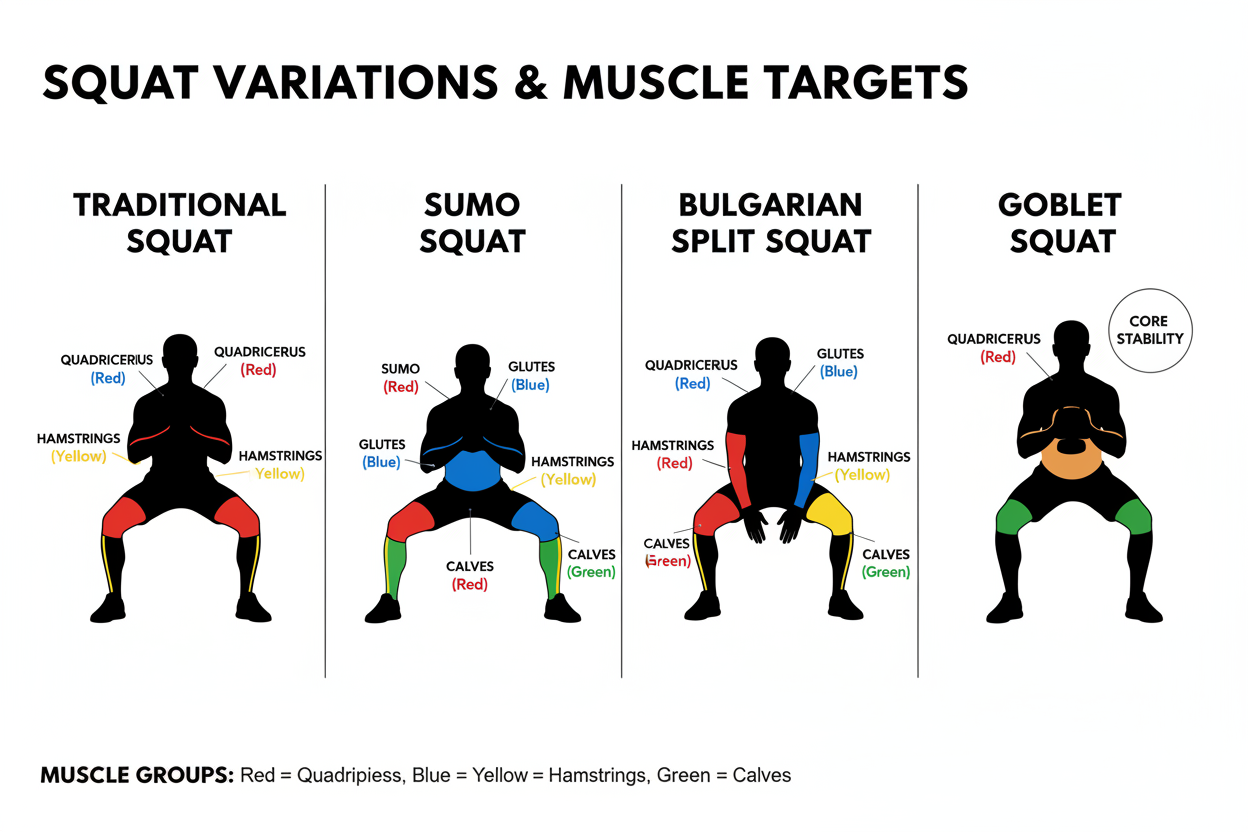
- High Bar Back Squat: Maximizes knee flexion, primarily targeting the Quadriceps.
- Low Bar Back Squat: Increases hip flexion, heavily recruiting the Glutes and Hamstrings.
- Front Squat: Vertical torso demands place load on the Quads and Upper Back (Thoracic Erectors).
- Sumo Squat: Wide stance shifts emphasis to the Adductors (Inner Thigh) and Glutes.
- Goblet Squat: Anterior load engages the Core and Quads while improving mobility.
The Mechanics of Bar Placement
The position of the load dictates the center of gravity. This forces your body to adjust its leverage, which changes the primary movers.
High Bar vs. Low Bar: The Eternal Debate
When analyzing squat variations and muscles targeted, the distinction between high bar and low bar is critical. In a high bar squat, the barbell rests on your traps. This forces you to stay upright to keep the bar over your midfoot.
Because your torso is vertical, your knees must travel further forward. This creates a longer moment arm at the knee joint, placing the brunt of the tension on the quadriceps. If you want teardrop quads, this is your go-to.
Conversely, the low bar squat places the bar across the rear delts. To prevent the bar from rolling off, you must lean your torso forward. This lean stretches the posterior chain. While the quads still work, the mechanical advantage shifts to the glutes and hamstrings to extend the hips.
Front-Loaded Variations
Moving the weight to the front of the body changes the game entirely. This category includes Front Squats and Goblet Squats.
The Front Squat Factor
Many lifters avoid these because they are uncomfortable, but regarding squat variations muscles worked, the Front Squat is the king of quad isolation. Because the weight is on your collarbone, you cannot lean forward without dropping the bar.
This strict verticality eliminates almost all momentum from the hips. It also forces your thoracic extensors (upper back) to fight gravity to keep your chest up. It is as much a posture builder as it is a leg builder.
Stance Width and Foot Angle
You can manipulate muscle recruitment without even changing the bar position.
Narrow vs. Sumo Stance
A narrow stance generally increases range of motion at the knee, biasing the outer sweep of the quad. However, widening your feet into a Sumo stance engages the adductor magnus (inner thigh). For powerlifters, a wider stance often allows for more weight because it shortens the range of motion and utilizes the massive hip musculature more effectively.
My Personal Experience with types of squats and muscles they work
I want to be real about the Front Squat. On paper, it is the superior quad builder. In reality, it is a test of pain tolerance that has nothing to do with your legs.
When I first switched from low bar to front squats to bring up my lagging quads, I wasn't limited by leg strength. I was limited by the feeling that I was slowly choking myself out. I remember distinctly the specific, bruised ridge that formed across my collarbone and front delts where the bar sat. No amount of "creating a shelf" seemed to stop the knurling from digging in once I got past 225 lbs.
There is also a panic moment at the bottom of a heavy rep where your elbows drop just a millimeter, and you feel the weight threaten to dump forward. Fighting that position creates a burning sensation in the middle of the upper back (between the shoulder blades) that lasts for two days. That is the "hidden" muscle work no textbook really prepares you for.
Conclusion
Stop guessing at the rack. If your goal is glute development, stop forcing upright high-bar squats. If you need quad mass, stop relying on wide-stance powerlifting techniques. Match the movement to the muscle you want to grow.
Frequently Asked Questions
Which squat variation is best for bad knees?
Generally, the Box Squat or a vertical-shin Low Bar Squat is friendlier on the knees. These variations reduce forward knee travel (shear force) and place more load on the hips and hamstrings, taking stress off the patellar tendon.
Do wide stance squats actually build the inner thigh?
Yes. Research confirms that wider stances significantly increase activation of the adductor magnus. If you are looking to fill out the inner thigh, incorporating wide-stance or Sumo squats is highly effective.
Can I build hamstrings just by squatting?
Not optimally. While low bar squats recruit hamstrings, the muscle undergoes simultaneous lengthening at the hip and shortening at the knee (Lombard's Paradox). For complete development, you should pair squats with a hip-hinge movement like Romanian Deadlifts.