Leg Day Anatomy 101: A Blueprint for Building Your Lower Body
Walking into the weight room can feel overwhelming, especially when you are staring down a row of machines designed for muscles you can’t even name. You know you shouldn't skip leg day, but knowing exactly what to do is a different story. To build a balanced, powerful physique, you need to understand the anatomy beneath the skin. Effective lower body training isn't just about squatting until you drop; it is about targeting the anterior and posterior chains with precision. By breaking down the specific muscle groups, you can ensure no part of your development lags behind.
I remember when I first started lifting, I thought leg training began and ended with the leg extension machine. I spent months hammering my quads, completely ignoring the back of my legs. The result wasn't just an imbalanced look; it was nagging lower back pain and stiff knees. Once I learned to incorporate movements for my hamstrings and glutes, my strength skyrocketed, and the joint pain vanished. It was a hard lesson in structural balance, but it taught me that a comprehensive approach is the only way to sustain long-term progress.
The Quadriceps: The Frontline of Leg Strength
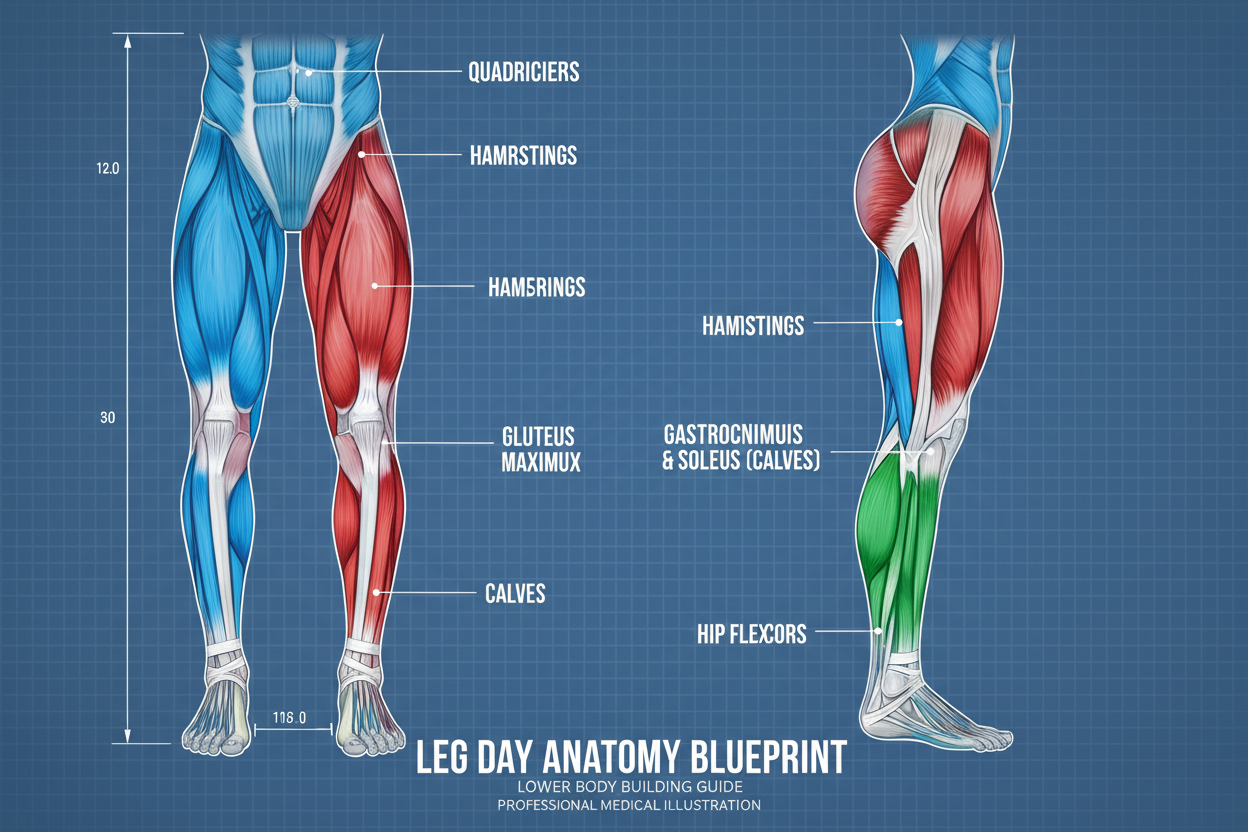
When people ask what leg muscles should i workout for size, the answer usually starts with the quadriceps. Located on the front of the thigh, this is a group of four muscles that are primarily responsible for extending the knee. They are the most visible muscles when you are wearing shorts and provide the pushing power for movements like jumping or standing up from a chair.
To effectively target the quads, you need exercises that involve significant knee bending. The squat is the king here, but variations like the front squat or the leg press can shift even more tension onto these muscles. If you want to isolate specific areas, such as the "teardrop" muscle just above the knee (the vastus medialis), foot placement and depth become critical factors. Deep knee flexion under load is the primary driver for quad growth.
The Hamstrings: More Than Just the Back of the Leg
While the quads push, the hamstrings pull. Sitting opposite the quads on the back of the thigh, these muscles are essential for knee flexion (bending the leg) and hip extension. Neglecting this group is a rookie mistake that often leads to injury. When you look for different parts of legs to workout, the hamstrings should be high on your priority list, specifically because they balance out the strength of the quads.
Training the hamstrings requires a two-pronged approach. You need curling movements, like lying or seated leg curls, to work the knee flexion function. However, you also need hip-hinge movements. The Romanian Deadlift (RDL) is arguably the best mass builder for the posterior chain. It stretches the hamstring under load at the hip joint, stimulating growth in the upper portion of the leg that curls simply can't reach.
The Glutes: The Engine Room
Many lifters mistakenly group the glutes in with back training or treat them as an afterthought, but they are the largest and most powerful muscle group in the body. The gluteus maximus provides the main thrust for running and squatting, while the gluteus medius and minimus (located on the sides of the hip) stabilize the pelvis. If your knees cave inward when you squat, weak glutes are often the culprit.
Identifying the right leg parts to workout for glute development means looking beyond standard squats. While squats do work the glutes, exercises that fully extend the hip are superior for isolation. Hip thrusts and glute bridges directly target the gluteus maximus without letting the quads take over. For the smaller stabilizing muscles on the side, lateral movements like banded walks or cable abductions are necessary to build that "shelf" look and protect the lower back.
Calves and Lower Leg Development
The calves are notoriously stubborn, often refusing to grow despite heavy training. This muscle group consists primarily of the gastrocnemius and the soleus. The gastrocnemius is the diamond-shaped muscle visible near the knee, while the soleus runs underneath it and down toward the heel. Understanding the parts of leg muscles gym goers often struggle with usually leads to a discussion about these two distinct areas.
The key to calf training lies in the knee angle. The gastrocnemius crosses the knee joint, meaning it is most active when the legs are straight, such as during standing calf raises or donkey calf raises. The soleus, however, does not cross the knee. Therefore, to target the soleus, you must perform calf raises with a bent knee, like in a seated calf raise machine. A complete lower leg routine must include both variations to maximize volume.
Adductors and Abductors
The inner (adductors) and outer (abductors) thigh muscles are the finishing touches on a complete leg physique. The adductors bring your legs together and contribute significantly to squat strength out of the bottom position (the hole). The abductors push the legs apart. While compound lifts hit these secondary muscles, dedicated machine work can prevent groin strains and improve hip mobility, adding width and sweep to the thigh appearance.
Decoding the Language of Leg Training
Navigating a workout program can be difficult if you don't speak the language. Understanding common leg muscles gym terms helps you execute exercises with the right intent. For example, if a program calls for a "compound movement," it refers to exercises like squats or lunges that use multiple joints (hips and knees) and muscle groups simultaneously. These are your mass builders.
Conversely, "isolation movements" refer to single-joint exercises like leg extensions or hamstring curls. These are used to target a specific muscle without fatiguing the rest of the body. You might also hear about the "posterior chain," which is a collective term for all the muscles on the back of your body—hamstrings, glutes, and lower back. Knowing these terms allows you to read a workout plan and instantly understand which muscles are being prioritized and why.
Structuring Your Routine
You do not need to hit every single muscle with five different exercises in one session. A smart split might involve two leg days a week: one focused on the anterior chain (quads) and another focused on the posterior chain (hamstrings and glutes). Alternatively, you can perform full-leg workouts that utilize one main compound lift followed by isolation work for the lagging areas. The goal is to ensure that over the course of a week, you have stimulated the front, back, inner, and outer portions of the leg with sufficient volume.
Consistency remains the most critical factor. Leg muscles are large and resilient; they require significant effort to adapt. By rotating your focus between the heavy compound lifts and targeted isolation work, you build a lower body that is not only aesthetically pleasing but also functionally strong and injury-resistant.
Frequently Asked Questions
How many times a week should I train my legs?
For most natural lifters, training legs twice a week is optimal. This frequency allows you to split the volume between quad-focused and hamstring/glute-focused days, ensuring enough recovery time while maximizing muscle protein synthesis signals.
Can I build big legs without doing barbell squats?
Yes, you can build impressive legs without barbell squats if you have back issues or mobility restrictions. Leg presses, Bulgarian split squats, and hack squats are excellent alternatives that can generate enough mechanical tension to stimulate significant muscle growth.
Why do my knees hurt after leg day?
Knee pain often stems from muscle imbalances, specifically weak glutes or tight hamstrings, causing the knee joint to track incorrectly. It can also result from poor form, such as letting the knees cave inward (valgus collapse) during heavy lifts, rather than pushing them outward.