Leg Curl Machine Name: The Definitive Guide to Gym Leg Equipment
Walking into a well-equipped commercial gym can feel like stepping into the cockpit of an airplane. You see rows of sleek, padded contraptions, but identifying them isn't always intuitive. You know the movement—bringing your heel toward your glute—but you are stuck wondering about the specific leg curl machine name so you can log your workout or ask a trainer for help.
Knowing the correct terminology isn't just about sounding like a pro; it is about understanding muscle mechanics. Different machines target the hamstrings and quads from unique angles, altering which muscle fibers carry the load. Let's clear up the confusion and break down the specific names of the equipment you need for a complete leg day.
Quick Summary: Leg Machine Names
- Seated Leg Curl: The user sits upright; targets the inner hamstrings (semitendinosus/semimembranosus).
- Lying Leg Curl (Prone): The user lies face down; emphasizes the outer hamstring (biceps femoris).
- Standing Leg Curl: A unilateral machine where the user stands on one leg and curls the other.
- Leg Extension: The primary "quad machine" where the user kicks the leg straight out.
- Hack Squat: A sled-based machine where the user pushes weight at a 45-degree angle.
Decoding the Leg Curl: Variations and Names
When you ask for the "leg curl machine name," you are usually referring to one of three specific pieces of equipment. While they all perform knee flexion, the position of your hips changes the stimulus.
The Seated Leg Curl
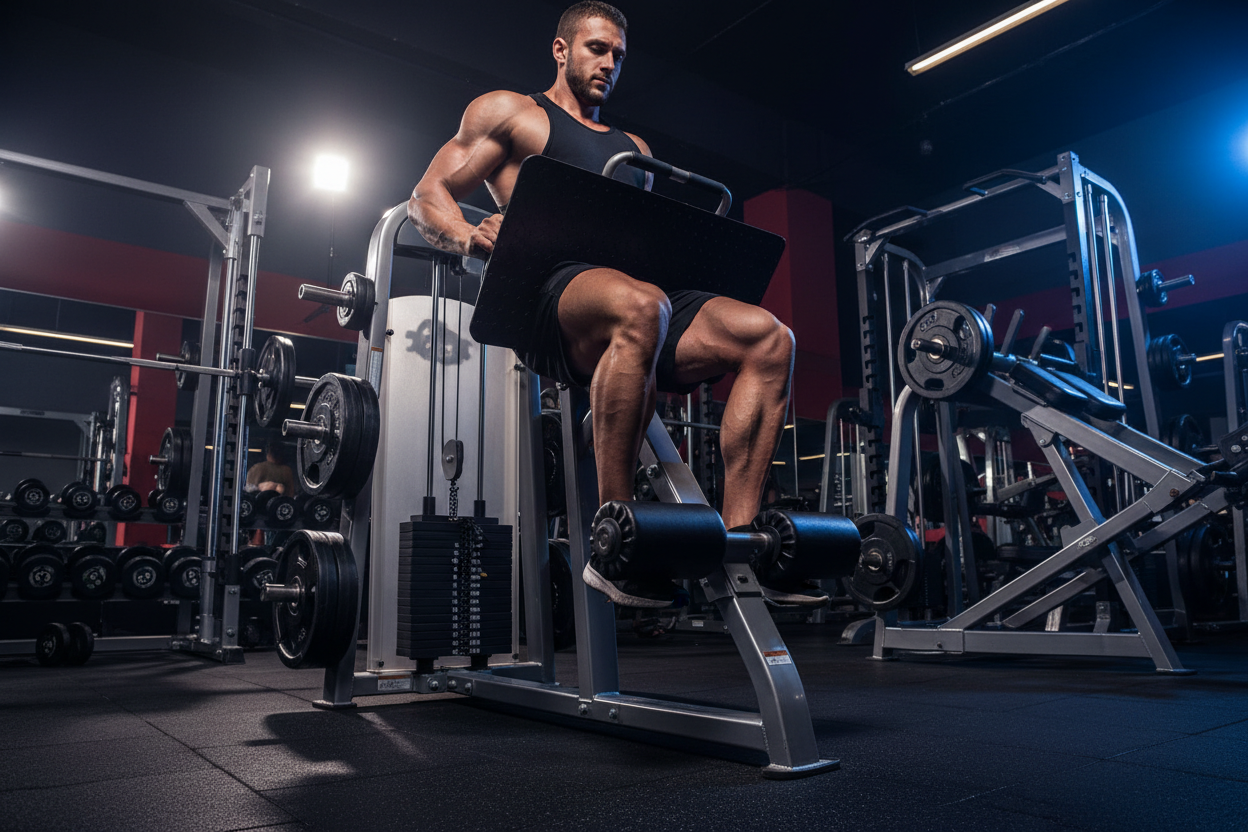
This is arguably the most common variant found in modern gyms. You sit upright with a pad clamped down over your thighs. Because your hips are in a flexed position (bent), your hamstrings are lengthened at the start of the movement.
From a biomechanical standpoint, the seated variation is often superior for pure hypertrophy (muscle growth) because the stretched position allows for greater tension generation.
The Lying Leg Curl (Prone Leg Curl)
This is the classic machine where you lie on your stomach. If you are looking for a list of leg machines at the gym, this one is a staple. It places the hips in an extended (flat) position.
The lying curl focuses heavily on the peak contraction—the "squeeze" at the top. However, many lifters make the mistake of lifting their hips off the pad as they curl, which transfers tension to the lower back. Keep your hips glued down.
The Standing Leg Curl
Often overlooked, this machine allows you to train one leg at a time (unilaterally). It is excellent for fixing muscle imbalances. If one hamstring is weaker than the other, this is the tool to fix it.
Beyond the Curl: Other Essential Leg Day Machines Names
You cannot build a complete physique just by curling. To balance the leg, you need to target the front of the thigh. Here is a breakdown of the opposing equipment.
The Leg Extension
If you are searching for the quad machine gym name, this is it. It is the direct antagonist to the leg curl. You sit and extend your knee against resistance. It is the only machine that effectively isolates the rectus femoris (the large middle quad muscle) because it trains the muscle in a shortened position.
The Leg Press
When discussing gym machine names legs workouts rely on, the Leg Press is king. It removes the stability requirements of a barbell squat, allowing you to load up heavy weight safely. Foot placement matters here: place feet high to target glutes and hams, or low to target quads.
The Hack Squat
This looks like a torture device to the uninitiated. You stand on a platform with shoulder pads resting on you, sliding on rails. It mimics a barbell squat but offers back support, making it one of the best gym machines names for legs when you want to train to failure safely.
My Personal Experience with the Leg Curl Machine
I have a love-hate relationship with the Lying Leg Curl specifically. On paper, it is a perfect isolation movement. In reality, the ergonomics vary wildly between manufacturers.
I remember training at an old-school bodybuilding gym that had a vintage chain-driven lying leg curl. The pivot point was slightly off-center compared to my knee joint. Every time I hit the top of the rep range, the ankle pad would roll halfway up my calf, pinching my skin and ruining the contraction. It taught me a valuable lesson: if the machine doesn't align with your joints, don't force it.
Now, I spend an extra 30 seconds adjusting the arm length and pad position before doing a single rep. If the pad rolls up your leg during the movement, the pivot point is too low or too far back. Adjust it until the pad stays glued to your Achilles tendon throughout the entire arc. That small tweak changed the movement from a calf-pinching annoyance to a hamstring-torching staple in my routine.
Conclusion
Knowing the correct leg curl machine name and the terminology for other lower body equipment gives you confidence. It allows you to track your progress accurately and understand exactly which muscles you are recruiting. Whether you are using the seated curl for a deep stretch or the leg extension to torch your quads, precision in your language leads to precision in your training.
Frequently Asked Questions
What is the proper name for the machine that works the back of your legs?
The general term is the Hamstring Curl or Leg Curl machine. Specifically, it is called the Seated Leg Curl, Lying Leg Curl, or Standing Leg Curl depending on your body position during the exercise.
What is the quad machine gym name?
The machine that isolates the quadriceps (front of the thigh) is called the Leg Extension machine. It involves sitting and extending the legs upward against resistance.
Are machines better than free weights for legs?
Not necessarily "better," but different. Free weights (squats, deadlifts) are superior for overall strength and stabilizer muscles. Machines (leg curls, leg presses) are better for isolating specific muscles and training safely to failure without risking injury.