Is the Assisted Barbell Machine Actually Effective? The Honest Truth
Walk into any commercial gym, and you will likely see a divide. On one side, powerlifters dominate the squat racks. On the other, the assisted barbell machine sits, often criticized by purists as a tool for "cheating."
If you have been told that fixed-path training kills your gains, you have been misled. While free weights are king for stabilization, this machine—technically known as the Smith machine—offers unique hypertrophy benefits that a floating barbell simply cannot match. Let’s break down the mechanics, the myths, and how to actually use this tool for growth.
Key Takeaways: Quick Summary
- Stability Increases Output: Because the machine handles stabilization, you can often push closer to true muscular failure safely.
- Fixed Path Mechanics: The vertical (or slightly angled) rails force a strict range of motion, making it ideal for targeting specific muscle heads.
- Safety First: The built-in safety hooks make it the best option for solo training without a spotter.
- Versatility: It functions excellently as an assisted squat bar for hack squat variations or split squats where balance is a limiting factor.
Understanding the Barbell Smith Machine
The barbell smith machine consists of a barbell fixed within steel rails, allowing only vertical or near-vertical movement. Unlike a standard Olympic bar, which weighs 45 lbs (20kg), the starting resistance on an assisted smith machine can vary significantly.
Some are counterbalanced to near zero, while others have a drag that makes them feel heavier. The defining feature, however, is the removal of the stabilization requirement. When you don't have to worry about the bar swaying forward or backward, your nervous system can dedicate more drive to the prime movers (the main muscles lifting the weight).
Why the "Assisted Squat Bar" Approach Works
Hypertrophy Over Functionality
If your goal is purely athletic functionality—like tackling someone on a football field—free weights are superior. But if your goal is muscle size (hypertrophy), the assisted machine shines.
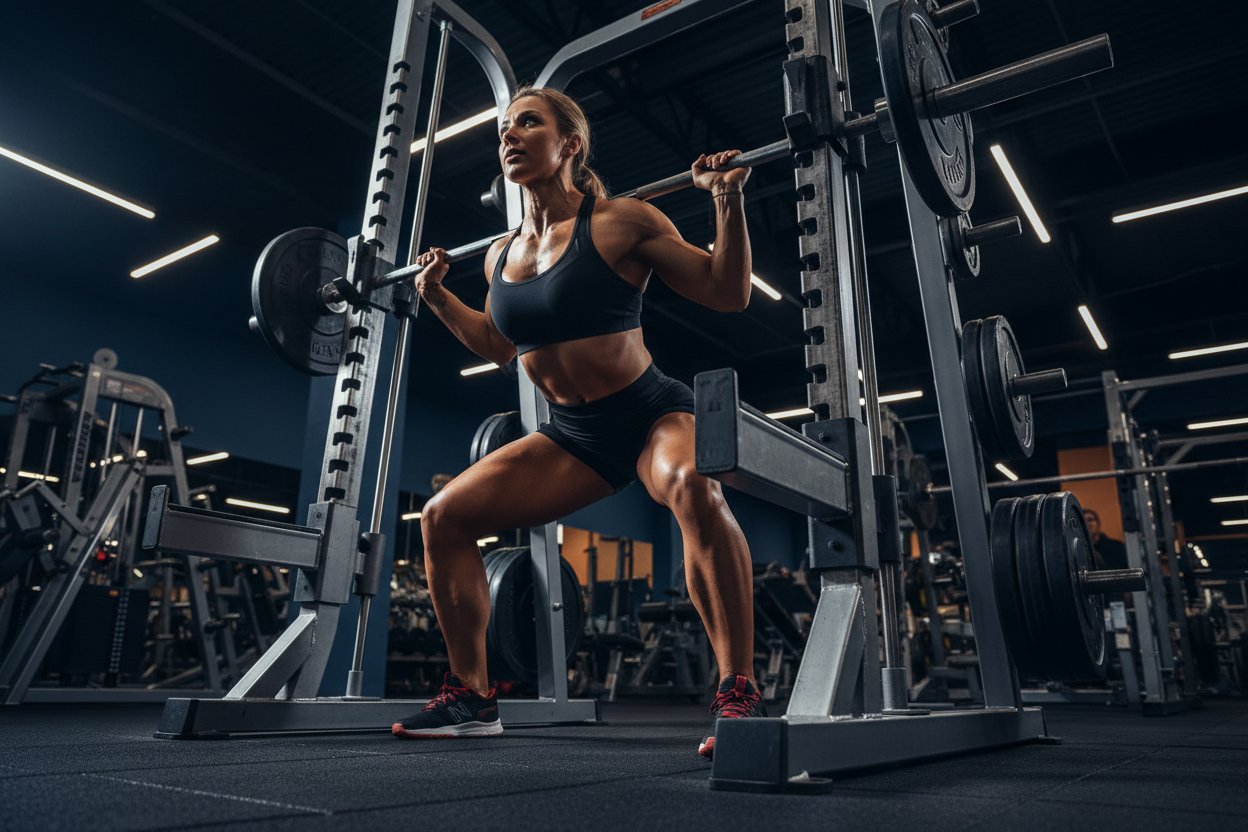
By removing the need to balance, you can isolate muscles more effectively. For example, during a squat, you can place your feet further forward than you could with a free bar. This "hack squat" stance shifts the load almost entirely to the quads, taking the lower back out of the equation.
The Safety Factor
We have all stuck a bench press rep halfway up. With free weights, that is a dangerous situation if you are alone. On an assisted machine, a simple twist of the wrist re-racks the weight instantly. This psychological safety net allows you to grind out those last two growth-inducing reps that you might skip on a free bench press out of fear.
Common Mistakes to Avoid
Forcing Natural Movement Patterns
The biggest error lifters make is trying to move exactly as they do with free weights. The machine has a fixed path; your body does not. If you try to squat with a vertical torso on an angled machine, you will shear your knees.
Instead, adjust your body to the machine. Lean into the fixed path. Use the stability to create angles that are impossible with free weights.
Ignoring the Rail Friction
Not all machines are created equal. An older machine might have "sticky" spots on the rails. If you are doing explosive work, this friction can mess up your tempo. Keep your reps controlled and deliberate to mitigate the drag.
My Training Log: Real Talk
I want to be transparent about my relationship with this equipment. For years, I avoided the Smith machine because I thought it wasn't "hardcore" enough. That changed when I tweaked my lower back deadlifting.
I switched to the assisted machine for squats during rehab, and here is the unpolished truth: the movement feels weird at first. Specifically, there is a distinct lack of "knurl bite." Most of these bars are thicker than Olympic bars and have smoother knurling. I remember the first time I went heavy, my hands started sliding despite the chalk because the bar rotation is often stiff or non-existent compared to a high-quality rogue bar.
Also, there is a specific, annoying sound—that metal-on-metal clack-whoosh—that happens if the rails aren't lubricated. I found that on the eccentric (lowering) phase, if I didn't push slightly out against the rails, the bar would catch and stutter, ruining my tension. Once I learned to "fight" the friction, the quad pump was actually superior to my free weight squats because I wasn't wasting energy stabilizing my core.
Conclusion
The assisted barbell machine isn't a replacement for free weights; it is a supplement to them. It allows for safe failure, unique foot placements, and intense isolation. Stop worrying about what the "gym bros" think and start utilizing the stability to build serious mass.
Frequently Asked Questions
How much does the bar weigh on an assisted smith machine?
It varies by manufacturer. A standard Olympic bar is 45 lbs, but Smith machine bars often range from 15 lbs to 25 lbs due to counterweights. Always check the manufacturer sticker on the side of the frame.
Is squatting on a machine bad for your knees?
It is only bad if you try to squat with the same form as a free weight squat. Because the bar doesn't move horizontally, you must place your feet further forward to allow your hips to sink without putting excessive shearing force on the knees.
Can I build strength with an assisted barbell machine?
Yes, but it is a different kind of strength. You will build raw muscle and pushing power, but you won't build the stabilizer muscles required to control a free weight. It is best used as an accessory to free weight training.