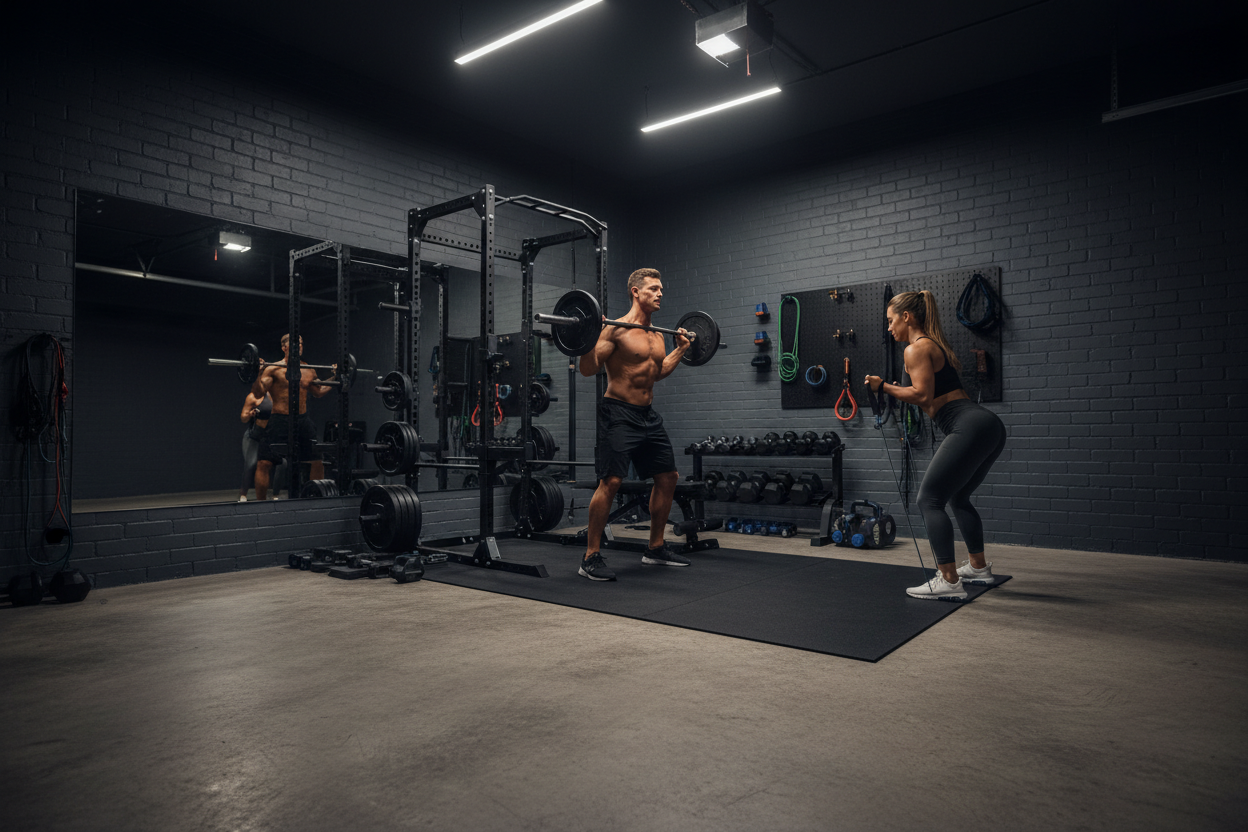
Is Smith Machine Bodybuilding Actually Effective? The Honest Truth
Walk into any hardcore gym, and you’ll hear the same sentiment: the Smith machine is a coat rack, not a lifting station. Old-school purists claim that if you aren't balancing the weight yourself, you aren't really lifting. But if you look at the training logs of Mr. Olympia champions like Dorian Yates or Jay Cutler, you see a different story. They didn't just use it; they relied on it.
The truth is, smith machine bodybuilding isn't about replacing the barbell. It is about understanding mechanical tension and stability. When your goal is pure hypertrophy—making a muscle grow as large as possible—stability is not your enemy. It is the catalyst that allows you to take a muscle to true failure safely.
Key Takeaways
- Stability Increases Output: Removing the need to balance the load allows for greater force production from the prime mover muscles.
- Safety at Failure: The locking mechanism allows you to train to absolute failure without a spotter, a critical factor for growth.
- Variable Foot Placement: Unlike free weight squats, you can adjust your stance (e.g., feet forward) to target specific muscle heads without falling over.
- Constant Tension: The fixed path keeps tension on the target muscle rather than dispersing it through stabilizers.
The Science of Stability and Hypertrophy
There is a misconception that "harder" always means "better." Free weights are harder because you have to stabilize the load in three-dimensional space. While this is excellent for functional strength and core coordination, it isn't always optimal for growing a specific muscle group.
When you use a Smith machine, you remove the limiting factor of stabilization. If your stabilizers fatigue before your pecs or quads do, you have to end the set before the target muscle has received a maximal stimulus. By fixing the bar path, you ensure that the prime mover—the muscle you actually want to build—takes the brunt of the load until it physically cannot contract anymore.
The "Fixed Path" Controversy
Critics argue that the fixed vertical (or slightly angled) path is unnatural. This is true if you try to replicate a free-weight movement pattern exactly. You cannot squat in a Smith machine exactly how you squat with a barbell. The mechanics must change.
However, bodybuilders use this fixed path to their advantage. It allows for manipulation of angles that are impossible with free weights. For example, performing a "feet-forward" squat places immense shear force on the knees if done with a free bar, but in a Smith machine, it shifts almost 100% of the load to the quadriceps while keeping the lower back relatively safe.
Strategic Implementation for Mass
You shouldn't spend your entire workout inside the rack. The Smith machine works best as a secondary compound movement or a heavy isolation finisher.
The Guillotine Press
For chest development, the standard bench press often becomes tricep or front-delt dominant. On a Smith machine, you can lower the bar toward your neck (the "Guillotine" style) safely. This flares the elbows and stretches the pectoral fibers significantly more than a standard press. Do not attempt this with free weights; if your hand slips, the consequences are severe. On the machine, the safety catches have your back.
Bulgarian Split Squats
This is perhaps the most humbling leg exercise in existence. Doing these with dumbbells requires significant balance. Doing them in a Smith machine removes the balance component, meaning the only thing stopping you from getting back up is the strength of your glutes and quads. It turns a coordination exercise into a pure mass builder.
My Training Log: Real Talk
I want to be transparent about my relationship with this machine. For years, I avoided it because I didn't want to look "soft." That changed during a high-volume leg cycle where my lower back was failing before my quads on barbell squats.
I switched to Smith Machine Hack Squats. The first thing I noticed wasn't the pump—it was the friction. There is a specific, gritty feeling of the bearings rolling over the guide rods that you don't get with free weights. It feels artificial at first, almost like the machine is fighting you on the eccentric (lowering) phase if the rails aren't perfectly oiled.
But the game-changer was the ability to walk my feet out 12 inches in front of the bar. You can't do that with a barbell; you'd fall backward. I remember reaching failure on rep 12, engaging the safety hooks with a quick wrist turn, and collapsing. My quads were on fire in a way I hadn't felt in years because, for the first time, my core wasn't the weak link. The knurling on those bars is usually passive and slippery compared to a power bar, so I had to use straps, but the isolation was undeniable. I stopped caring about the "unfunctional" stigma the moment my pants started fitting tighter around the thighs.
Conclusion
The Smith machine is a tool, just like a dumbbell or a cable station. If you use it expecting it to build a 600-pound deadlift, you will be disappointed. But if you use it to safely overload specific muscle fibers, maintain constant tension, and push beyond mechanical failure, it is a potent weapon in your bodybuilding arsenal. Stop worrying about what the powerlifters think and focus on the contraction.
Frequently Asked Questions
1. Is the Smith machine better than free weights for muscle growth?
It depends on the context. Free weights recruit more muscle fibers overall due to stabilization requirements. However, the Smith machine is often superior for isolating specific muscles and safely training to failure, which are key drivers for hypertrophy.
2. Will using the Smith machine cause injuries?
Injuries usually occur when users try to force a natural free-weight movement pattern into the machine's fixed path. Because the bar doesn't move horizontally, your body must adjust around the bar. If you adjust your stance and form to fit the machine's mechanics, it is generally very safe.
3. Does the Smith machine count for bench press strength?
Generally, no. A Smith machine bench press is easier to stabilize, meaning you can often lift more weight than you could with a free barbell. While it builds chest muscle effectively, that strength does not translate 1:1 to a standard bench press.