Is an All in One Trainer Machine Actually Worth the Hype?
Building a home gym usually involves a frustrating game of Tetris. You want a power rack for heavy lifting, a cable system for isolation work, and maybe a Smith machine for stability. Suddenly, your two-car garage has zero room for cars. This is exactly why the all in one trainer machine has exploded in popularity.
But with price tags often rivaling a used sedan, you need to know if this Frankenstein-style equipment is a genuine solution or just a jack-of-all-trades, master of none. Let's break down the mechanics, the ROI, and the reality of owning one.
Key Takeaways
- Space Efficiency: Combines a power rack, functional trainer, and Smith machine into a single footprint (usually 15-20 sq ft).
- Cost vs. Value: High upfront cost, but often cheaper than buying three separate commercial-grade machines.
- Versatility: Allows for seamless switching between compound movements (squats/bench) and isolation work (cable flys/lat pulldowns).
- The Trade-off: Setup time can be longer between exercises compared to having dedicated stations.
The Anatomy of the Beast
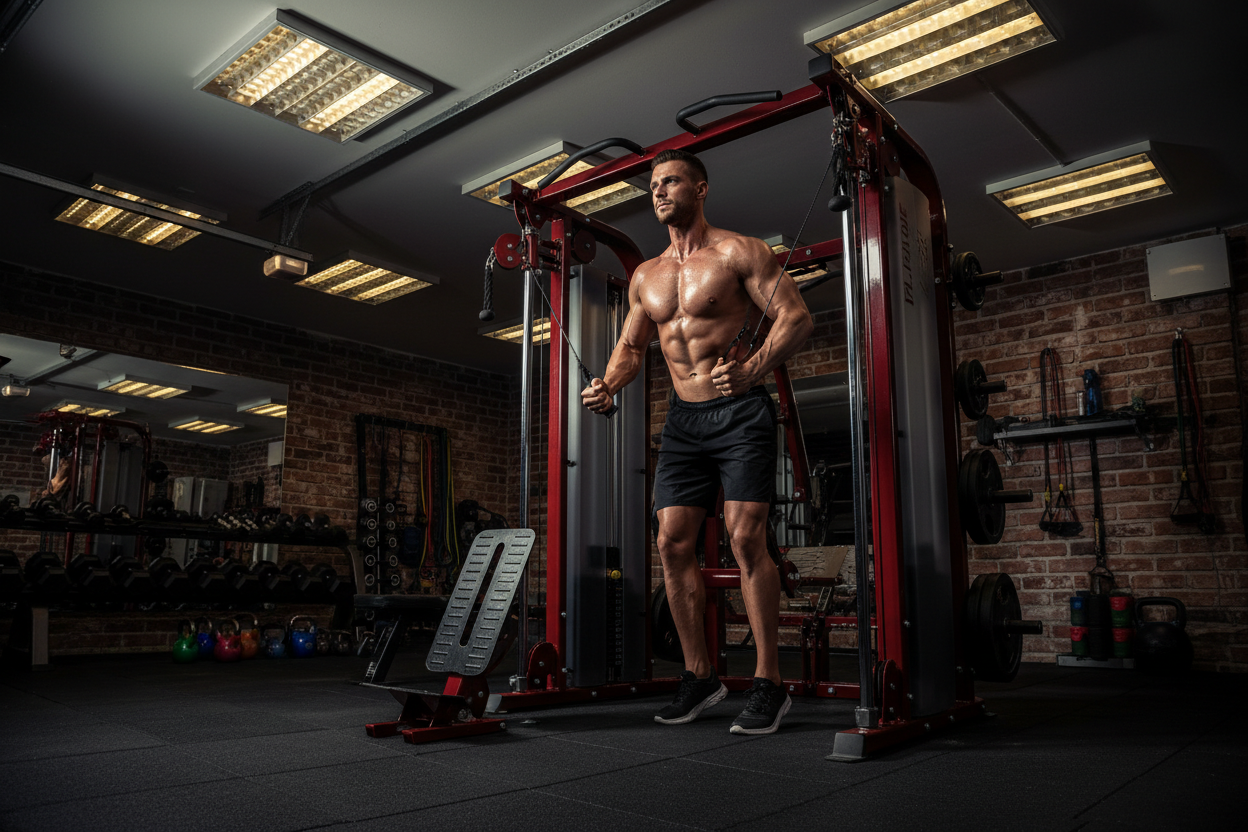
To understand the value, you have to understand what you are actually buying. A high-quality all in one trainer isn't just a rack with some pulleys slapped on it. It is an engineering convergence of three distinct gym staples.
The Power Rack Element
At its core, this is your safety net. The uprights need to be made of 11 or 12-gauge steel. This allows you to perform free-weight movements like squats, overhead presses, and deadlifts. Unlike a standalone rack, the stability here is often reinforced by the weight of the attached cable stacks, making it incredibly sturdy.
The Functional Trainer (Cables)
This is where the magic happens. Most units feature a dual pulley system. When looking at these, pay attention to the pulley ratio. A 2:1 ratio (where 100lbs feels like 50lbs) is standard for these machines. It allows for longer cable travel and smoother motion, which is critical for dynamic movements like woodchoppers or rear delt flys. If you are purely chasing static strength, this might annoy you, but for hypertrophy and functional movement, it is ideal.
The Smith Machine Component
Many lifters scoff at the Smith machine, but in a home gym setting, it is invaluable. It allows you to push to absolute failure safely without a spotter. On an all in one trainer, the Smith bar usually runs on linear bearings. If the machine uses cheap plastic bushings instead of bearings, the movement will feel gritty and stuck. Always check the specs for "linear bearings."
Space Economy vs. Workflow
The biggest selling point is obviously space. You are condensing roughly 60 square feet of equipment into about 20. However, there is a workflow consideration that manufacturers rarely mention.
When you use separate machines, you can superset easily. You bench press, stand up, and walk to the cable tower. With an all in one trainer, you are working inside the same cage for everything. If you want to superset a barbell squat with a cable movement, you might find the barbell gets in the way of the pulleys. You have to be more deliberate with your programming to minimize setup changes.
My Personal Experience with all in one trainer machine
I want to step away from the specs and talk about what it actually feels like to live with one of these units in a garage gym. I spent six months training exclusively on a mid-to-high-tier all in one trainer.
The first thing I noticed wasn't the versatility—it was the "foot traffic" issue. On many of these machines, the bottom frame connecting the left and right uprights sits slightly off the ground. Every time I walked in to set up for a squat, I had to consciously step over that rear cross-member. It sounds minor, but when you have 315 lbs on your back and you're walking a squat out, knowing that metal bar is near your heels adds a mental load you don't get with a standard open rack.
Another nuance is the "clutter factor" of attachments. These machines come with leg press plates, landmines, dip handles, and lat bars. I found myself spending the first 5 minutes of every workout just clearing the cage of attachments I used the day before. The workout itself is fantastic—the pump is real, and the cable smoothness rivaled my local commercial gym—but the logistics of managing all that gear in one spot requires discipline. If you are messy, this machine will punish you.
Conclusion
The all in one trainer machine is the ultimate solution for the lifter who refuses to compromise on exercise selection but is limited by square footage. It requires a significant financial commitment and a willingness to adapt your workflow, but it effectively eliminates the excuse of "I don't have the right equipment." If you treat it with respect and maintain the pulley systems, it will serve as the centerpiece of your fitness journey for decades.
Frequently Asked Questions
Can I build as much muscle with an all in one trainer as I can in a commercial gym?
Absolutely. Muscle hypertrophy requires mechanical tension and metabolic stress, both of which can be achieved through the heavy compound lifts (via the rack) and isolation movements (via the cables) that these machines provide. The equipment does not limit your gains; only your programming does.
What is the minimum ceiling height needed for an all in one trainer?
Most standard units require a ceiling height of at least 84 to 88 inches (approx. 7 to 7.5 feet). However, if you plan on doing pull-ups, you need to account for your head clearance above the frame, so a 90-inch ceiling is often the safe recommended minimum.
Is the Smith machine bar weight included in the total weight rating?
Usually, no. The Smith bar itself often has a starting weight (counterbalanced or not) ranging from 15 to 45 lbs. The weight rating listed on the machine (e.g., "2,000lb capacity") refers to the structural integrity of the cables and rack, not the weight of the bar itself.