Full Body Apartment Workout: Build Muscle With Zero Noise
Living in a third-floor walk-up with paper-thin walls and a downstairs neighbor who bangs on the ceiling if you drop a pen makes staying fit complicated. I've trained dozens of clients living in 500-square-foot studios where doing a single burpee risks an eviction notice. You want to train hard, but standard high-intensity interval routines sound like a stampede of elephants to anyone living below you.
That is exactly why I developed a routine specifically for these constraints. A true full body apartment workout does not rely on plyometrics, jumping jacks, or slamming weights onto the floor. Instead, it relies on manipulating how your muscles experience tension.
By shifting the focus from speed and momentum to slow, deliberate movement, you can achieve maximum muscle fatigue silently. You can build strength, break a sweat, and keep the peace with your neighbors all at the same time.
Quick Takeaways
- Use time-under-tension (TUT) to simulate heavy weights without the noise.
- High-density mats are non-negotiable for absorbing micro-vibrations and protecting floors.
- Isometric holds and slow eccentrics exhaust muscles safely and silently.
- You can train your back effectively using just a sturdy doorway and a thick towel.
The Realities of Training in a Small Apartment
I remember trying to follow a popular online fitness program in my old 600-square-foot apartment. During the first set of jump squats, my ceiling fan rattled, and my downstairs neighbor immediately texted me. Sound travels fast through cheap flooring.
Most fitness programs assume you have a garage gym or at least a solid concrete floor. They program jumping lunges, heavy deadlifts, and kettlebell swings. In an apartment setting, low ceilings limit your overhead mobility, and limited square footage means you can't exactly do walking lunges across the living room without running into the coffee table.
Thin floors act like acoustic amplifiers. Even placing a 25-pound dumbbell down a little too quickly creates an impact noise that echoes through the building's framing. You need a strategy that acknowledges these physical limitations rather than fighting them. It is entirely possible to get a great pump in a small room, but you have to check your ego at the door and change how you define workout intensity.
Introducing the Stealth Tension Method
To build muscle quietly, you have to abandon momentum. I teach my clients what I call the "Stealth Tension" method. This approach manipulates time-under-tension (TUT) and isometric holds to create a highly effective home workout for body fitness without relying on plyometrics or dropping heavy weights.
When you lift a weight fast, you use momentum to help move the load. When you slow that movement down to a 4-second lowering phase (the eccentric) and add a 2-second pause at the bottom (the isometric), your muscles have to do 100 percent of the work. You can take a standard bodyweight squat and make it excruciatingly difficult just by changing the tempo to a slow 5-second descent.
This method is entirely silent because there is no impact phase. It forces you to control your body in space, recruiting deep stabilizing muscles that often get ignored during fast, sloppy reps. You reach muscle failure through sustained, burning tension, not by letting heavy loads crash against the floorboards. It requires immense mental focus, but the physical payoff is huge.
Floor Protection: Your First Line of Defense
Even if you never jump, you still need floor protection. Hardwood and laminate floors are notoriously bad at absorbing sound; they reflect it. When you shift your weight, pivot your foot during a lunge, or set down a water bottle, the sound carries downward.
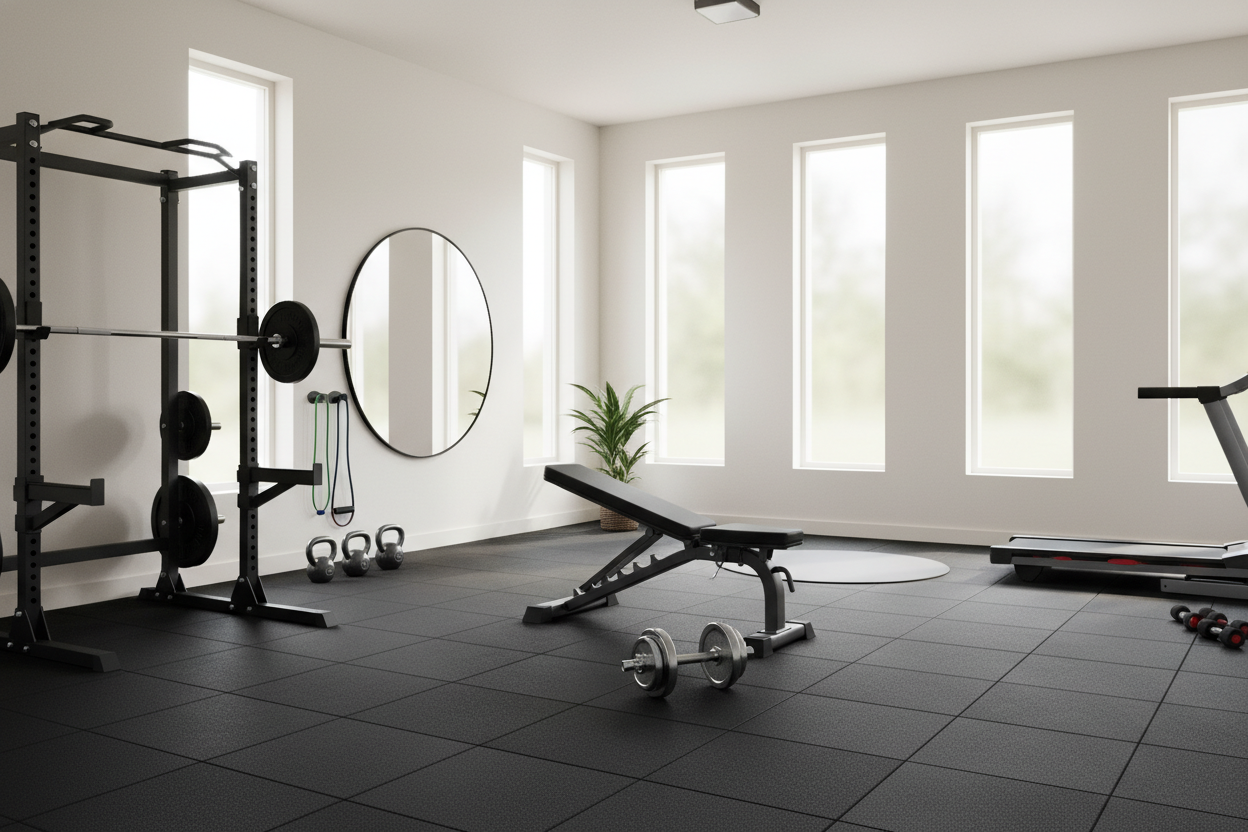
For any serious in home body workout, a high-density mat is your foundation. I always recommend my clients measure out a dedicated 6x4 foot space. This is usually enough room to lie down fully and perform a push-up or a split squat without hitting the couch or the TV stand.
A standard 3mm yoga mat simply will not cut it. You need something thicker that actually absorbs micro-vibrations and protects your security deposit from scuffs. I typically steer clients toward an apartment-friendly 6x4ft exercise mat because it fits perfectly in a standard living room setup while providing enough grip for barefoot training. The density dampens the sound of your movements, creating a literal buffer between your workout and the neighbor below.
The Zero-Noise Exercise Arsenal
Let's build the actual routine. These movements form the core of my home workouts for whole body engagement. We are completely avoiding any jumping, skipping, or high-impact transitions. Everything is slow, controlled, and intentionally quiet.
Lower Body: Deficit Split Squats and Glute Bridges
Legs are notoriously hard to train without heavy barbells, but the deficit split squat solves this problem. Elevate your front foot on a thick book or a yoga block. Lower your back knee toward the floor over a slow 4-second count. Pause for 2 seconds at the bottom, hovering just a millimeter above the floor. Push up over 3 seconds. Do 12 reps of this per leg, and your quads will be on fire.
For the posterior chain, single-leg glute bridges are silent killers. Lie on your back, plant one foot flat, extend the other leg straight out, and drive your hips up. Squeeze the working glute hard for a full 3 seconds at the top of every single rep. Perform 15 reps per side.
Upper Body Push: Pause Push-Ups and Pike Presses
The standard push-up is great, but we can make it much harder. Lower yourself over 4 seconds, and when your chest is an inch from the floor, hold that position for 3 full seconds. Push back up. This mechanical disadvantage exhausts the chest and triceps incredibly fast.
For shoulders, the pike press is ideal. Walk your feet toward your hands so your body forms an inverted V. Lower the crown of your head toward the floor slowly, pause at the bottom, and press back up. It mimics an overhead press without needing a single dumbbell.
Upper Body Pull: Doorway Rows and Towel Isometrics
Pulling movements are tricky without a pull-up bar, which often damages apartment doorframes anyway. Instead, grab a thick towel. Wrap it around a sturdy doorknob (ensure the door is pulled shut toward you, not pushed away, so the latch holds the weight). Lean back and perform rows, squeezing your shoulder blades together for 2 seconds on every rep.
For direct lat work, use towel isometrics. Hold a towel straight out in front of you with both hands. Try to rip the towel apart as hard as you can. Keep pulling outward while you slowly raise your arms overhead and lower them back down. The sustained tension fires up the entire upper back.
Scaling Up: Adding Compact, Quiet Equipment
Eventually, your bodyweight alone might not feel like enough. When you are ready to scale up, you have to be highly selective about equipment. Iron hex dumbbells clank loudly. Instead, look into urethane-coated dumbbells or adjustable systems that use a tight locking mechanism to prevent the plates from rattling.
I personally tested a pair of 5-52.5 lb adjustable dumbbells in a studio apartment for six months. They saved immense space, fitting neatly into a 2x2 foot corner next to the radiator. The honest downside? The plastic housing on some models can still click slightly during fast bicep curls, so you must maintain strict, slow form to keep them totally silent.
If you want cardiovascular or full-body resistance, look into magnetic resistance home exercise machines for a full body workout. Magnetic systems use eddy currents instead of friction pads, meaning they are virtually silent when in use. Just remember, if you are bringing in an 80-pound rower or a compact multi-gym, you absolutely must place a large exercise mat for home gym underneath it to protect your hardwood floors from permanent indentation and to muffle the machine's operational vibrations.
Structuring Your Weekly Apartment Routine
To get the most out of this setup, train three days a week on non-consecutive days (for example: Monday, Wednesday, Friday). This allows your muscles adequate time to repair.
Do 3 to 4 sets of each exercise listed in the zero-noise arsenal. Keep your rest periods relatively short, around 60 to 90 seconds between sets. Because you aren't loading the spine with 300-pound barbells, your central nervous system recovers faster, allowing you to train with high intensity frequently without burning out.
Focus entirely on the mind-muscle connection. If a set calls for 10 reps, but you lose the slow tempo at rep 8, stop there. The quality of the slow eccentric phase is what drives the muscle growth in this program.
FAQ
Will I lose muscle switching from heavy weights to bodyweight?
Not if you match the intensity. Muscle growth requires mechanical tension and metabolic stress. Slow eccentrics and pauses provide both, even without an external load. Your muscles don't know the difference between a 50lb dumbbell and intense isometric tension.
How do I do cardio quietly in an apartment?
Skip the jump rope and jumping jacks. Try low-impact mountain climbers, sliding lunges (using socks on a smooth floor), or high-resistance shadow boxing to spike your heart rate silently.
Are adjustable dumbbells safe to use on apartment floors?
Yes, provided you never drop them. Adjustable dumbbells contain fragile internal mechanisms that can break on impact. Always set them down gently on a thick, dense exercise mat.