I Tried Every Household Dumbbell Alternative (Most Suck)
I remember the first time I tried to train in a studio apartment with exactly zero equipment. I was staring at a shelf of canned beans, wondering if I could actually get a pump with 15 ounces of chickpeas. Spoiler: I couldn't. Finding a legitimate dumbbell alternative that doesn't feel like a middle school science project is harder than it looks.
Quick Takeaways
- Most household items like soup cans are too light to build muscle.
- A loaded backpack is the most versatile substitute for weights at home.
- 5-gallon water jugs provide over 40 lbs of resistance but are hard to grip.
- Focus on tempo and 'time under tension' to make light weights feel heavy.
- If you have a small budget, buy a bench before buying a single heavy dumbbell.
The Problem With Most DIY Weight Advice
If you search for alternatives to dumbbells, you'll find a dozen articles telling you to lift milk jugs or soup cans. Let's be real: unless you are coming off a major surgery or have never lifted a finger in your life, a 14-ounce can of tomato sauce isn't doing anything for your hypertrophy. It’s a waste of time. To build muscle, you need mechanical tension and progressive overload. You need something that actually makes you struggle to finish a set of 10.
The issue with most 'household items to use as weights' is the lack of scale. A standard water bottle weighs about one pound. Even if you do 100 reps, you're mostly just improving your endurance for holding water bottles. You aren't building a bigger chest or stronger legs. If you want a real dumbbell substitute, you have to stop looking in the pantry and start looking for items that weigh at least 15 to 20 pounds minimum.
We also have to talk about grip. Most DIY weights are awkward. If the handle is so thick or slippery that your hands give out before your muscles do, you aren't training your target area—you're just practicing not dropping things on your toes. A real weight substitute needs to be heavy enough to matter and holdable enough to use safely.
The Only Household Items Actually Worth Lifting
When you're scouring your house for weight substitutes, you need density. You want items that pack a lot of mass into a small volume so they don't bang against your knees during a movement. Forget the light stuff. We are looking for heavy household items to use as weights that can actually simulate a 25-lb or 50-lb dumbbell.
I’ve found that the best options are things that were designed to carry weight anyway. Luggage, storage bins with handles, and heavy-duty containers are your best friends here. You want something that allows for a semi-functional grip so you can actually focus on the contraction rather than just surviving the set.
The Loaded Backpack (Your Best Bet)
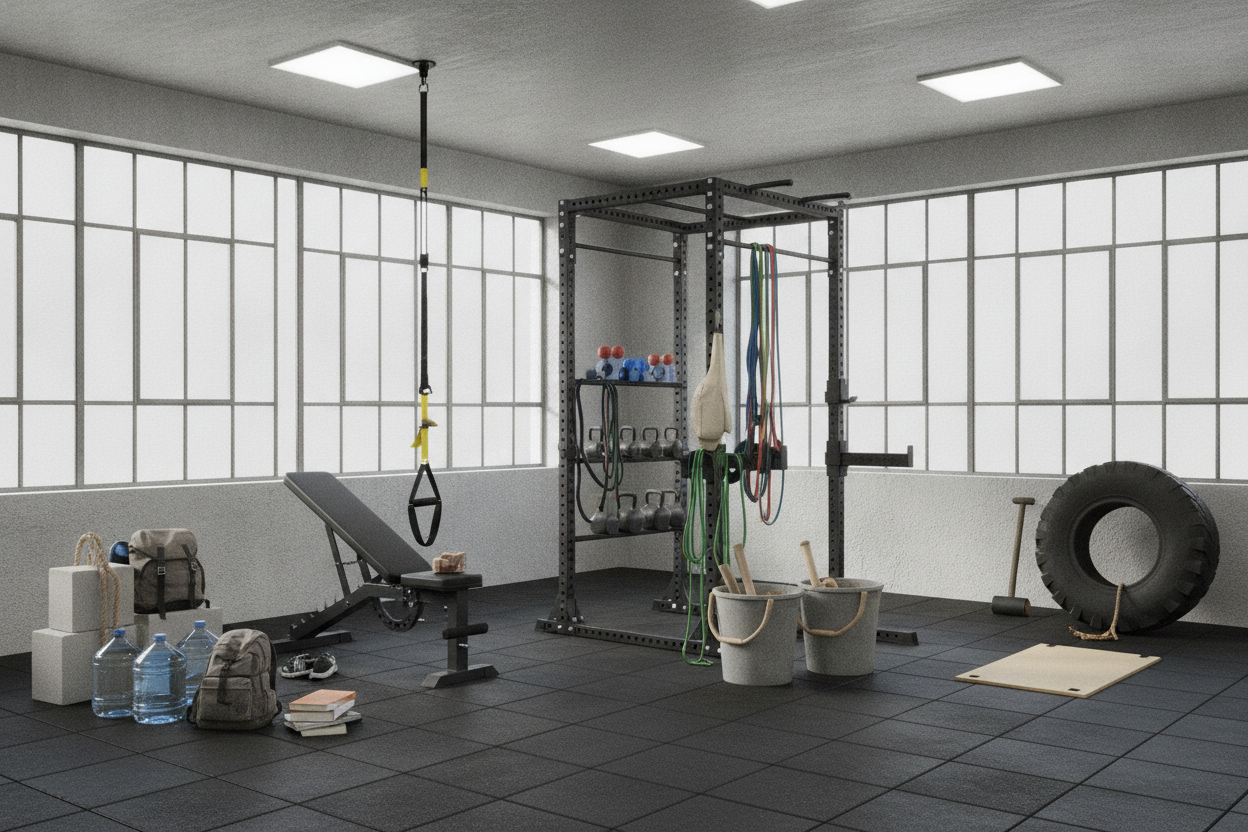
If I could only pick one substitute for weights at home, it’s a high-quality rucksack or a sturdy backpack. You probably have an old one in the closet. The beauty of a backpack is the adjustability. You can stuff it with books, bags of rice, or even small rocks from the garden. It’s the closest thing to a 'selectable' dumbbell you’ll find in your house.
I’ve used a loaded backpack for front squats by holding it against my chest, and for one-arm rows by grabbing the top handle. If you have a bag with padded straps, you can even wear it for pushups or lunges. It stays close to your center of gravity, which is much safer for your lower back than swinging a loose bag of groceries around. Just make sure the seams are reinforced; I’ve seen cheap school bags explode mid-rep, and cleaning up five pounds of loose rice is a great way to ruin a workout.
5-Gallon Water Jugs (The Awkward Heavyweight)
If you need a heavy dumbbell replacement, look at the blue 5-gallon water jugs. The math is simple: water weighs about 8.3 pounds per gallon. A full 5-gallon jug is roughly 42 pounds. That is a serious amount of weight for most home trainees. You can use these for makeshift farmer's carries, deadlifts, or even suitcase squats.
The downside is the handle. Most of these jugs have a thin plastic handle that will dig into your palms. I usually wrap a small towel around the handle to save my skin. They are also bulky, so doing something like an overhead press is tricky because the jug wants to tilt. But for pure floor-to-waist movements, these are the gold standard for things to use as weights at home when you're on a zero-dollar budget.
How to Program a Workout Without Real Iron
When you're figuring out what to use if you don't have weights, you have to change how you think about 'intensity.' Since your makeshift weights are likely lighter than what you'd use at a commercial gym, you have to make the reps harder. I’m a big fan of the 4-2-1 tempo: four seconds on the way down, a two-second pause at the bottom, and one second to explode up. This increases the metabolic stress on the muscle without needing an extra 20 pounds of iron.
You can also play with leverage. For example, an at home dumbbell shoulder workout can be made significantly harder by holding your makeshift weight further away from your body or changing the angle of your torso. A 10-lb jug of laundry detergent feels like 30 lbs if you do a lateral raise with a straight arm and a slow eccentric. Don't just mindlessly move the weight; make the muscle work for every inch of the movement.
Another tactic is the '1.5 rep' style. Go all the way down, come halfway up, go back down, and then come all the way up. That’s one rep. It doubles the time the muscle is under tension. If you're using a backpack or water jugs, these techniques are the difference between a productive session and just moving stuff around your living room.
When It's Time to Graduate From Makeshift Weights
I’ll be honest: there is a ceiling to what a dumbbell substitute at home can do. The biggest issue isn't the weight itself; it's the balance. Real dumbbells are balanced; a bag of dog food is not. When the internal load shifts, it puts weird torque on your wrists and elbows. Eventually, your joints will start complaining before your muscles get a chance to grow.
Another factor is the psychological jump. It is hard to get 'into the zone' when you're lifting a container of cat litter. There’s a certain mental shift that happens when you pick up a knurled steel handle. If you find yourself consistently maxing out the capacity of your backpack or getting frustrated with leaking water jugs, it’s time to move to a real home weights workout. You don't need a full rack of 5-100 lb dumbbells, but a single pair of adjustable ones will change your life.
Don't fall into the trap of thinking you can DIY your way to a pro-level physique forever. Makeshift weights are a bridge, not a destination. They are great for maintaining what you have or getting started, but real iron is built for a reason. It’s durable, it’s compact, and it doesn't leave a mess on the floor when you drop it.
Should You Just Buy a Bench Instead?
Here is my controversial take: if you're broke and have to choose between one heavy dumbbell or a piece of furniture, buy a decent adjustable weight bench. Why? Because a bench turns your body into the weight. With a bench, you can do incline pushups, decline pushups, Bulgarian split squats, and dips. It provides a stable platform that makes bodyweight training significantly more effective than fumbling with a slippery rock in your backyard.
Pairing a solid bench with a few heavy resistance bands is often a better 'budget' setup than trying to find heavy household items to use as weights. You can loop the bands under the bench for chest presses or rows. It’s a cleaner, more professional way to train that doesn't involve raiding your pantry every Monday, Wednesday, and Friday.
Personal Experience: The Kibble Incident
I once tried to use a 40-lb bag of high-protein dog food for goblet squats because I didn't want to drive to the gym in the snow. It worked for two sets. On the third set, the plastic gave way, and I ended up with 40 pounds of kibble all over my basement floor. My dog thought it was the best day of his life; I spent an hour cleaning. The lesson? If it wasn't made to be lifted repeatedly, it probably shouldn't be. Use a backpack to contain the mess.
FAQ
What can I use instead of 5 lb weights?
A standard 2-liter soda bottle filled with water is about 4.4 lbs. It's the perfect size for high-rep lateral raises or shadow boxing. If you need it slightly heavier, fill it with sand or dirt instead.
What is the best makeshift weight for legs?
A duffel bag filled with sandbags or bags of potting soil. Leg muscles are huge and need a lot of weight. A duffel bag can usually hold 50-80 lbs, which is enough to make a lunge or squat feel meaningful.
Are resistance bands better than household weights?
Usually, yes. They provide consistent tension and are much easier on your joints than trying to balance a heavy, awkward object like a water jug or a toolbox.
How do I make my own weights?
The most reliable DIY method is filling PVC pipes with concrete or using 'sandbags' made from old duffel bags and play sand. These are much more durable than using actual household items.