I Tested Every Cardio and Weight Training Fat Loss Split (Here's What Won)
I remember the night I finally pulled a 405-lb deadlift, only to realize I was so winded from walking the plates back to the tree that I had to sit down for ten minutes. I was strong, sure, but I was also carrying an extra 30 pounds of 'bulk' that was mostly just pizza and ego. I spent the next six months testing every possible cardio and weight training fat loss split to see if I could keep the strength while losing the gut without living in my garage for three hours a day.
- Lift Heavy First: Prioritize your central nervous system when you are fresh to keep your muscle mass.
- Short Intervals: You don't need an hour on a treadmill; 10-15 minutes of high intensity is plenty.
- Layout Matters: If your equipment isn't staged, you'll find excuses to skip the hard stuff.
- Recovery is King: You can't redline your heart and your squat every single day.
Why Doing Everything at Once Usually Fails
The most common mistake I see—and one I made for years—is the 'Metcon Trap.' You take a perfectly good strength program and strip away the rest periods, turning your heavy sets of five into a sweaty, breathless mess. You aren't lifting enough weight to trigger muscle growth, and you aren't moving fast enough to get a true aerobic benefit. You just end up tired, weak, and frustrated.
When you try to combine cardio and weight training for fat loss into a single, frantic circuit, your body gets confused. The signals for building strength and building endurance often compete. If you're swinging a kettlebell for 50 reps just to get your heart rate up, you aren't focusing on the explosive hip hinge that actually builds power. You're just doing 'cardio with a heavy object,' which is a recipe for joint pain and mediocre results.
I used to think that if I wasn't dripping sweat onto the concrete within ten minutes, I wasn't working hard enough. I was wrong. Real fat loss comes from maintaining your metabolic engine (your muscle) while creating a caloric deficit through movement. If you burn off your muscle because you're doing too much high-rep fluff, your metabolism actually slows down in the long run. You want to be a furnace, not a candle.
The Real Secret to Cardio and Weight Training Fat Loss
The breakthrough for me was realizing that the order of operations is everything. If you want to maximize cardio & weight training for weight loss, you have to stop treating them like equal partners in the same session. Strength is the foundation. You should be hitting your heavy compounds—squats, presses, pulls—while your glycogen stores are full and your focus is sharp. This preserves the muscle tissue that keeps your BMR high.
Once the heavy iron is moved, then you pull the trigger on conditioning. By doing your cardio at the end of a lifting session, you're tapping into fat stores more effectively because you've already burned through a chunk of your ready-to-use glucose. It also prevents 'interference'—you won't be too tired to squat safely because you didn't just run three miles beforehand. People often get stuck in the weeds of programming, but you should really Stop Debating Weight Training or Cardio for Fat Loss and just start layering them correctly.
My preferred method is 'Finisher Intervals.' After my main lifts, I’ll hit 10 rounds of 30 seconds on, 30 seconds off on a rower or with a heavy sandbag. It’s brutal, it’s fast, and it doesn’t eat into my recovery for the next day. This approach ensures that you are still a strength athlete who happens to be lean, rather than a cardio junkie who looks like they've never seen a barbell.
Setting Up Your Garage for Lightning-Fast Transitions
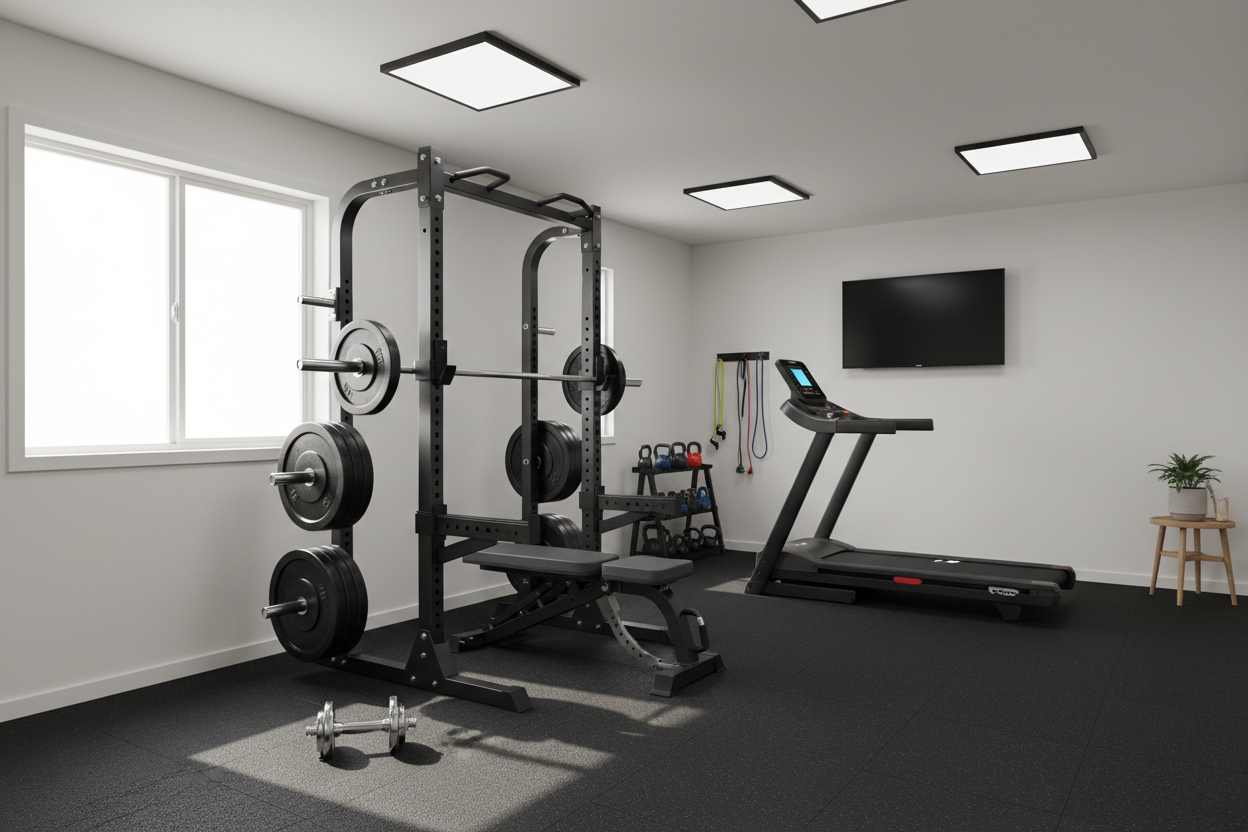
If you have to spend five minutes moving a bench and clearing floor space to start your conditioning, you aren't going to do it. Your garage gym needs to be a functional circuit. I keep a dedicated zone that is always clear for high-impact movement. Having a Large Exercise Mat For Cardio 6X12 is a life-saver here. It’s thick enough to handle dropped kettlebells but firm enough that you aren't wobbling during burpees or jump rope sets. Plus, it defines the 'work' space versus the 'storage' space.
Efficiency is the enemy of fat. Wait, that sounds backwards—efficiency is the enemy of *burning* fat. You want your transitions to be seamless so your heart rate doesn't have time to bottom out. I recommend having a dedicated Weight Set And Bench station that stays put. Don't use your adjustable bench as a coat rack or a place to stack boxes. It should be ready for your heavy presses so you can move immediately from the rack to the floor.
I also suggest keeping a timer visible on the wall. Relying on your phone is a mistake; you'll end up checking emails or Instagram. A big, bright LED gym clock keeps you honest. When that buzzer goes off, you move. No hunting for your jump rope, no moving the lawnmower out of the way. If your gym is a mess, your workout will be a mess.
My 4-Day Blueprint for Leaning Out
This is the exact split I use when I need to drop 10 pounds without watching my bench press numbers crater. It’s four days a week, roughly 60 minutes per session. Two days focus on upper body power, two days on lower body strength, each followed by a specific conditioning 'finisher.'
Monday: Heavy Upper Body. Think 5x5 on the bench or overhead press. I use my Gxmmat Adjustable Weight Bench for incline work to hit the upper chest, then move into heavy rows. The finisher is 12 minutes of EMOM (Every Minute on the Minute) kettlebell swings. Tuesday: Heavy Lower Body. Squats or Deadlifts. The finisher here is lower impact, like a steady-state incline walk on the treadmill or a light bike ride to flush the legs.
Thursday: Hypertrophy Upper. Higher reps (8-12) to get the pump and keep the joints happy. Finisher: Battle ropes or medicine ball slams for 10 minutes of Tabata style (20s work/10s rest). Friday: Hypertrophy Lower/Full Body. Lunges, split squats, and maybe some power cleans. Finisher: The 'Death March'—carrying heavy dumbbells for 50 feet, resting, and repeating until your grip fails. This structure ensures that cardio and weight training fat loss isn't just a theory, but a repeatable system.
Wednesday, Saturday, and Sunday are for 'Active Recovery.' This isn't an excuse to be a couch potato. Go for a 30-minute walk, play with your kids, or do some mobility work. The goal is to keep the blood moving without adding more stress to your joints. If you feel like you're dragging, you're probably overdoing the intensity on your 'off' days.
Stop Overthinking the Calorie Math
I see guys in the gym staring at their Apple Watches every thirty seconds like it's a bomb about to go off. 'I only burned 400 calories!' they complain. Forget the watch. Those sensors are notoriously inaccurate for weight lifting anyway. What matters is the intensity you bring to the session and the consistency of your diet. If you are getting stronger and your clothes fit better, the math is working.
Focus on the 'Big Rocks.' Are you hitting your protein? Are you lifting heavy three to four times a week? Are you getting your heart rate up after those lifts? If the answer is yes, the fat will come off. Don't let the search for the 'optimal' heart rate zone prevent you from just doing the hard work. Put the phone away, turn up the music, and move the iron.
What is the best cardio for fat loss?
The one you will actually do. For me, it's the rower or heavy carries because they don't beat up my knees like running does. If you hate running, don't run. Sled pushes are arguably the best fat-burning tool ever invented and they have zero eccentric load, meaning less soreness.
Should I do cardio before or after weights?
Always after. You want your maximal energy and focus to go into the heavy lifts where form is critical. Doing cardio first fatigues your stabilizing muscles, which increases your risk of injury during a heavy squat or deadlift.
How many days a week should I train?
For most people with a job and a life, four days is the sweet spot. It allows for enough intensity to see results but provides three full days of recovery. If you're a beginner, even three days of full-body training with a short walk afterward will work wonders.
Do I need expensive machines?
No. You can get an incredible cardio workout with a $20 jump rope or a single kettlebell. While a high-end rower or air bike is nice, they aren't requirements. Your effort level is the most important variable.