I Printed a Book of Exercises PDF Just to Stop Looking at My Phone
I was halfway through a heavy squat session, resting between sets of 315. I pulled out my phone to check my log, saw a notification about a work email, and ten minutes later I was watching a video of a guy restoring a rusty cast iron skillet. My heart rate dropped, my focus evaporated, and the barbell was stone cold. This was the moment I realized my smartphone was a parasite on my training volume.
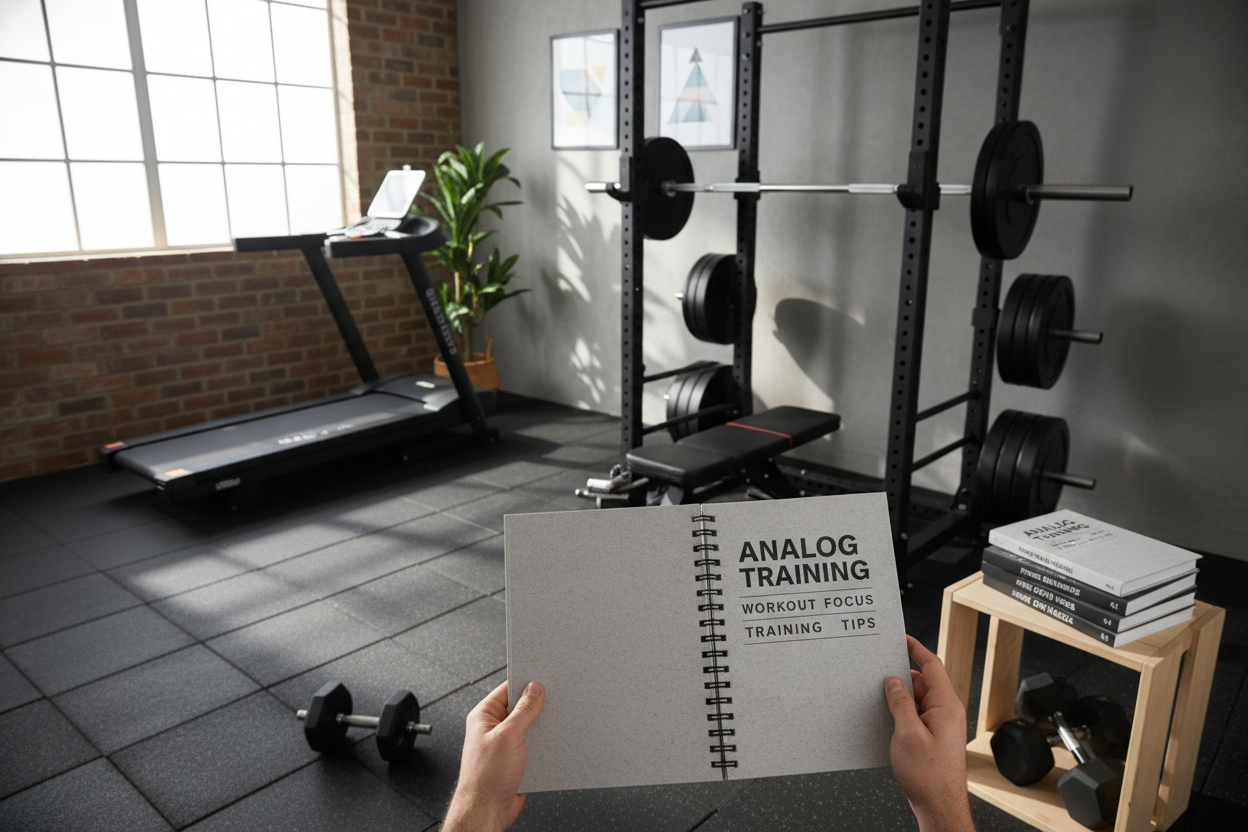
I finally decided to print out a book of exercises pdf and leave the phone in the kitchen. It sounds low-tech, almost primitive, but going analog is the single most effective focus hack I have implemented in my garage gym in five years. No notifications, no blue light, just paper and iron.
Quick Takeaways
- Eliminating phone distractions can slash 15-20 minutes off your total workout time.
- Physical exercise books pdf allow for faster referencing of form cues without screen glare.
- A movement-based organization system (Push/Pull/Hinge) beats a standard 'bro-split' layout.
- Heavy-duty sheet protectors are mandatory to prevent sweat and chalk from ruining your pages.
The Smartphone Is the Enemy of Progressive Overload
We tell ourselves we need the phone for 'utility.' We use it to log sets, check a RPE chart, or look up a quick form video for a movement we haven't done in months. But the friction of unlocking a screen is a gateway to doomscrolling. You check your rest timer, see a red dot on an app icon, and suddenly your three-minute rest period becomes a twelve-minute rabbit hole.
Progressive overload requires intensity and consistency. When you are distracted, you lose the 'feel' of the weight. You forget how that last set of RDLs felt in your hamstrings because you were too busy reading a comment thread. A physical manual stays open to the page you need. It doesn't lock, it doesn't buzz, and it doesn't care about your social media feed.
Why I Hunted Down a Proper Book of Exercises PDF
I spent weeks filtering through junk to find a reference guide that actually mattered. I even spent time testing if any gym exercise book pdf free download was worth the ink, but most were just thin marketing brochures for overpriced supplements. I needed something substantial—a movement encyclopedia that showed clear start and finish positions for everything from a Zercher squat to a face pull.
The goal was to find fitness pdf books that prioritized biomechanics over aesthetic photos. I wanted to see where the joints should be stacked, not how much oil the model had on their triceps. Once I found a high-quality file, I didn't just keep it on my hard drive; I hit 'Print' on 80 pages of pure utility. Transitioning to a physical binder meant I had a permanent, tangible resource that lived on my workbench, not in a cloud folder I'd never open.
Anatomy of a Reference Manual That Actually Works
A good gym manual isn't a textbook; it’s a quick-reference guide. If you have to read three paragraphs of text to understand a lat pulldown, the book has failed. The best guides use high-contrast anatomical diagrams that highlight the primary and secondary movers. I want to see a red highlight on the lats and a yellow highlight on the rhomboids so I know exactly where I should be 'feeling' the squeeze.
The images need to be large enough to see from five feet away. When I’m setting up my adjustable bench, I want to glance at the binder on the floor and immediately recognize the bench angle and hand placement. Minimal text is a feature, not a bug. Give me three bullet points on setup and one 'pro-tip' on execution, and then get out of the way.
Categorizing by Movement, Not Just Muscle Group
Most people organize their training by 'Chest Day' or 'Leg Day,' but that’s not how a reference manual should work. I organized my binder using tabs for Push, Pull, Hinge, Squat, and Carry. This makes it incredibly easy to swap an exercise on the fly. If the cables are acting up and I can't do a cable fly, I flip to the 'Push' tab and find a dumbbell alternative in seconds.
I also added a specialized section at the back for prehab and mobility. I specifically included a page for shoulder range of motion exercises to use during my warmups. Having those diagrams right there reminds me to actually do the work instead of rushing straight to the heavy pressing movements.
Building the Ultimate Analog Home Gym Setup
Don't just staple the pages together and call it a day. If you're training in a garage, humidity and sweat will turn raw paper into a soggy mess in a week. Get a 1-inch D-ring binder and a pack of heavy-duty non-glare sheet protectors. This allows you to flip pages with chalky hands without ruining the ink. I also use a dry-erase marker on the plastic sleeves to check off my sets as I go.
I keep my binder open on my large exercise mat during my dynamic warmup. It’s part of the ritual now. While I’m doing my bird-dogs and cat-camels, I’m looking at the cues for my main lifts. It sets the mental tone for the session. The mat provides a clean, dedicated space where the binder stays open and accessible throughout the entire workout.
The 30-Day 'Screen-Free' Workout Challenge
Here is my challenge to you: for the next 30 days, leave your phone inside the house. Use a cheap digital kitchen timer for your rest periods and a physical notebook to log your weights. Rely entirely on your printed fitness pdf books for form reminders. You will likely find that your '60-minute' workout suddenly only takes 45 minutes because the digital friction is gone.
Training is supposed to be a break from the noise of the world. By printing your resources, you reclaim that headspace. It’s just you, the iron, and the plan on the page. No distractions, no scrolls, just progress.
FAQ
Do I need a professional printer for this?
No. A standard home inkjet or laser printer is fine. Just make sure you print in high quality so the anatomical diagrams are sharp. If you want it to last forever, take the file to a local print shop and have them do it on 32lb paper.
What if I need to see a video for a new movement?
Watch the video in the house before you head to the gym. Internalize the cues, write them down in the margins of your binder, and then go execute. If you absolutely must see a video mid-workout, you probably aren't ready to go heavy on that movement yet.
How do I log my weights without an app?
Get a dedicated training log or a simple composition notebook. There is something incredibly satisfying about physically crossing out a heavy set with a pen that a haptic buzz on a screen just can't replicate.