I Spent Years Looking for a Good Leg Exercise (And Found 3)
I remember sitting in my garage at midnight, staring at a pair of rusty 45s and wondering why my quads still looked like they belonged to a marathon runner. I had spent months trying every trend on my feed, from banded sissy squats to weird isometric holds. I was desperately searching for a good leg exercise that didn't feel like a circus act.
The truth is, most of us overcomplicate the lower body. We ask what exercise is good for legs while ignoring the three basic movements that have built massive wheels for decades. I wasted three years on optimization before I realized that intensity and stability beat variety every single time.
- Unilateral movements like split squats prevent muscle imbalances and save your lower back.
- Hamstrings require a heavy hinge; you can not build a complete leg with just quad-dominant moves.
- Constant tension is the secret to making light weights feel heavy.
- A stable, non-slip surface is non-negotiable for heavy leg days.
Why I Stopped Chasing the 'Perfect' Lower Body Move
Social media is a plague for program consistency. You see a pro bodybuilder doing a cable-stabilized-poliquin-step-up and suddenly your own routine feels obsolete. I spent way too long wondering what exercises are good for legs instead of just picking one and getting strong at it. This paralysis by analysis is a common trap, especially if you are looking for a good gym exercise for beginners.
The secret isn't finding a new move; it is finding a move that allows you to load the muscle heavily without your joints screaming. When you bounce from variation to variation every week, you never actually master the mechanics. I had to strip my ego back to zero and focus on three specific movements that actually deliver.
Movement 1: The Front-Foot Elevated Split Squat
If I could only keep one leg move, this is it. By elevating your front foot just 2-4 inches on a weight plate or a small block, you increase the range of motion at the hip and knee. This creates a brutal stretch in the quad and glute that a standard squat just can't match. It is the ultimate answer when people ask what exercise is good for legs but don't have a five-figure power rack setup.
I usually grab a pair of 50-lb dumbbells and focus on keeping my torso upright. Because it is a unilateral move, you don't need a massive barbell on your back to get a training effect. This saves my spine and allows me to push to absolute failure. If you aren't shaking by the end of the second set, you aren't going deep enough.
Movement 2: The Dumbbell Romanian Deadlift (RDL)
Too many lifters forget the back of their legs. They ask what exercises are good for legs and only think about their quads. The Dumbbell RDL is my bread and butter for the posterior chain. Unlike the barbell version, dumbbells allow you to keep the weight closer to your center of gravity, which is much kinder to the lower back.
The key here is the hinge. Think about pushing your glutes back toward the wall behind you until you feel a pulling sensation in your hamstrings. Stop there—don't try to touch the floor if it means rounding your back. I have found that 3 sets of 12 with a slow eccentric builds more thickness in the hamstrings than any leg curl machine I have ever used.
Movement 3: The Constant-Tension Goblet Squat
This is my finisher. I take a single heavy dumbbell, hold it against my chest, and squat. But here is the trick: I don't lock out at the top. I stay in the bottom 80% of the movement. This keeps the quads under constant tension for the entire set.
By the time I hit rep 15, my legs feel like they are filled with hot lead. It is a mental game as much as a physical one. I don't care about the weight as much as the tempo. A 3-second descent followed by an immediate drive back up will fry your legs in under 10 minutes. It is simple, brutal, and effective.
Setting Up Your Space for Heavy Lifts
You can have the best programming in the world, but if your feet are sliding, you're going to get hurt. I learned this the hard way when I tried to do heavy split squats on a dusty concrete floor. My back foot slipped, and I spent the next week limping with a strained adductor. Stability is the foundation of force production.
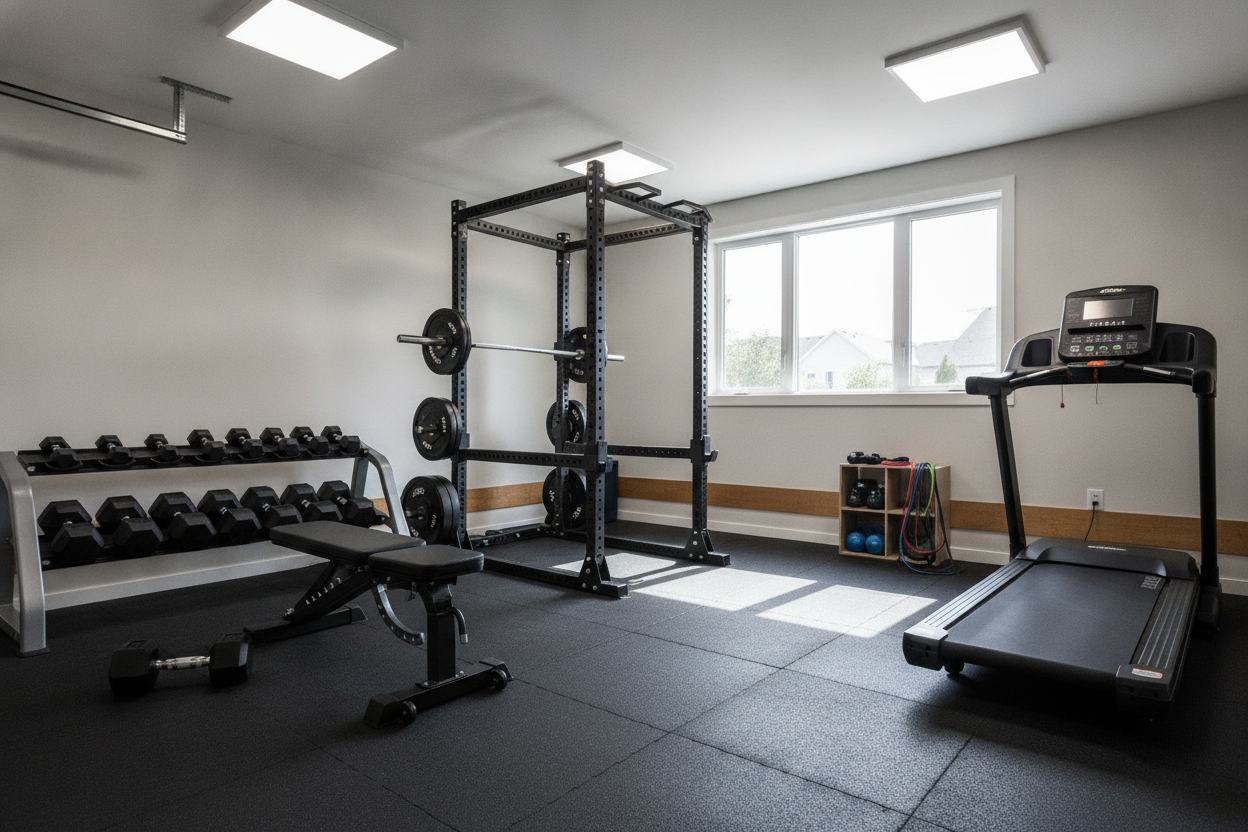
Invest in a high-traction surface. I eventually laid down a large exercise mat for home gym use, and it changed everything. Being able to grip the floor with your toes allows you to drive through the heel without worrying about a trip to the ER. It makes your home gym feel like a professional facility rather than a storage unit.
Is it better to use dumbbells or a barbell for legs?
Dumbbells are often better for home lifters because they allow for more natural movement patterns and don't require a spotter. You can push to failure and simply drop them if the lift fails.
How many times a week should I train legs?
Twice a week is the sweet spot. It gives you enough volume to grow but enough recovery time so you aren't walking like a newborn giraffe every day of the week.
Can I build big legs without a squat rack?
Absolutely. Between split squats, RDLs, and weighted lunges, you can build massive legs with just a heavy set of dumbbells and some consistency.