I Replaced My Cable Machine With Barbell Exercises for Upper Body
I remember staring at a $2,500 functional trainer online, then looking at my bank account and my cramped 10x12 garage. I didn't have the space or the cash for a massive pulley system, but I was desperate for that constant tension you get from a cable crossover. Most people think you're stuck with basic presses once you leave the commercial gym, but barbell exercises for upper body can actually do a hell of a lot more if you stop treating the bar like a rigid stick and start treating it like a lever.
- Torso Angle is Everything: Leaning into or away from the bar changes where the peak tension hits.
- The Landmine is Your Best Friend: It turns linear gravity into a circular arc that mimics cable flys.
- Tempo Over Load: To mimic cables, you have to slow down the eccentric (lowering) phase.
- Don't Go Bilateral Only: Use the bar one arm at a time to prevent strength imbalances.
Why Free Weights Can't Naturally Do What Pulleys Do
Gravity is a one-way street. It only pulls straight down. When you're doing a standard bench press, the exercise is hardest at the bottom when your chest is stretched. As you lock out, the tension almost disappears because your bones are doing the work, not your muscles. This is why home lifters often feel like their chest and back development stalls compared to the guys at the big-box gyms who have access to 15 different cable machines.
A cable machine provides constant tension because the weight stack is being pulled via a pulley, regardless of where your hands are in space. To get that same feeling with a bar, you have to manipulate the strength curve. You can't just move the weight up and down; you have to change how your body interacts with the bar's path. If you just stick to the basic 'big three' movements, you're leaving a lot of hypertrophy on the table.
The Biomechanics Cheat Code for Garage Gyms
The secret to a successful upper body barbell workout is understanding force vectors. In plain English: the weight only feels heavy when it's moving against gravity. By wedging one end of the barbell into a corner—or a dedicated landmine attachment—you create a pivot point. Now, the bar moves in an arc.
When you stand at a 45-degree angle to a landmine-anchored bar, the resistance isn't just pushing down; it's pushing back and out. This allows you to simulate the 'squeeze' of a cable machine. By intentionally altering your torso angle—leaning forward during a row or standing tall during a press—you can shift the tension from your lower lats to your upper traps without ever touching a pin-loaded machine. It's about making the bar fight you in directions it wasn't designed for.
4 Barbell Exercises for Upper Body That Replace Pulleys
If you want a complete upper body exercise with barbell equipment, you need to move beyond the overhead press. First up is the Meadows Row. Named after the late John Meadows, you stand perpendicular to the bar, grab the fat end (the sleeve), and row it to your hip. It feels exactly like a single-arm cable row and hits the lats with a stretch you can't get from a standard barbell row.
Next, use the Landmine Press to replace high-cable chest flys. Hold the end of the bar with one hand and press it across your body toward your midline. Because the bar is on a pivot, you get that inner-chest squeeze that usually requires a crossover machine. For arms, try the Drag Curl. Instead of curling the bar in an arc, you 'drag' it up your torso, keeping your elbows pinned back. This keeps constant tension on the biceps, mimicking a cable curl perfectly.
Finally, don't sleep on the Floor Pullover. Lying on the ground and moving the bar from behind your head to over your chest simulates a lat pull-down's vertical stretch. It’s a staple for a barbell upper body workout that actually builds a wide back. These upper body exercises barbell style are the bread and butter of a minimalist setup.
Setting Up Your Rack for Lightning-Fast Transitions
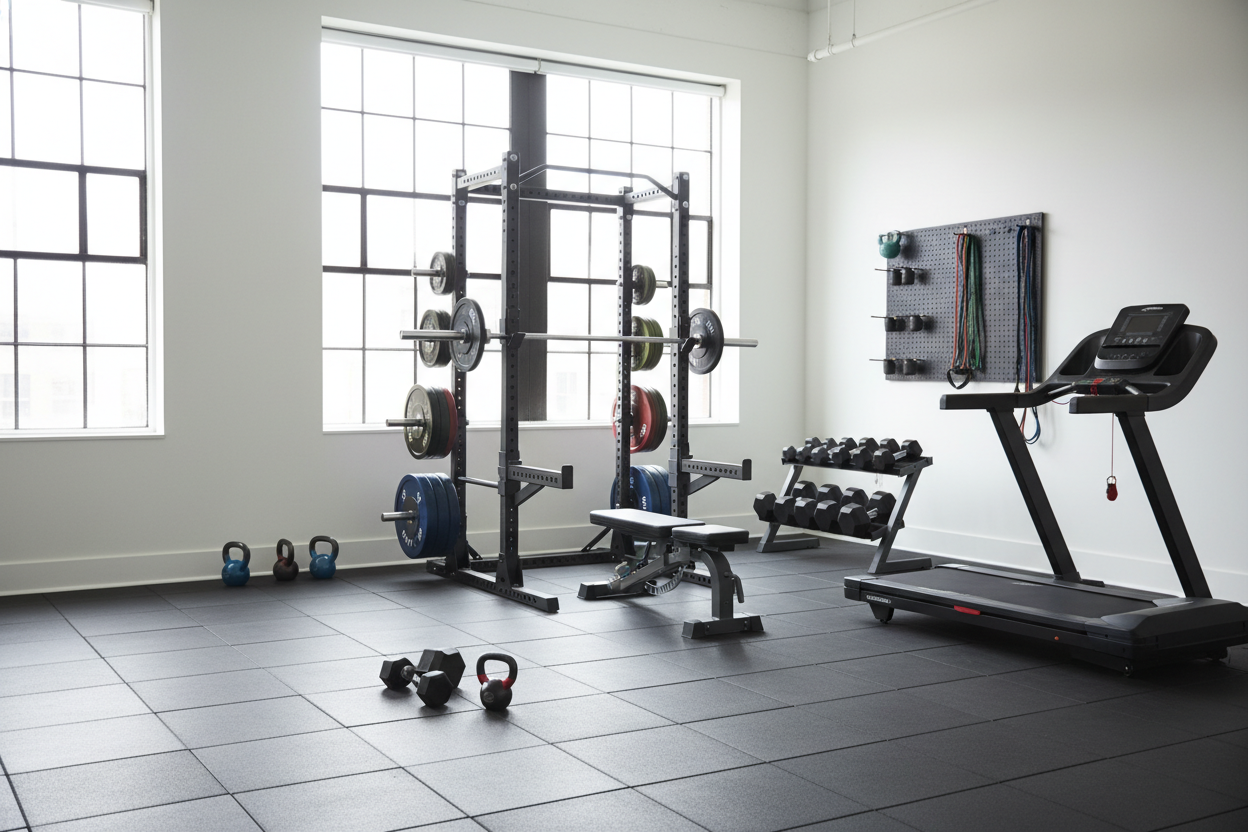
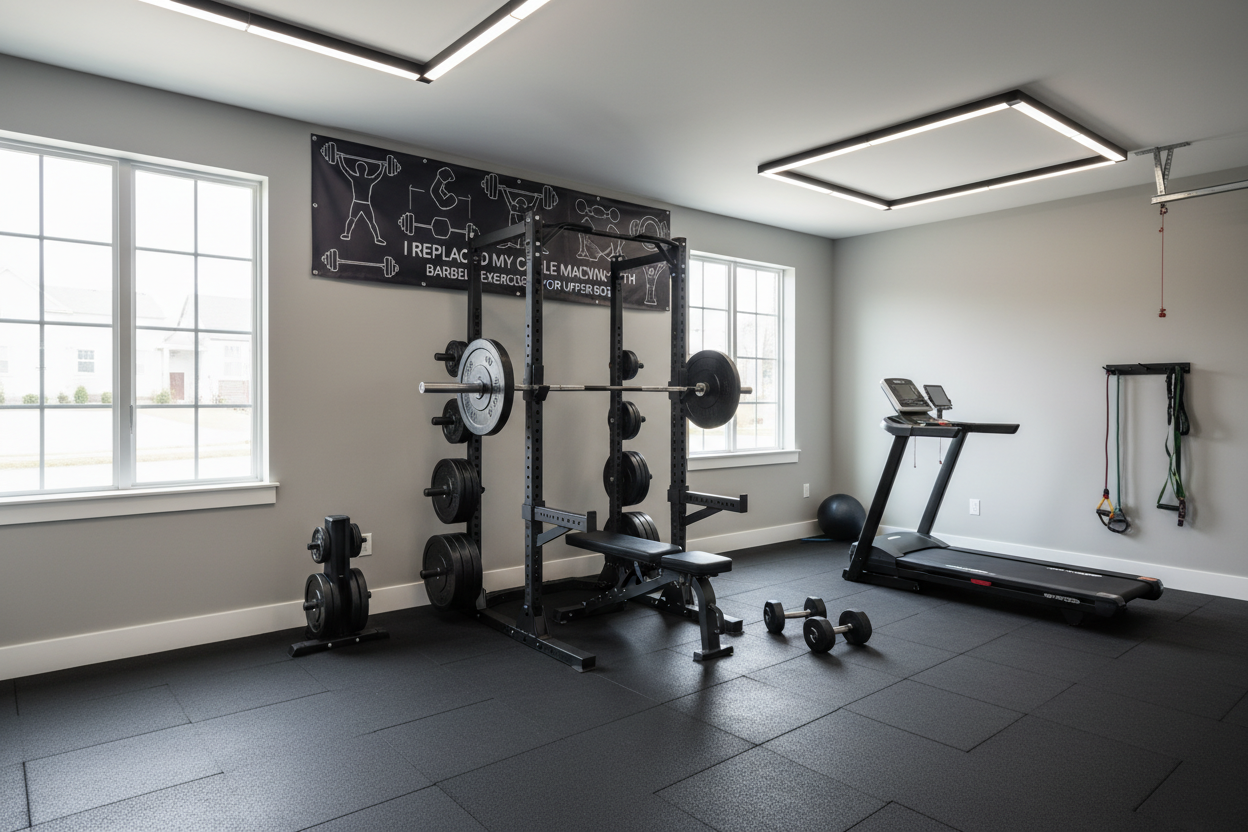
Nothing kills a workout vibe faster than spending five minutes stripping 45s just to move from a press to a row. In my garage, I use a power rack weight bench barbell package because it gives me multiple anchor points. I keep my j-hooks at chest height for rows and my safety pins at hip height for rack pulls, allowing me to pivot the bar quickly without rearranging the whole room.
I also highly recommend using a barbell bumper plate set for these cable-mimic movements. Since bumpers have a uniform diameter, the bar stays at a consistent height when you're doing floor pullovers or Meadows rows. Iron plates are great, but when you're sliding a bar around in a landmine, the smooth rubber of a bumper plate won't chew up your floor or your rack's finish.
The One Massive Flaw With This Bar-Only Approach
I'll be honest: there is a catch. When you use a single bar for everything, your dominant side loves to take over. This is called a bilateral deficit. Over months of training, your right shoulder might end up doing 60% of the work while your left does 40%, and you won't even notice until you look in the mirror and realize you're making you lopsided.
To fix this, you have to program unilateral (one-arm) movements for at least half of your upper body workouts with barbell setups. The landmine is your savior here. Since you're grabbing the sleeve of the bar with one hand, your weak side has nowhere to hide. If you only do standard two-handed presses and rows, you'll eventually hit a plateau that no amount of extra weight can fix. Balance the bar work with single-arm focus, and you'll never miss that cable machine again.
Can I do these exercises with a standard 1-inch bar?
You can, but it's not ideal. Most landmine attachments and 'Meadows' style grips are designed for 2-inch Olympic sleeves. A standard bar is also usually shorter, which messes with the leverage you need to mimic cable tension.
Do I need a dedicated landmine attachment?
Not necessarily. You can wedge the end of your bar into a corner with a heavy sandbag or an old tennis ball over the end to protect your drywall. However, a cheap pivot sleeve that fits into your rack's upright is a much safer and smoother experience.
How do I keep the bar from slipping during 'cable' flys?
Chalk is your friend. Since you're often holding the smooth sleeve of the bar rather than the knurling, a little grip aid goes a long way. Also, make sure you're wearing shoes with good traction; your feet are the anchor for these diagonal force vectors.