I Hate the Treadmill: My Go-To No Cardio Exercise Plan
I remember staring at the timer on a commercial gym treadmill, watching 45 minutes tick by like it was a prison sentence. My knees ached, my heavy squat numbers were tanking, and I was bored to tears. Now that I train in my own garage, I've realized that the best no cardio exercise isn't a machine—it's just moving heavy things faster.
- Traditional steady-state cardio can actually kill your explosive strength gains.
- Density training turns heavy iron into a metabolic furnace.
- Compound movements like thrusters and cleans are the foundation of this style.
- Proper flooring is essential for safety when moving at high intensity.
Why I Finally Pulled the Plug on Traditional Cardio
I used to be the guy who felt guilty if I didn't 'do my time' on the belt after a lifting session. I’d finish a heavy set of five on the bench and then trudge along for 30 minutes at a 3.0 incline. It felt like I was erasing my progress. My central nervous system was fried, and I wasn't actually getting leaner; I was just getting tired and flat. My heavy squat strength started dipping because I was never fully recovered.
The breaking point came when I realized I was spending six hours a week on a machine I hated just to maintain a physique I wasn't even happy with. I pulled the plug, sold the treadmill for a fraction of what I paid, and reclaimed that floor space. The result? I got stronger, my joints stopped clicking, and I actually looked like I lifted. If you want to stay lean without the monotony, you need to rethink what conditioning actually looks like.
The Secret to a Real No Cardio Workout
The magic happens when you manipulate density. Instead of looking at total weight moved, look at how much work you can cram into a specific window. This is how you build a no cardio workout that actually builds muscle. My favorite tool for this is the EMOM (Every Minute on the Minute). It’s simple: set a timer for 20 minutes. At the top of every minute, perform a set of a compound lift. The faster you finish, the more rest you get before the next minute starts.
By the 12th minute, your heart will be hammering against your ribs. You get a massive metabolic effect while still holding a barbell in your hands. This isn't just 'lifting weights'; it's high-output conditioning that preserves your hard-earned muscle. For some athletes, this is a much more sustainable approach than a 30 Minute No Repeat Tabata Hiit Workout Insane Cardio Burn Max Calories if you prefer the feel of a knurled bar over bodyweight jumping jacks.
My Core No Cardio Exercise Selection
You can't do this with isolation moves. Bicep curls and tricep extensions won't move the needle because they don't demand enough oxygen. To make this work, you need movements that recruit every major muscle group simultaneously. Front squats are my first choice because they force your upper back and core to work overtime just to keep you upright while your quads do the heavy lifting.
Thrusters are the undisputed king of this training style. Combining a deep front squat with an overhead press is miserable, but it's the most efficient way to spike your heart rate. I also lean heavily on kettlebell swings. When done for high reps with a heavy bell, they develop that 'explosive' cardio that transfers directly to your deadlift lockout. If you aren't gasping for air after a set of 25 heavy swings, you aren't going heavy enough.
Barbell Complexes That Will Break You
Try this specific complex: 5 Power Cleans, 5 Front Squats, 5 Overhead Presses, and 5 Back Squats. The rule is simple: the bar cannot touch the ground until all 20 reps are finished. Rest 90 seconds and repeat for five rounds. By the third round, you'll realize you don't need a Peloton to feel like you're dying. The bar starts to feel twice as heavy, and your grip strength will be tested just as much as your lungs.
Setting Up Your Space for Uninterrupted Lifting
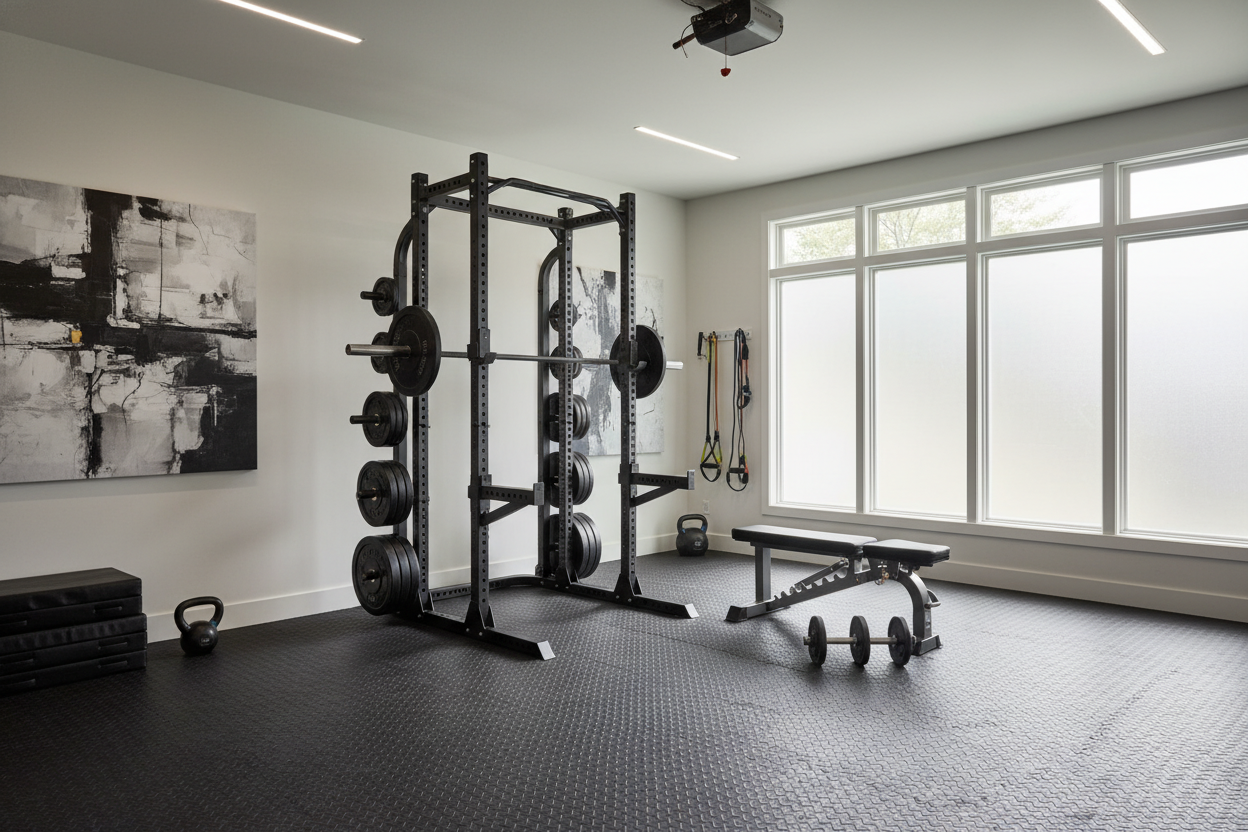
When you're doing high-rep complexes or heavy EMOMs, you cannot afford to be slipping on bare, dusty concrete. I've almost eaten it mid-clean because of a slick floor, and it’s a mistake you only make once. You need a dedicated, high-traction area where you can transition between movements without thinking about your footing. A 6X8Ft Exercise Mat Yoga Mat Gym Flooring For Home Workout provides enough real estate to drop a bar or swing a bell safely.
If your garage gym is more of a 'sanctuary' and you're moving between a rack and a kettlebell station, consider a Large Exercise Mat to define your working zone. Having a consistent, shock-absorbing surface means you can focus on the intensity of the lift rather than whether or not you're going to crack your foundation or slide out during a heavy thruster.
The Hard Truth About Staying Lean Without Running
Here is the reality check: you cannot out-train a bad diet, especially when you stop doing traditional cardio. When you ditch the 500 calories you used to burn on the treadmill, your nutrition has to be dialed in. I focus on high protein to support recovery and keep my carbohydrates centered around my training window. It is simple thermodynamics; if the output from running is gone, the input from your fork has to be managed.
I’ve found that I actually stay leaner this way because I’m not constantly 'ragingly hungry' like I was after long runs. Lifting heavy and fast keeps your growth hormone levels high and your insulin sensitivity sharp. It’s a more sophisticated way to train, but it requires more discipline in the kitchen. Stop thinking about cardio as a way to 'burn off' a pizza and start thinking about your lifting as the engine that drives your metabolism.
FAQ
Is this better than running for fat loss?
For most people looking to maintain muscle mass, yes. It creates a larger 'afterburn' effect (EPOC) than steady-state walking or jogging.
How many times a week should I do this?
Start with two sessions. Replace your boring cardio days with one of these heavy density sessions and see how your recovery holds up.
Can I do this with dumbbells?
Absolutely. Dumbbell thrusters and man-makers are actually more taxing for some because they require more stabilization than a barbell.