I Built a CrossFit Gym in My Garage for Under $2,000—Here's Everything You Need to Know
Building a CrossFit gym at home is more affordable and straightforward than most people think. You don't need $10,000 or a massive warehouse-style space to get started. With some strategic planning and the right equipment choices, you can create a functional training area in your garage, basement, or spare room that rivals commercial box memberships.
The real question isn't whether you should build a home CrossFit gym—it's how to do it smartly without wasting money on equipment that'll collect dust.
What You Actually Need for a Functional CrossFit Setup
The beauty of CrossFit is its simplicity. Unlike traditional gyms that require dozens of machines, a proper crossfit gym setup relies on versatile, multi-functional pieces. The essentials break down into three categories: a barbell with plates, a pull-up rig or bar, and a jump rope. Everything else enhances your workouts but isn't strictly necessary on day one.
When I started planning my garage gym, I made the mistake of creating an elaborate wish list that totaled nearly $8,000. After actually doing CrossFit workouts at home for six months with minimal gear, I realized 80% of that list was unnecessary. The workouts that truly challenge you—the ones that leave you gasping on the floor—rarely require fancy equipment.
Best CrossFit Equipment: Where to Invest Your Money
Your barbell is the single most important purchase. This isn't the place to cut corners. A quality Olympic barbell will last decades and handle everything from snatches to deadlifts. Look for bars with a tensile strength rating of at least 190,000 PSI and good knurling that won't tear your hands apart but provides solid grip.
For plates, bumper plates are non-negotiable if you plan to do Olympic lifts. They protect your floor and allow you to safely drop the bar from overhead. You don't need competition-grade bumpers—basic rubber bumpers work perfectly fine for home use. Start with pairs of 45s, 25s, 15s, and 10s. You can add 5s and 2.5s later for micro-loading.
The pull-up rig is your second major investment. Freestanding rigs offer maximum stability and the option to add accessories like dip bars and ring attachments. Wall-mounted rigs save space and cost less but require solid wall studs. Ceiling-mounted pull-up bars are the budget option, though they limit your exercise variety.
Flooring Matters More Than You Think
Don't overlook flooring when planning your crossfit setup. Concrete is unforgiving on dropped barbells and your joints. Horse stall mats—the 4x6 foot, 3/4-inch thick rubber mats from farm supply stores—are the gold standard for home gyms. They're durable, affordable at around $40-50 per mat, and protect both your equipment and your foundation.
Crossfit Garage Gym Packages vs. Piecing It Together
Several companies now offer crossfit garage gym packages that bundle everything together. Rogue, Fringe Sport, and Titan Fitness all have package deals ranging from $1,500 to $5,000. These packages typically include a barbell, bumper plates, a rig, and sometimes extras like kettlebells or plyo boxes.
The advantage? You save time researching individual pieces and often get a modest discount. The downside is less flexibility in choosing specific items. I went the piecemeal route, which took more research but let me prioritize quality where it mattered most and save money on less critical items.
For most people starting out, a mid-range package around $2,000-2,500 hits the sweet spot. You get everything functional without overbuying, and reputable companies ensure compatibility between components.
DIY CrossFit Gym: Smart Ways to Save Money
Building a DIY crossfit gym doesn't mean you need to weld your own rig from scrap metal (though some people do). It means making strategic choices about where to spend and where to save.
Used equipment is your friend. Check Facebook Marketplace, Craigslist, and local gym liquidation sales. Barbells and plates are nearly indestructible—a used barbell that's been maintained works as well as a new one. I found a barely-used Rogue Ohio Bar for $150, half the retail price, from someone who bought it during the pandemic and never used it.
Some crossfit homemade equipment options actually work well. PVC pipe makes excellent mobility tools and practice barbells for learning Olympic lift technique. Sandbags filled with playground sand cost $20 versus $100+ for commercial versions. Plyo boxes can be built from plywood for under $50 if you're handy with basic tools.
What Not to Cheap Out On
Your barbell, as mentioned, deserves quality. Same goes for anything that affects safety—don't buy sketchy J-hooks or spotter arms from unknown manufacturers. And while DIY solutions work for some things, I learned the hard way that homemade parallettes aren't worth the wobble and instability.
Space Planning for Different Home Setups
Garage gyms are the most popular choice for CrossFit training at home. A single-car garage (roughly 12x20 feet) provides enough space for most workouts. You'll want at least 8-foot ceilings for overhead movements, though 9-10 feet is ideal.
A basement crossfit gym works great if you have the ceiling height. Many basements top out at 7-8 feet, which limits overhead work but still allows most CrossFit movements. Temperature control is easier in basements, making year-round training more comfortable.
Even a 10x10 section of a spare room can work as a crossfit set up at home if you're strategic. Wall-mounted foldable rigs collapse when not in use, and you can store plates vertically to save floor space. You'll need to be more selective about equipment, but the core movements remain accessible.
My Actual Build and What I Learned
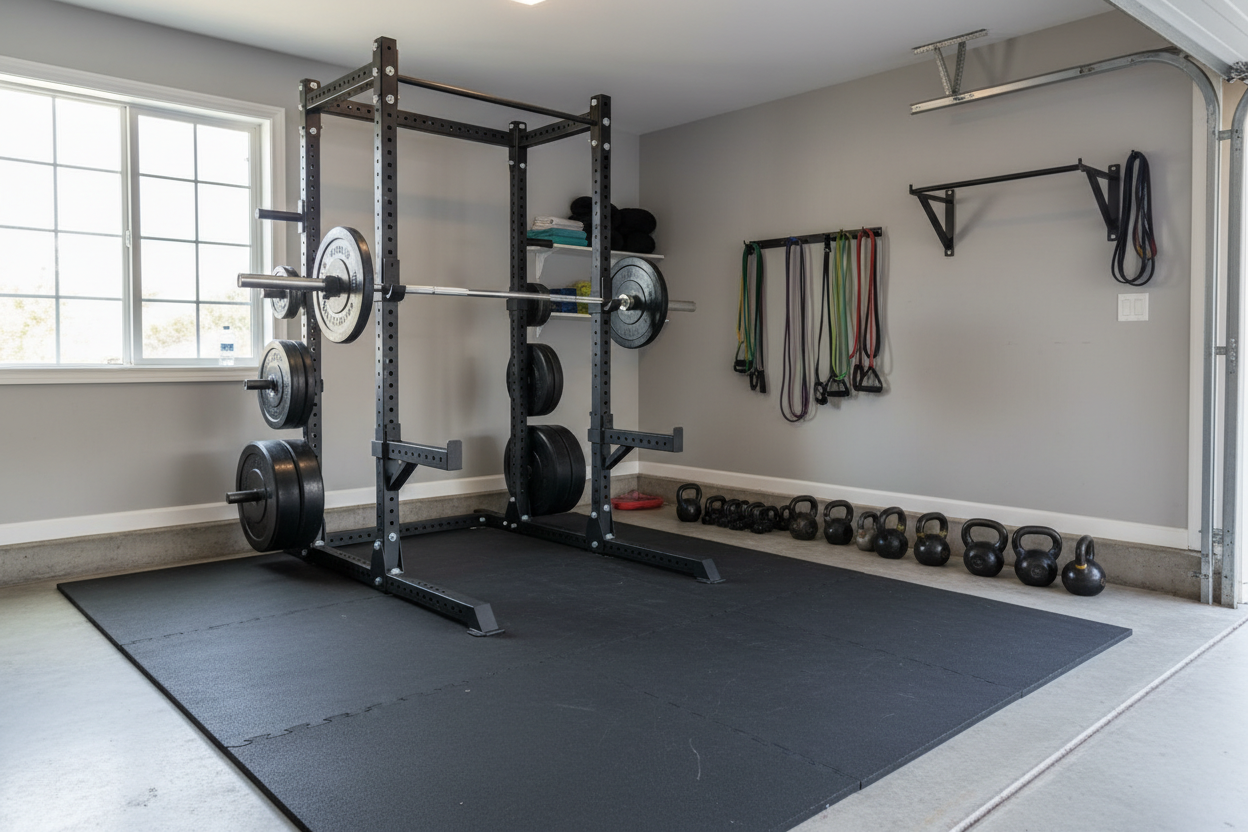
I converted half of my two-car garage into a functional CrossFit space for about $1,800. The breakdown: $300 for a quality barbell, $450 for 260 pounds of bumper plates, $600 for a squat rack with pull-up bar, $200 for horse stall mats, and the remaining $250 for a jump rope, gymnastics rings, a kettlebell, and a wall ball.
What surprised me most was how little I missed from commercial gyms. The rower would be nice occasionally, but it's not worth $1,000 for how often I'd use it. The assault bike? Same story. Most hero WODs and benchmark workouts are completely doable with basic equipment.
The biggest game-changer wasn't expensive equipment—it was the convenience. No commute, no waiting for equipment, no monthly fees. I work out more consistently now than when I had a box membership.
Getting Started Without Overthinking It
If you're serious about how to build a crossfit home gym, start with the essentials and add over time. Month one: barbell, plates, and a pull-up solution. Month two: flooring and a plyo box. Month three: kettlebells or dumbbells. This approach spreads costs and lets you learn what you actually use versus what sounds cool.
The best equipment for crossfit is whatever keeps you training consistently. A $500 setup you use five days a week beats a $5,000 setup that intimidates you into inaction.
Frequently Asked Questions
How much space do I really need for a home CrossFit gym?
A 10x10 foot area is the absolute minimum for basic CrossFit workouts, though 12x12 or larger is more comfortable. You need enough room to safely perform movements like burpees, box jumps, and barbell work without hitting walls or equipment. Ceiling height matters too—aim for at least 8 feet for overhead movements.
Can I build a functional CrossFit gym for under $1,000?
Yes, but you'll need to prioritize carefully and likely buy used equipment. Focus on a quality barbell ($200-250), basic bumper plates ($300-400), a simple pull-up bar ($50-150), flooring ($100-150), and a jump rope ($20). You can add other equipment gradually as your budget allows.
What's the one piece of equipment I shouldn't skip?
A good barbell is non-negotiable. It's the foundation of CrossFit training and will last for decades if you invest in quality. Everything else can be substituted, improvised, or added later, but you can't effectively do CrossFit without a proper barbell and plates.