How to Use Home Gym Equipment: The Definitive Guide for 2025
You finally bought the setup. It’s sitting in your garage or spare room, shiny and promising. But now that it's assembled, you are staring at the pulleys and levers wondering where to start. You aren't alone. Many fitness enthusiasts invest heavily in gear but struggle with how to use home gym equipment effectively to generate real hypertrophy.
Using a multi-station machine or a power rack isn't just about moving weight from point A to point B. It requires understanding biomechanics, machine adjustment, and tension control. If you treat a cable machine like a dumbbell, you lose half the benefit. This guide breaks down exactly how to operate your station safely.
Key Takeaways
- Align Pivot Points: On machines like leg extensions, the machine's pivot point must align perfectly with your joint (knee) to prevent injury.
- Adjust Before You Lift: Never adapt your body to the machine. Use the adjustment knobs to fit the equipment to your limb length.
- Control the Eccentric: Home gym cable systems often lack the friction of commercial gear; control the lowering phase to keep tension on the muscle.
- Inspect Cables Weekly: Check for fraying plastic coating to ensure smooth operation and safety.
Understanding Your Machine's Anatomy
Before you load the weight stack, you need to understand how gym equipment functions mechanically. Most home setups fall into two categories: fixed-path lever machines and cable-pulley systems.
The Pivot Point Rule
If you are learning how to use a home gym machine that has a seat and a lever (like a chest press or leg curl), the most critical factor is the axis of rotation. Look for the bolt or cam that the arm swings around.
For a leg extension, that bolt needs to be in a direct line with your knee joint. If the machine's pivot point is two inches in front of your knee, you introduce shearing force that can grind down cartilage. Spend the first five minutes of your workout adjusting the back pad until this alignment is perfect.
Cable Systems and Pulleys
When figuring out how to use home gym cable stations, realize that gravity is not always pulling straight down. The resistance comes from the direction of the cable.
To target the chest effectively, the cable should align with your arm path. If you are doing a high-to-low fly, your arm should follow the line of the cable. If you break that line, you create friction in the pulley housing and lose tension on the muscle.
Setting Up: The Adjustment Phase
Most injuries happen because the user skips the setup. Here is the protocol for how to use a home gym equipment station correctly:
- Seat Height: For pressing movements, set the handles at mid-chest level (nipple line). If they are at shoulder height, you risk impingement.
- Range of Motion (ROM) Limiters: Many home gyms have a pin that limits how far back the handles go. Set this so you feel a stretch in the muscle, but not pain in the joint capsule.
- The Check-Pin: Ensure the weight stack pin is fully inserted. A halfway-inserted pin can vibrate out during a set, causing the stack to crash.
Execution: Time Under Tension
Home gym stacks often feel lighter than commercial gym weights due to different pulley ratios (often 2:1). This means 100lbs on the stack might only feel like 50lbs in your hand.
To counter this, you must slow down. Explode on the concentric (lifting) phase, pause for one second at the peak contraction, and take three full seconds to lower the weight. This eliminates momentum and forces the muscle to do the work.
My Personal Experience with how to use home gym equipment
I want to be real about the transition from a commercial gym to a home unit. The first time I bought a mid-range multi-gym, I expected it to feel like the silky-smooth Life Fitness machines I was used to. It didn't.
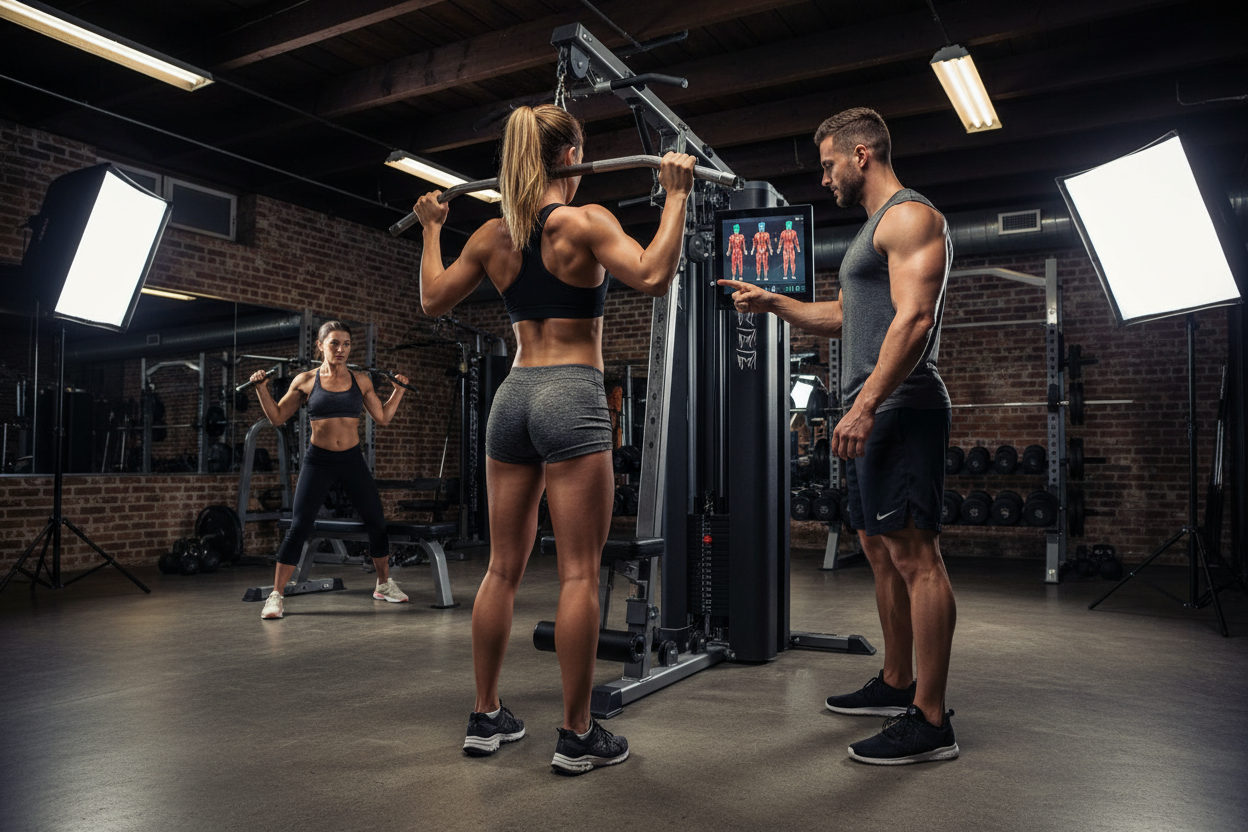
I vividly remember the specific, gritty vibration of a nylon pulley that hadn't been lubricated yet. There was this annoying "sticking point" halfway through a lat pulldown where the carriage would stutter on the guide rods. I learned the hard way that how to use home gym equipment involves maintenance, not just lifting. If I didn't wipe down those chrome guide rods with silicone spray every Sunday, the friction would ruin the eccentric part of my rep. Also, the knurling on home-grade attachments is usually passive—it gets slippery fast. I had to start keeping a block of chalk on the shelf just to maintain a grip during heavy rows.
Conclusion
Mastering your home gym isn't about lifting the heaviest pin on the stack. It is about aligning the machine to your body, maintaining the equipment, and controlling the tempo to compensate for pulley ratios. Once you dial in the setup, your home gym becomes the most efficient tool for hypertrophy you own.
Frequently Asked Questions
How often should I lubricate my home gym guide rods?
You should wipe down the guide rods and apply a 100% silicone lubricant every 2 to 4 weeks, depending on usage. Avoid oil-based lubricants like WD-40, as they attract dust and gunk up the bearings.
Why does the weight feel lighter on my home gym than at the commercial gym?
This is usually due to the pulley ratio. Many home gyms use a 2:1 ratio, meaning the mechanical advantage makes 100lbs feel like 50lbs. You can compensate by increasing rep ranges or slowing down your lifting tempo.
Can I get a full-body workout with just a multi-station home gym?
Absolutely. As long as the machine has a high pulley (for lat pulldowns/triceps), a low pulley (for rows/curls), and a pressing arm, you can hit every major muscle group effectively.