Why Your Climbing Shoulder Pain Won't Go Away (And How to Fix It)
You know the feeling. You’re three moves into your project, reaching for a high gaston, and suddenly there’s a sharp pinch deep in the joint. Or maybe it’s the dull, throbbing ache that keeps you awake at night after a heavy session. Climbing shoulder pain is the single most common complaint I hear at the crag and in the clinic. It’s the silent project killer.
Many climbers try to push through, assuming it’s just general soreness. But ignoring that specific mechanical pinch usually leads to months of downtime rather than days. The shoulder is the most mobile joint in the body, but that mobility comes at the cost of stability—a trade-off that rock climbing exploits ruthlessly.
Key Takeaways: The Recovery Protocol
If you are looking for the fast track to shoulder health, here is the core strategy you need to follow:
- Stop testing it: Every time you "check" if it still hurts by replicating the move, you re-aggravate the tissue.
- Address the hunch: Climber's posture (tight pecs, rounded shoulders) is the primary driver of impingement.
- Strengthen the antagonist: Your lats are strong; your rotator cuff and lower traps are likely weak.
- Active Rehab: Rest doesn't fix mechanics. Controlled loading (exercises) does.
- Modify, don't quit: You can often keep climbing by avoiding specific moves (gastons, internal rotation) while rehabbing.
The Anatomy of a Climbing Shoulder Injury
To fix the issue, you have to understand the mechanics. When you deal with shoulder pain from climbing, you are usually dealing with an imbalance. We spend our lives pulling down and rolling our shoulders forward. This shortens the pectoral muscles and lengthens the stabilizers in the back.
This creates a lack of space in the subacromial space (the gap between the top of your shoulder blade and the arm bone). When you raise your arm above your head—which is 90% of climbing—the tissues get pinched in that narrowed gap. This is the classic recipe for climbing shoulder impingement.
Identifying Your Injury
Before jumping into rehab, we need to differentiate between common climbing shoulder injuries. While a professional diagnosis is mandatory for severe pain, here are the usual suspects:
1. Shoulder Impingement
This is the most frequent issue. It feels like a pinch when reaching overhead or across your body. It’s usually caused by poor scapular mechanics.
2. Rotator Cuff Tears
A rotator cuff injury climbing scenario often happens during a dynamic move or a heavy catch. If you have weakness lifting your arm or a deep ache that travels down the arm, the cuff might be involved.
3. Labral Tears (SLAP Lesions)
The labrum is the cartilage ring that deepens the shoulder socket. A tear here often feels like a "clunking" or catching sensation deep inside the joint.
The "Science" of Rehabilitation: Why Rest Isn't Enough
Rest reduces inflammation, but it does not fix the mechanical fault. If you rest for two weeks and return to the wall with the same weak lower traps and tight pecs, the shoulder injury rock climbing caused will return immediately.
You need to remodel the tissue and retrain the movement pattern. We do this through specific climbing shoulder exercises that target the rotator cuff and scapular stabilizers.
Essential Shoulder Exercises for Climbers
Forget generic gym workouts. We need to target the muscles that stabilize the humerus during vertical pulling motions.
1. The Wall Climb Shoulder Exercise (Serratus Activation)
This is often overlooked but critical for upward rotation of the scapula. The wall climb exercise for shoulder health is simple but humbling.
Stand facing a wall with forearms on the wall (pinky side against the wall). Slide your arms up the wall into a 'Y' shape without shrugging your shoulders or arching your back. This forces the serratus anterior to work, creating space in the shoulder joint to prevent impingement.
2. External Rotation with Support
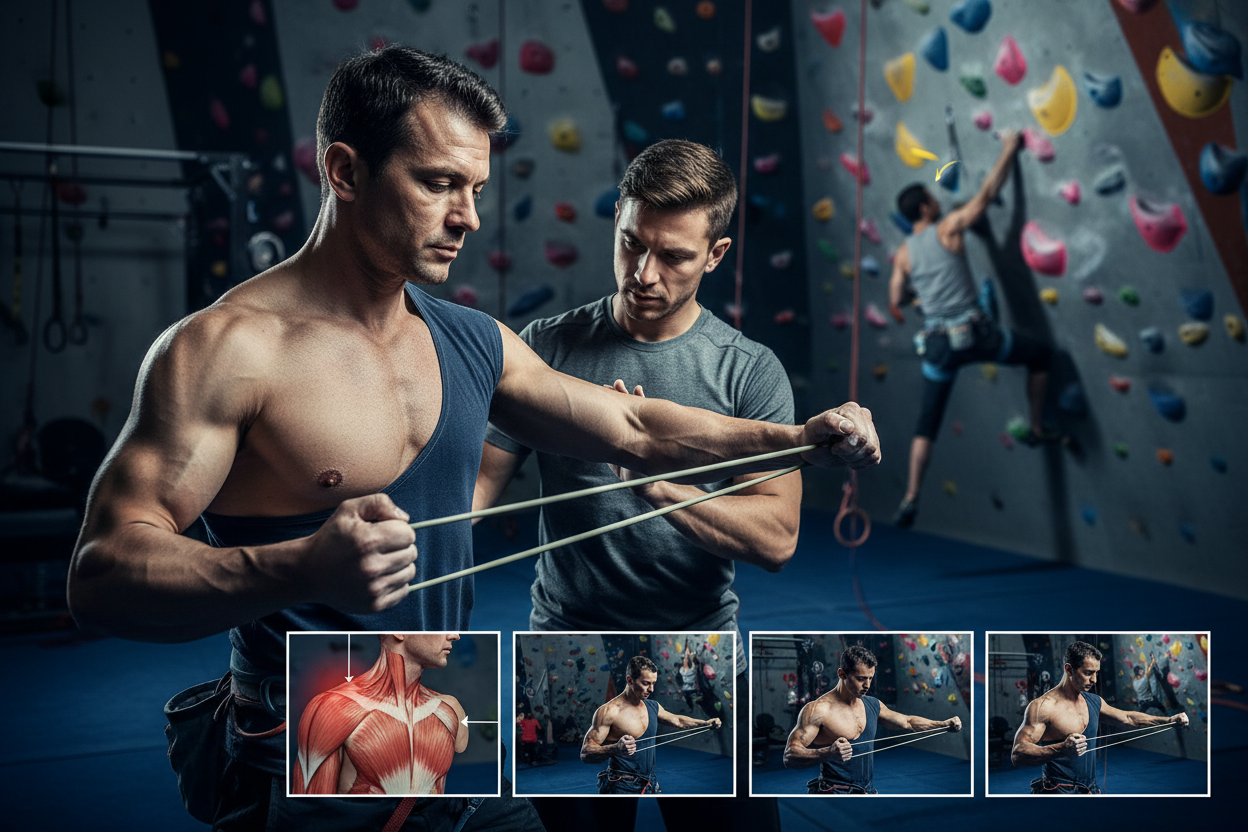
To combat climbing rotator cuff injury risks, you must strengthen external rotation. Use a light resistance band. Keep your elbow pinned to your side (use a rolled-up towel between elbow and ribs for better mechanics) and rotate the hand outward. The towel is key—it prevents you from cheating with your deltoids.
3. Prone Ys and Ts
Lie on your stomach (or on a gym ball). Raise your arms into a 'Y' shape and then a 'T' shape. Focus on squeezing the shoulder blades down and back. This targets the lower trapezius, which is the direct antagonist to the overactive upper traps climbers usually have.
Common Mistakes That Prolong Pain
The "Hanging" Rest: Hanging on your skeleton (passive hanging) with disengaged shoulders puts massive strain on the ligaments. Always maintain a slight engagement (active shoulders) when resting on a route.
Ignoring the Hips: Shoulder pain rock climbing induces is often a result of bad footwork. If you aren't driving with your legs, your shoulders take the full load. Improve your hip mobility to save your shoulders.
My Training Log: Real Talk
I’ve been there. Two years ago, I developed a nagging pain in my left shoulder. It wasn't a dramatic "pop" on a dyno. It was insidious. I noticed it most when I was driving home from the gym—a dull, toothache-like throb that made holding the steering wheel at the 10-o'clock position miserable.
I tried to ignore it. I taped it up. I took ibuprofen. I kept projecting a steep 45-degree board problem that required a heavy left-hand gaston. Big mistake. One session, my arm just gave out. It felt like someone had unplugged the power cord to my deltoid.
The rehab was boring. That's the honest truth. Doing wall climb shoulder exercises feels ridiculous when you used to do one-arm pull-ups. But the specific moment I knew it was working was about six weeks in. I was putting away dishes, reaching for a high shelf, and realized I didn't have to hike my shoulder up to my ear to get the reach. The stability was back. Don't skip the boring stuff; it's the only way back to the sharp end.
Conclusion
Climbing shoulder issues are manageable, but they demand respect. You cannot bully your rotator cuff into submission. By addressing your posture, strengthening the stabilizers, and listening to the warning signs, you can build a shoulder that is bulletproof against the demands of the sport. Treat rehab as part of your training, not a break from it.
Frequently Asked Questions
Can I still climb with shoulder pain?
It depends on the severity. If the pain is sharp or structural (clicking/popping), stop immediately. for mild impingement, you can often climb easy vertical routes, avoiding overhangs and gastons, provided pain does not exceed a 3/10.
How long does a climbing shoulder injury take to heal?
Soft tissue injuries like tendonitis can take 4-6 weeks of active rehab. A rotator cuff climbing injury or tear can take 3 to 6 months. Consistency with rehab exercises significantly shortens this timeline.
Why do I get shoulder pain only after climbing?
This is often inflammation setting in. While you are climbing, adrenaline and warm muscles mask the issue. Post-climb pain usually indicates overuse or mild tendinopathy that needs to be addressed before it becomes a tear.