How to Stop Your Arms From Failing During a Home Leg Workout
We’ve all been there. You’re halfway through a set of lunges, your quads are finally starting to burn, and then it happens—your forearms catch fire. Your grip slips, your upper back rounds, and you have to rack the weights before your legs even hit a decent RPE. It’s the ultimate frustration of the home leg workout: your small muscles fail before your big ones do.
I’ve spent years training in a 10x10 spare bedroom, and I can tell you that the biggest mistake people make isn’t the weight they choose—it’s how they hold it. If you want a leg day that actually builds muscle, you have to stop treating your lower body sessions like a forearm endurance test. You need to learn how to bypass the grip and focus on the floor beneath you.
Quick Takeaways
- Grip strength is usually the first thing to fail in dumbbell-only routines.
- Floor traction is non-negotiable for heavy unilateral movements.
- B-stance variations allow for heavier loading without crushing your spine.
- Bodyweight hamstring curls are superior to light dumbbell curls for isolation.
The Limiting Factor in Every Dumbbell Leg Day
The problem with most leg exercises home workout plans is that they rely on you holding heavy objects in your hands. If you’re trying to grow your quads, you need to push them close to failure. But if you’re holding two 50-lb dumbbells, your grip or your traps might give out at rep 10, even if your legs had five more reps in the tank. This is why many people find legs training at home to be less effective than the gym.
To fix this, you have to prioritize stability. When you are unstable, your brain sends a signal to your muscles to stop firing at 100% capacity. It’s a safety mechanism. By removing the balance and grip issues, you unlock the ability to actually push your quads and glutes. Stop worrying about how many things you can hold and start worrying about how much tension you can put on the target muscle.
Stop Slipping: Why Your Floor Dictates Your Leg Strength
If you are doing leg workouts at home on a hardwood floor or a cheap, thin rug, you are leaving gains on the table. Every time you step into a lunge, your foot makes micro-adjustments to keep from sliding. This leaks power. You cannot produce maximum force if your foundation is shifting. It’s like trying to fire a cannon from a canoe.
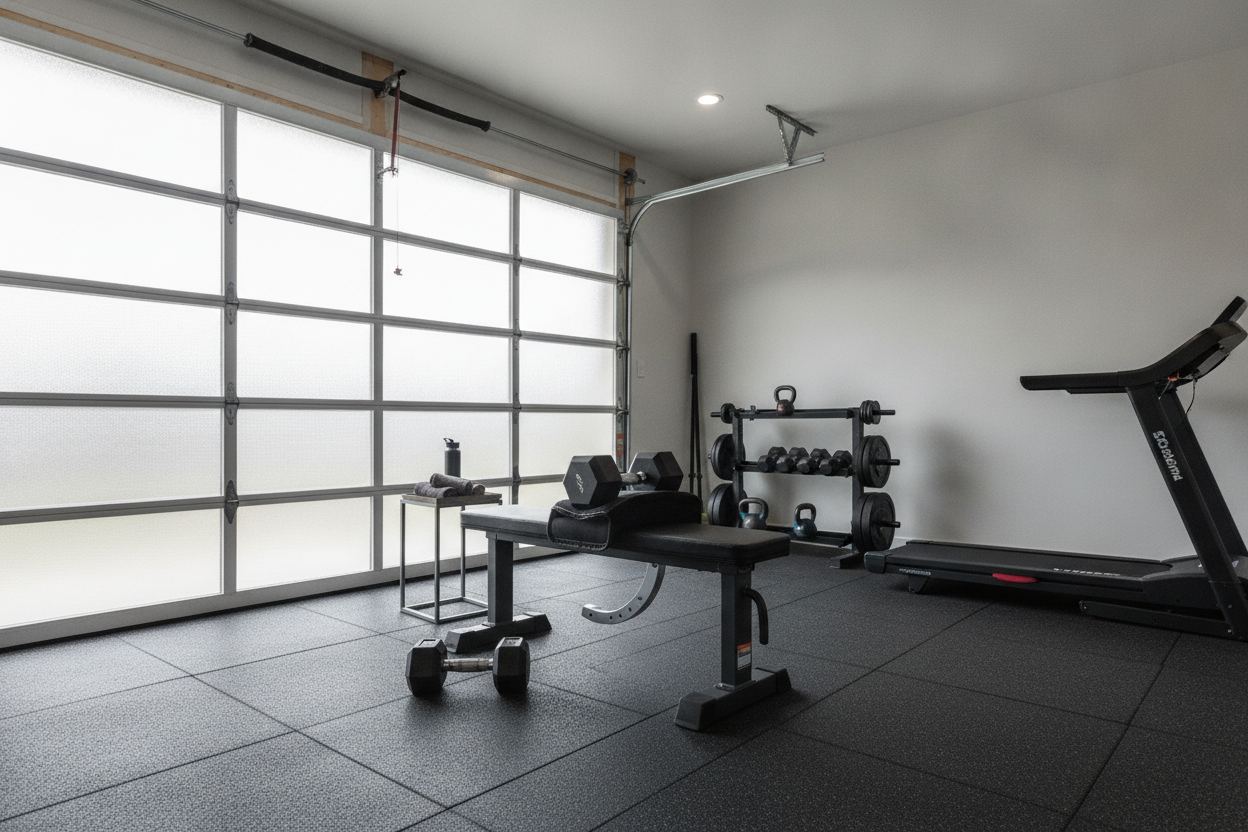
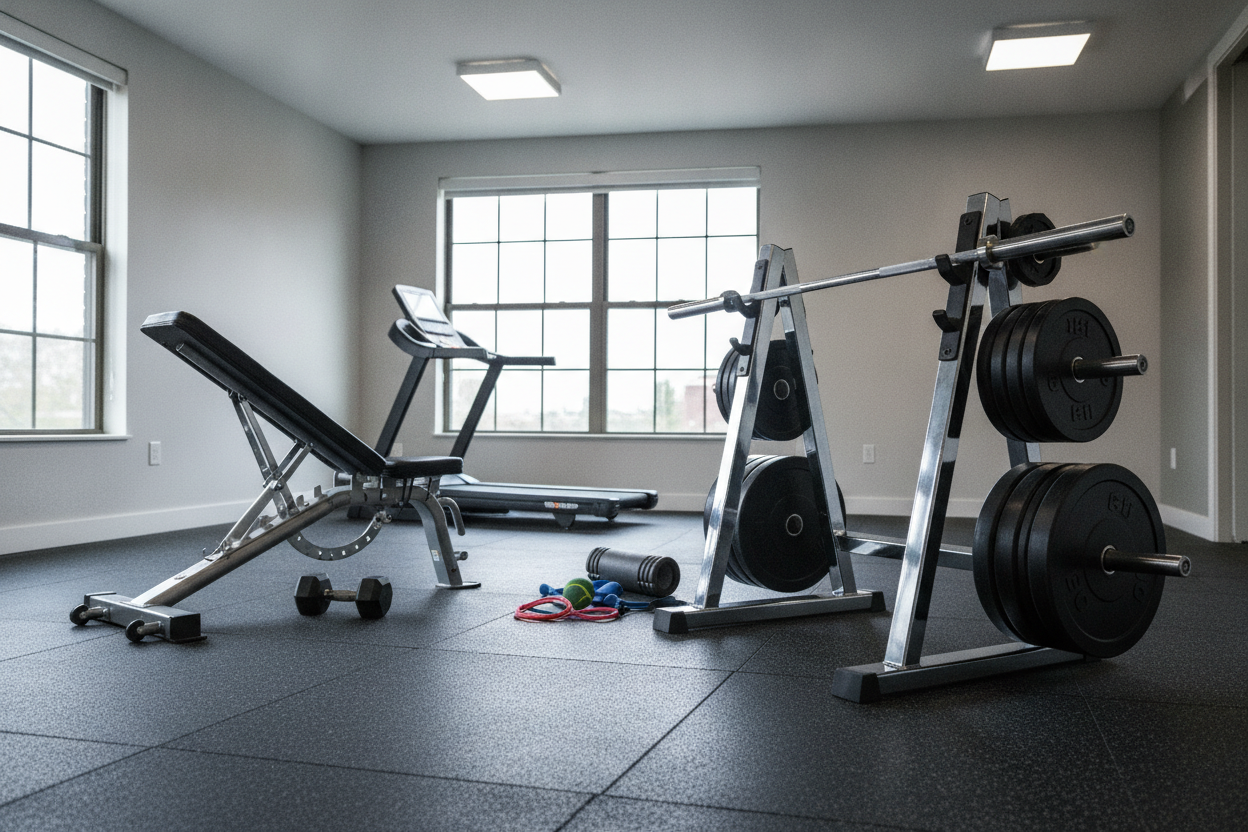
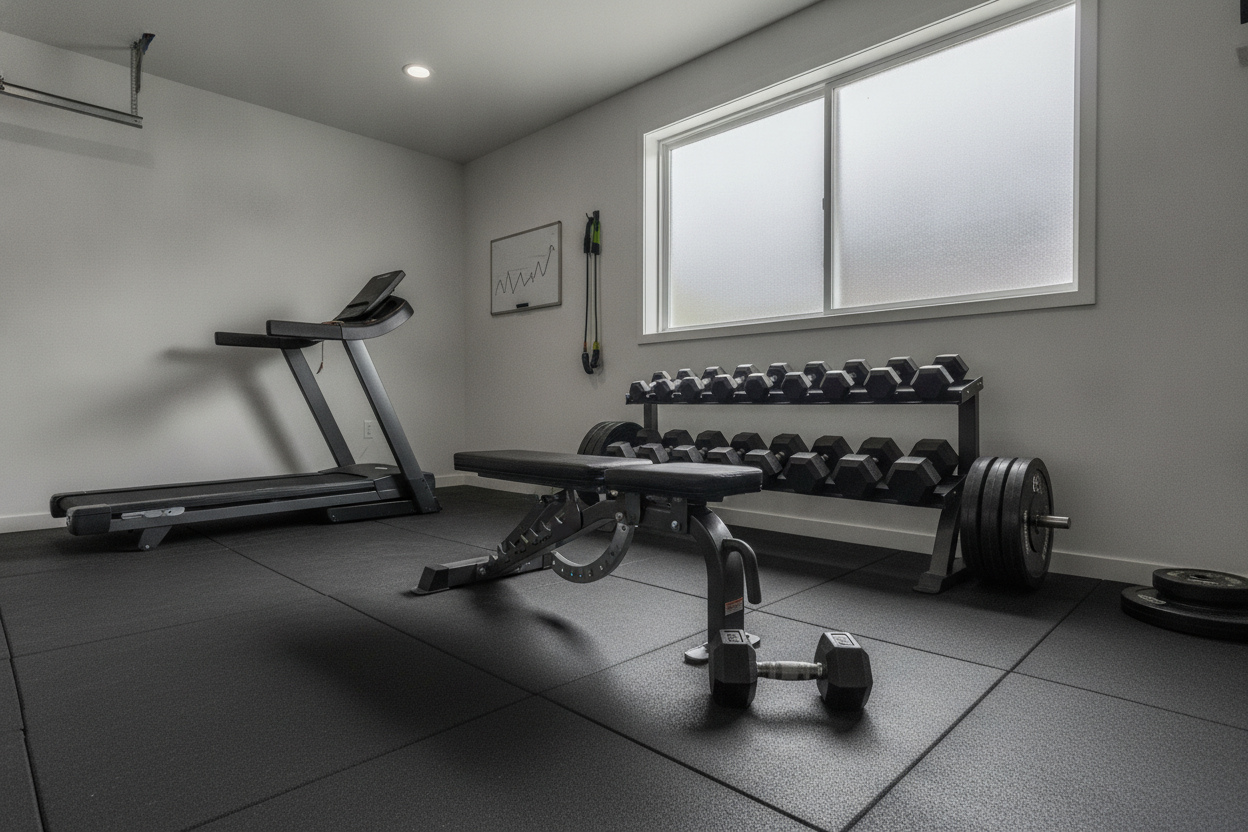
I recommend investing in a high-quality gym flooring mat that is dense enough to support your weight without squishing. A good leg day home workout requires a surface that grips your shoes (or bare feet). When your foot is locked into the floor, you can drive through your mid-foot with 100% of your power. This is especially true for split squats, where the back foot tends to drift on slippery surfaces.
Ditch the Heavy Goblet Squat for B-Stance Variations
The goblet squat is the king of indoor leg exercises, but it has a ceiling. Once you try to hold a 70-lb dumbbell at chest height, your upper back and core become the bottleneck. You’ll be gasping for air and your biceps will be screaming before your quads even feel the work. Instead, I move my clients toward B-stance variations when doing weighted squats at home.
A B-stance (or kickstand) squat involves putting one foot slightly behind you, resting on the toe. This provides balance while putting 90% of the load on the front leg. Now, instead of holding one massive weight at your chest, you can hold two moderate dumbbells at your sides. Your center of gravity is lower, your core isn't the limiting factor, and you can take that front leg to absolute failure. It’s a simple leg workout at home adjustment that yields massive results.
The Friction Hack for Brutal Hamstring Curls
Most people struggle with how to workout legs at home when it comes to the hamstrings. They try to squeeze a dumbbell between their feet for lying leg curls, which is awkward and usually ends with a weight falling on the floor. It's a waste of time. Instead, use the friction hack. If you have a smooth floor, put on some socks. If you have a mat, use furniture sliders or even a paper plate.
Lie on your back, bridge your hips up, and slide your heels out and back in. This eccentric load is exactly what you need for exercises to build leg muscle at home. It hits the hamstrings harder than any light dumbbell curl ever could. Focus on a slow 3-second descent. Your hamstrings will be on fire by the eighth rep, and you didn't have to hold a single pound in your hands.
The 4-Move Living Room Routine
Here is a leg workout you can do at home that bypasses grip fatigue and hits every major muscle group. Perform this twice a week for the best results.
- B-Stance Dumbbell Squats: 3 sets of 10-12 reps per leg. Hold dumbbells at your sides like suitcases.
- Slider Hamstring Curls: 3 sets of 12-15 reps. Focus on keeping your hips high throughout the movement.
- Rear-Foot Elevated Split Squats: 3 sets of 8-10 reps. Use a couch or a chair to hook your back foot.
- Deficit Calf Raises: 3 sets of 20 reps. Stand on the edge of a sturdy book or a stair to get a full stretch.
Rest 90 seconds between sets. If you find your grip still failing on the split squats, try 'staggering' your weights—hold a heavy weight on the side of the working leg and use your other hand to lightly touch a wall for balance.
My Personal Experience with Home Leg Days
I used to think that unless I had a squat rack, my legs would shrink. I spent months doing high-rep bodyweight squats that did nothing but make me sweat. The turning point was when I bought a pair of 50-lb adjustables and realized I couldn't hold them long enough to finish a set of lunges. I ended up dropping a weight on my big toe because my palms were sweaty and I was using a cheap yoga mat that bunched up. That injury forced me to rethink my setup. I moved to a high-traction mat and started using B-stance variations. Not only did my balance improve, but my quads actually started growing again because I could finally use weights that challenged them.
FAQ
How can I workout my legs at home without weights?
Focus on unilateral (one-legged) movements and tempo. A Bulgarian split squat with a 5-second descent will challenge almost anyone, even without extra weight. You can also increase the 'mechanical disadvantage' by doing sissy squats or Nordic curls.
Is a home leg workout as effective as the gym?
Yes, but you have to be smarter about it. You don't have a 45-degree leg press, so you have to use high-tension movements like the ones mentioned above. You can't just go through the motions; you have to find ways to make 20-lb dumbbells feel like 100 lbs through positioning.
What is the best exercise for legs and thighs at home?
The Bulgarian Split Squat is the undisputed king. It targets the quads, glutes, and adductors while requiring very little equipment. If you only do one leg exercise, make it that one.