How to Start Using a Rowing Machine for Total Body Fitness
Walking into the gym and heading straight for the treadmill is easy. Walking toward the rower—often called the 'erg'—feels different. It looks technical, loud, and frankly, a bit intimidating. But once you understand the mechanics, it is arguably the most efficient piece of equipment on the floor. If you want to know how to start using a rowing machine correctly to build endurance and power without wrecking your back, you are in the right place.
Key Takeaways: Quick Start Guide
- The Order Matters: The mantra is Legs-Body-Arms on the drive, and Arms-Body-Legs on the recovery.
- Don't Max the Damper: Setting the fan lever to 10 doesn't mean 'harder workout.' Keep it between 3 and 5 for a realistic water feel.
- Check Your Grip: Keep a loose grip on the handle. Squeezing too tight causes forearm fatigue before your legs get tired.
- Start Short: A 10-15 minute session is plenty for your first attempt. Focus on form over fatigue.
Understanding the Machine: Setup Before Sweat
Before you pull a single stroke, you need to fit the machine to your body. Whether you are attempting a sunny rowing machine workout for beginners or hopping on a commercial Concept2, the setup dictates your success.
Foot Placement and Straps
Adjust the footplates so the strap crosses over the ball of your foot—specifically, the widest part of your shoe. If the strap is too high (near the ankle), you lose mobility at the catch (the start of the stroke). If it's too low (near the toes), your heel will slip out during the drive. Secure it tight enough that your foot doesn't wiggle, but not so tight you cut off circulation.
The Damper Setting (It's Not Resistance)
Here is the biggest misconception in rowing basics for beginners: The lever on the side of the flywheel is not a resistance knob like on a stationary bike. It controls 'drag factor'—how much air enters the flywheel.
Setting it to 10 feels like rowing a heavy wooden boat against the current. Setting it to 1 feels like a sleek racing shell. For a magnetic rowing machine workout or air rower, aim for a medium setting (3-5) to mimic water resistance. This allows you to maintain a better rhythm and saves your lower back.
Mastering the Stroke: The 'Pick Drill' Approach
Rowing is 60% legs, 20% core, and 20% arms. Most beginners flip this ratio, pulling wildly with their arms. To fix this, we break the stroke down. This is the core of how to start rowing training.
1. The Catch (The Start)
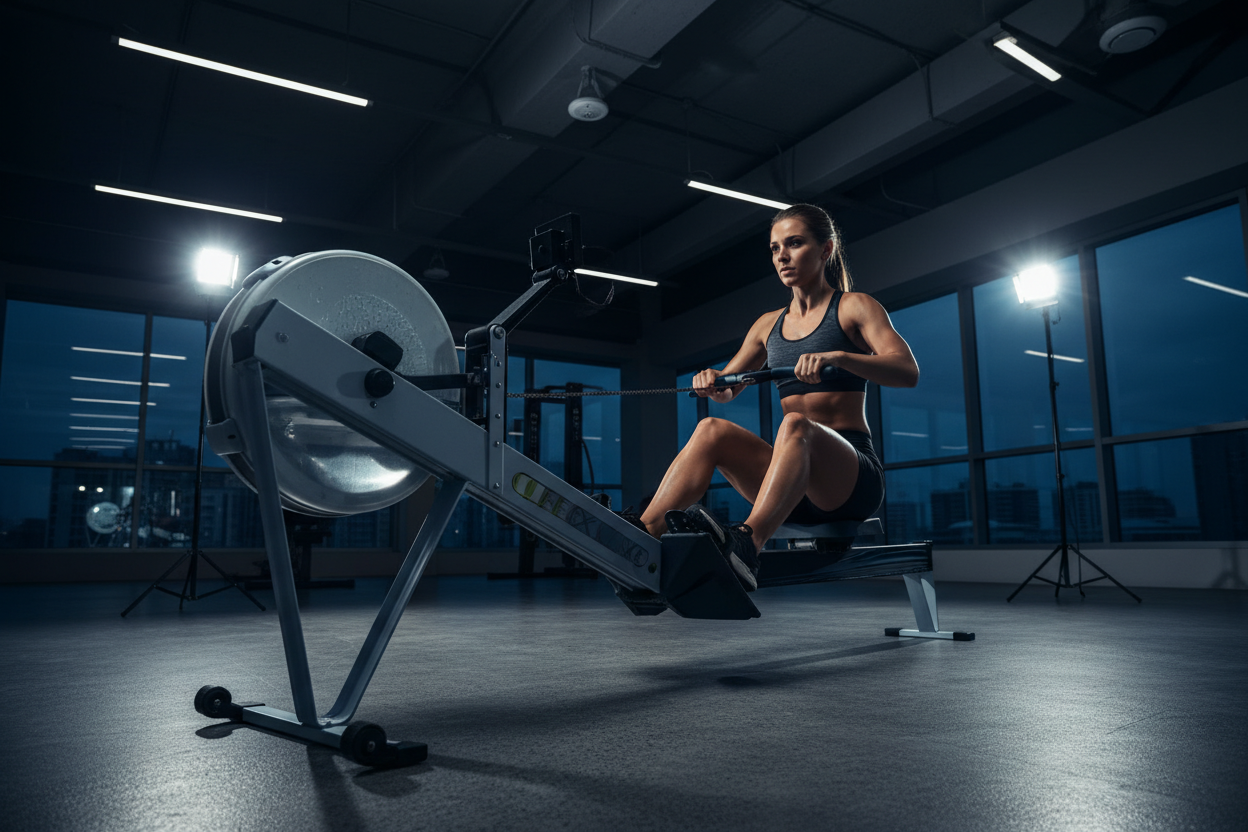
Slide forward. Your shins should be vertical, arms extended straight in front of you, and shoulders relaxed. Hinge forward slightly at the hips (about 1 o'clock position). Your heels might lift slightly—that is okay.
2. The Drive (The Work)
This is where the power happens. Push explosively with your legs while keeping your arms straight. Do not pull yet. Once your legs are almost extended, swing your torso backward using your hips. Finally, pull the handle to your lower chest (sternum). Think of it as a deadlift turned horizontally.
3. The Finish
Legs are flat, core is engaged leaning slightly back (11 o'clock position), and the handle is touching your sternum. elbows should be tucked in, not flared out like a chicken.
4. The Recovery (The Rest)
This is the reverse. Extend your arms away from your body first. Then, hinge your body forward. Finally, bend your knees to slide the seat forward. If you bend your knees before your arms are straight, the handle will hit your knees. This sequence—Arms, Body, Legs—is vital for rowing drills for beginners.
Your First Workouts: Quality Over Quantity
How long should a rowing machine workout be for a novice? Keep it short. Your lower back isn't used to this load yet.
The 10-Minute Foundation
This is the best rowing machine workout for beginners to establish rhythm.
- Warm-up (2 mins): Row slowly. Focus strictly on the sequence: Legs, Body, Arms.
- Work (6 mins): Row at a consistent pace. Aim for a beginner rowing strokes per minute (SPM) of 18 to 22. This feels slow, but it forces you to push hard with your legs to generate power rather than rushing up and down the rail.
- Cooldown (2 mins): Light rowing with zero resistance.
Interval Training (The Fat Burner)
Once you have the form down, you can ramp up the intensity. This is a classic ergometer workout structure.
- Row 1 Minute: Hard pressure (24-26 SPM). You should be unable to hold a conversation.
- Rest 1 Minute: Just sit or row very lightly.
- Repeat 5 times.
This 10 minute rowing workout beginner routine spikes your heart rate without exhausting your form.
My Training Log: Real Talk
I remember my first rowing workout vividly, and not for a good reason. I hopped on an older water rower at a hotel gym—a waterrower beginner workout gone wrong. I didn't check the footplate height. Five minutes in, my shins were screaming because I was pulling myself forward with my toes rather than pushing with my heels.
But the real reality check? The blisters. Nobody told me about the specific friction points on the pads of my fingers. I wasn't wearing gloves (and I still don't recommend them—you need to build calluses), but I was gripping the handle like I was strangling it. My forearms blew up with lactic acid before my cardio even kicked in. The lesson I learned the hard way: hook your fingers loosely over the handle. You should be able to wiggle your thumbs while you row. If your knuckles are white, you're doing it wrong.
Conclusion
Learning how to workout on a rowing machine is a skill, not just a chore. It requires patience to master the sequence of movement. But once it clicks, you unlock a low-impact, high-intensity tool that torches calories and builds functional strength. Start with short sessions, respect the recovery phase, and drive with those heels.
Frequently Asked Questions
How often should a beginner row?
For a solid rowing schedule for beginners, aim for 3 times a week with rest days in between. Because rowing is a full-body movement, your back and glutes need time to recover, especially if you are also doing other strength training.
Is rowing a good upper body workout?
Yes, but it's a misconception that it's only an upper body workout rowing machine session. While it builds your lats, rear delts, and biceps, 60% of the power comes from your legs. If your arms hurt more than your legs, you are likely pulling too early in the stroke.
How do I know if I'm getting a good workout?
Look at your 'split time' (time per 500m) on the monitor. To maximize rowing machine workout efficiency, try to lower that number while keeping your stroke rate low (under 24). This means you are applying more force per stroke, which is the secret to an intense rowing workout.