How to Spot Real Hold Strong Gym Equipment (And Avoid Junk)
I remember the first time I loaded 315 on a budget rack I bought off a random marketplace ad. As I walked the bar out, the uprights swayed like a palm tree in a hurricane. I barely got the bar back on the hooks before the whole thing felt like it was going to buckle. That is the moment I realized that buying hold strong gym equipment isn't just about aesthetics—it is about not ending up in the ER.
Quick Takeaways
- 11-gauge steel is the gold standard for anyone lifting over 300 lbs.
- Check the welds; if they look like messy bird poop, the structural integrity is compromised.
- UHMW plastic liners on J-cups are mandatory to save your barbell knurling.
- Stability starts with the floor; never bolt a rack into soft foam.
The Day My Cheap Power Rack Almost Folded
I was chasing a PR and thought a $200 rack was 'good enough' for my garage. It was not. The steel was so thin I could practically dent it with a standard hammer. When you are under a heavy load, you need to trust that the metal isn't going to give up before your legs do.
The sway was the worst part. Every time I racked the weight, the whole frame groaned. It is a terrifying feeling when the equipment you bought to keep you safe becomes the biggest threat in the room. Real hold strong fitness gear needs to be over-engineered because gravity does not take days off, and a 'budget' save today is a hospital bill tomorrow.
What Actually Makes Gear Heavy Duty? (Stop Guessing)
Stop looking at the shiny powder coating and start looking at the spec sheet. If a manufacturer does not list the steel gauge or the tubing size, they are probably hiding something. Heavy-duty gear is heavy for a reason—it uses more raw material to ensure the frame stays rigid under stress.
Steel Gauge vs. Tubing Size
Steel gauge is counterintuitive: the lower the number, the thicker the steel. 11-gauge is roughly 3mm thick and is what you will find in most serious strength facilities. 14-gauge is common in 'big box' store gear and is about half as thick. If you are planning on squatting anything significant, do not even look at 14-gauge.
Interestingly, a 2x2 rack made of 11-gauge steel is often more stable than a 3x3 rack made of 14-gauge. It is the wall thickness that prevents the bolts from 'crushing' the tube and keeps the uprights from twisting. I always tell people to prioritize thickness over the 'beefy' look of wide tubing.
The Hardware: Welds, Bolts, and J-Cups
The devil is in the details. Look at the J-cups. If they are just bare metal-on-metal, they will chew up your barbell knurling in weeks. Look for UHMW plastic liners. Also, check the bolts. If they are not at least Grade 5 or Grade 8, they are the weak point in your armor. Cheap racks often use soft hardware that shears under lateral pressure.
Why You Don't Need a Commercial Studio to Lift Heavy
You do not need a $5,000 rig that supports 20 people at once to get a great workout. Honestly, nobody needs pro fitness equipment meant for a high-traffic commercial gym just to get strong in their garage. Those massive rigs are built for 24/7 abuse from hundreds of strangers.
For a home setup, you just need a solid 3x3 or 2x3 frame that is either bolted down or has a wide enough base to prevent tipping. You are looking for durability, not necessarily the 'commercial' label that usually just adds a 40% markup for no added benefit to a solo lifter.
Your Rack Is Only as Stable as Your Floor
I see guys spend a fortune on a rack and then put it on bare concrete or those squishy foam puzzle mats. That is a recipe for disaster. The rack will slide during re-racks, and the concrete will eventually crack under the vibration of dropped weights.
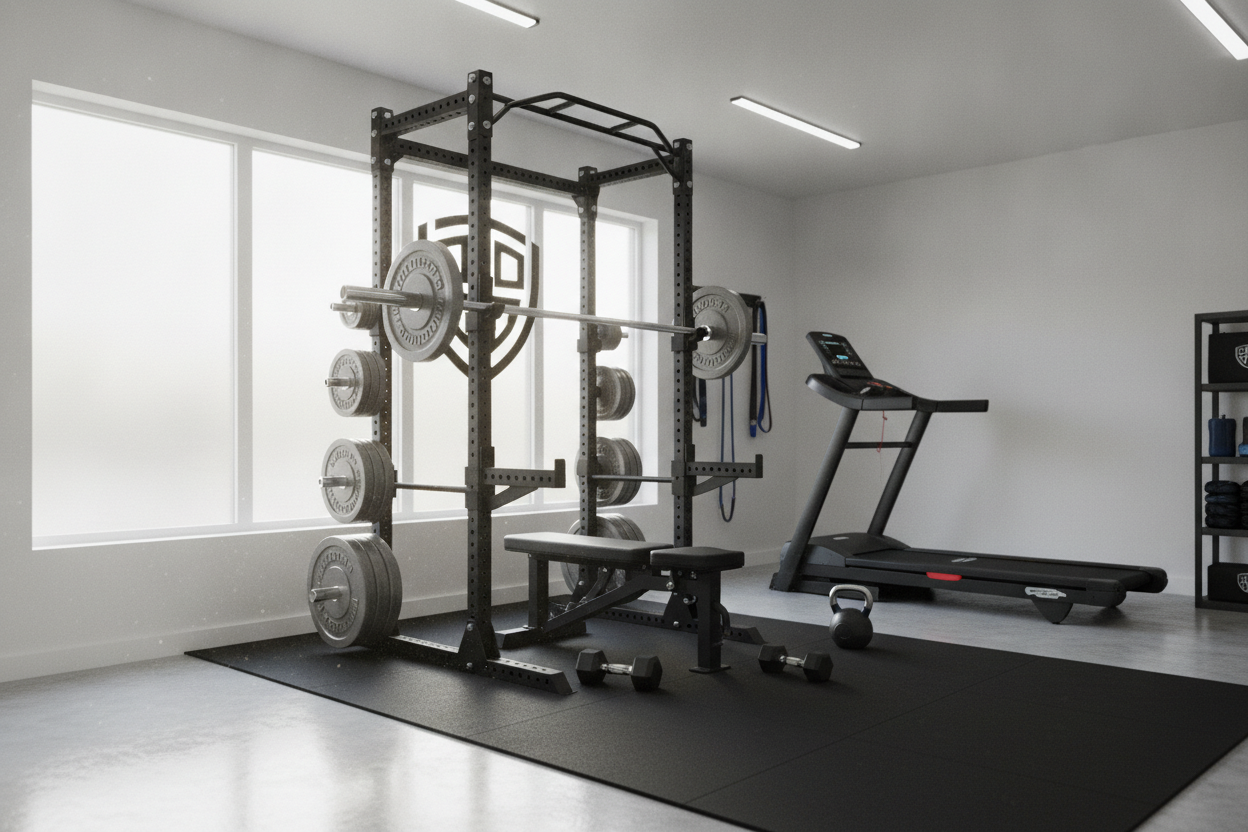
I always recommend a heavy-duty 6x8ft exercise mat to act as a proper foundation. It grips the floor and keeps the rack from 'walking' across the room. Plus, it saves your joints when you are doing anything standing. If the foundation is soft, your rack will never feel truly solid.
Finding Hold Strong Fitness Gear Without Getting Scammed
Do not trust the '1,000-lb capacity' stickers on a rack that only weighs 80 lbs. It is simple physics—if the rack is light, it cannot support heavy weight safely. When you are looking for home gym equipment deals, always verify the shipping weight. If the rack weighs less than you do, it is a coat rack, not a squat rack.
Read the reviews for mentions of 'wobble' or 'thin powder coat.' If people are complaining that the holes do not line up during assembly, it is a sign of poor quality control. High-end gear should fit together like a Lego set, with zero play in the joints once the bolts are torqued down.
The Final Verdict: Buy Once, Cry Once
I have wasted a lot of money trying to save money. If you are serious about lifting, buy the right rack once. If your budget is tight, it is better to buy the bare minimum equipment for a home gym that is high quality, rather than a cheap 'full bundle' that breaks in six months. Invest in the steel that holds the weight, and it will take care of you for decades.
FAQ
What is the best steel gauge for a home rack?
11-gauge is the gold standard. It is thick enough to handle heavy loads and allows for accessories to be bolted on without deforming the uprights.
Should I bolt my rack to the floor?
If you have a 2-post rack or a slim 4-post rack, yes. It prevents the rack from tipping during pull-ups or heavy re-racks. If you have a flat-foot rack with a deep base, it is usually not necessary.
What is the difference between 2x3 and 3x3 tubing?
3x3 is the most common for high-end accessories and offers the most stability. 2x3 is plenty strong for most lifters but can be harder to find compatible attachments for from third-party brands.