How to Pick Exercise Equipment for Home (Without Getting Evicted)
I remember the first time I dropped a 225-pound deadlift on a bare concrete floor at 6 AM. My wife didn't just wake up; she thought a car had hit the garage. That is the reality of choosing exercise equipment for home: if you do not plan for the noise, your training program will last exactly one session before the neighbors or your family stage an intervention. Building a home gym is about more than just buying the heaviest stuff you can afford; it is about managing acoustics and floor load.
I have spent the last decade testing home gym fitness equipment in garages, basements, and second-story apartments. I have learned that the loudest part of your workout is rarely your breathing—it is the vibration of iron hitting the floor. To keep your household gym equipment from becoming a neighborhood nuisance, you need to think like a sound engineer who also happens to bench 315.
- Floor Protection: High-density rubber is non-negotiable to stop vibrations.
- Plate Choice: Urethane or rubber bumper plates are significantly quieter than cast iron.
- Cable Systems: Use pulleys for high-volume work to avoid the 'clang' of free weights.
- Magnetic Cardio: Choose magnetic resistance over air-based fans to keep decibels low.
The 5 AM Problem: Why Most Iron Setups Rattle the Drywall
Most people think a home workout set is just a rack and some plates. They buy the cheapest cast iron they can find and wonder why the whole house shakes. Standard iron plates are basically bells. When they hit each other on the bar, or worse, hit the floor, they create a high-frequency ring and a low-frequency vibration that travels through floor joists like a lightning bolt. If you are training while the kids are asleep, this is your biggest enemy.
Acoustic resonance is a real jerk. In a standard suburban home, those vibrations do not just stay in the room; they climb the walls. You need equipment for fitness at home that absorbs energy rather than reflecting it. This is why I always tell people to skip the bargain-bin 'home exercise instrument' sets and look for gear designed with dampening in mind. Your 5 AM heavy triples do not have to sound like a construction site.
Your Foundation Dictates the Noise (Don't Skip This Step)
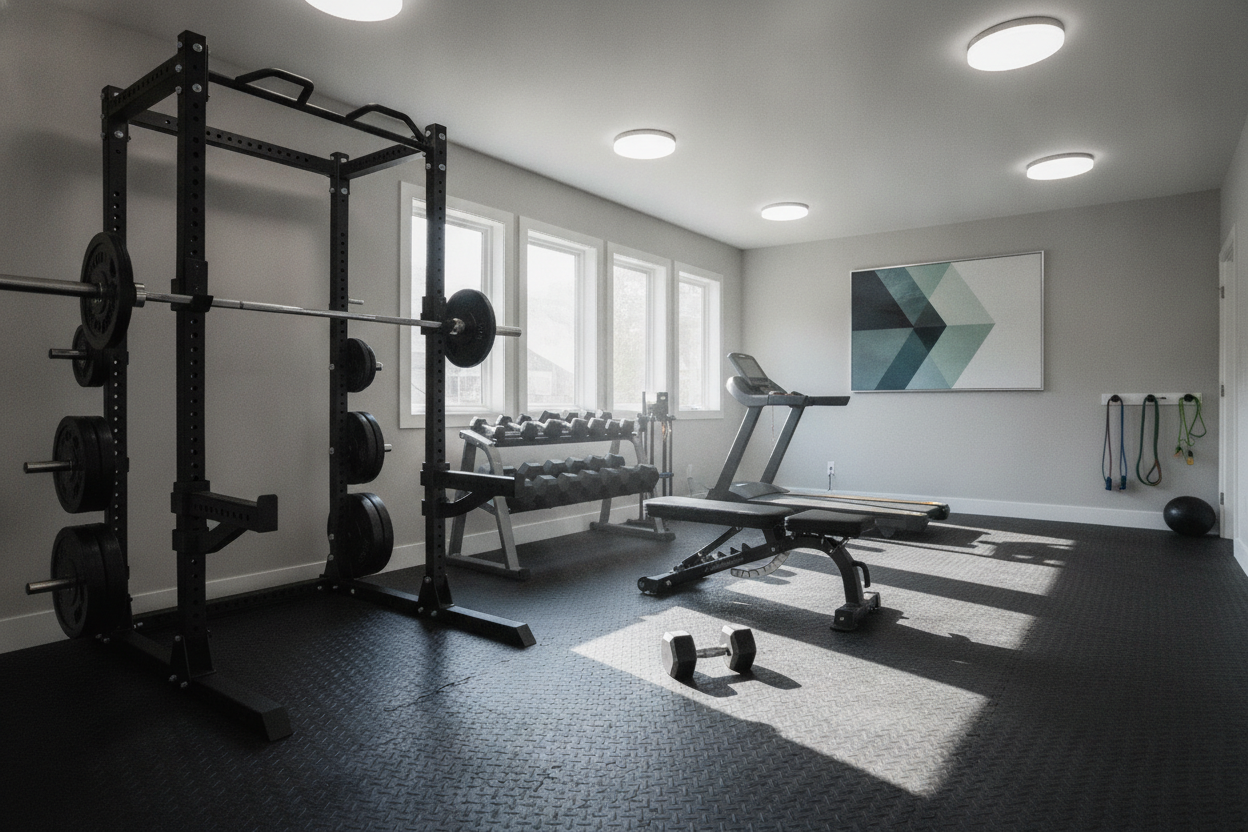
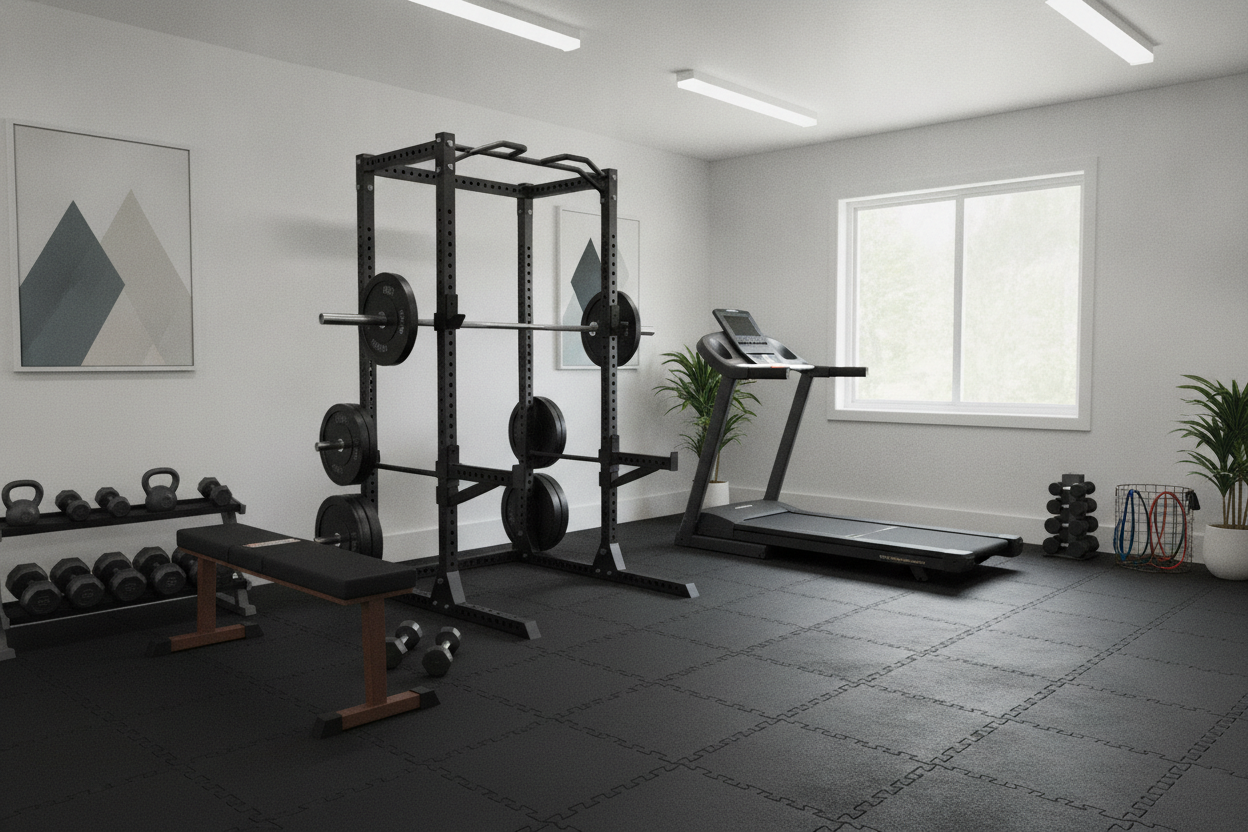
Before you even look at at home exercise machines, you have to look at the floor. Concrete is hard, but it is also loud. If you are in an apartment or a second-story room, you are essentially standing on a giant drum head. You need a multi-layered approach to shock absorption. I usually recommend starting with a large exercise mat for home gym use as a base layer. This protects your actual flooring from scratches and provides the first line of defense against vibration.
On top of that base, you want 3/4-inch horse stall mats or high-impact gym tiles. This layering technique kills the impact before it ever touches your floor joists. It is the difference between a 'thud' that stays in the room and a 'boom' that wakes the neighbors. This is the most critical piece of home workout gym equipment you will ever buy, even if it is the least exciting to look at.
Ditch the Clanging Iron: The Case for Bumper Plates and Urethane
If you are serious about workout equipment at home, you need to stop buying raw iron. Yes, it looks cool and sounds 'hardcore,' but it is a nightmare for noise. Urethane-coated plates or virgin rubber bumper plates are the way to go. Urethane is especially great because it is thinner than rubber—meaning you can fit more on the bar—but it deadens the sound of plates clacking together during a set of squats.
When you are researching top home exercise equipment, you will notice that the best setups prioritize deadening. Bumper plates allow you to perform Olympic lifts or deadlifts with a much lower decibel output. Even if you do not plan on dropping the weight, the accidental bump against the rack is muffled. It turns a sharp 'crack' into a dull 'thump.' Your sanity, and your family's sleep schedule, are worth the extra $1.00 per pound.
Cable Systems: The Secret Weapon for Quiet Hypertrophy
Free weights are great, but cable-based gym instruments for home are the ultimate stealth tools. A functional trainer or a high/low pulley system allows you to keep constant tension on the muscle without the risk of dropping anything. Since the weight stack moves on guide rods, there is zero impact noise unless you slam the plates—and if you are slamming the plates, you are doing it wrong anyway.
I have found that for late-night or early-morning sessions, a cable system is my go-to. You can hit chest, back, and arms with heavy loads, and the only sound is the slight whir of the pulleys. It is the most efficient workout tools at home for anyone who needs to be a 'ninja' in the gym. Plus, cables provide a different resistance profile that complements your heavy barbell work perfectly.
Silent Cardio Machines That Will Still Ruin You
Air bikes are fantastic for conditioning, but they sound like a jet engine taking off in your living room. If you want at home fitness equipment that won't drown out the TV or wake the baby, go magnetic. Magnetic resistance rowers and spin bikes are nearly silent. You get the same level of torture without the wind noise.
I always suggest placing a 6x4ft exercise mat directly under your cardio machines. Not only does it catch the inevitable puddle of sweat, but it also isolates the mechanical hum of the bike or rower from the floor. Even a 'silent' magnetic bike has some vibration, and that extra layer of rubber makes a massive difference in how that sound carries through the house.
My Personal Experience: The Great Deadlift Disaster
I once tried to save money by using thin foam puzzle mats I found at a big-box store. I thought, 'It is just rubber, right?' Wrong. I was doing a set of 405-lb deadlifts, and by the third rep, the foam had compressed so much it was like hitting the concrete directly. Not only did I crack a floor tile, but the vibration actually knocked a picture frame off the wall in the next room. That was the day I realized that 'cheap' home equipment workout gear actually costs you more in repairs later. Now, I over-spec everything. I use 3/4-inch rubber, urethane plates, and I never lift without a solid base. It is better to spend the money once on quality gear than to spend it twice on repairs and replacements.
FAQ
Is rubber flooring safe for upstairs apartments?
Yes, but you need density, not just thickness. Look for high-density recycled rubber. It will distribute the weight of your home gym machines and prevent the legs of your rack from sinking into the carpet or damaging the subfloor.
Do rubber bumper plates smell?
Cheap recycled rubber plates can have a 'tire shop' smell for a few weeks. If you are sensitive to smells or working in a small space, spend the extra money on urethane or 'virgin' rubber. They have almost zero odor right out of the box.
How do I maintain a quiet cable machine?
Keep the guide rods clean. Wipe them down once a month and apply a tiny bit of silicone-based lubricant. If the pulleys start squeaking, it is usually just dust buildup. A clean machine is a silent machine.